
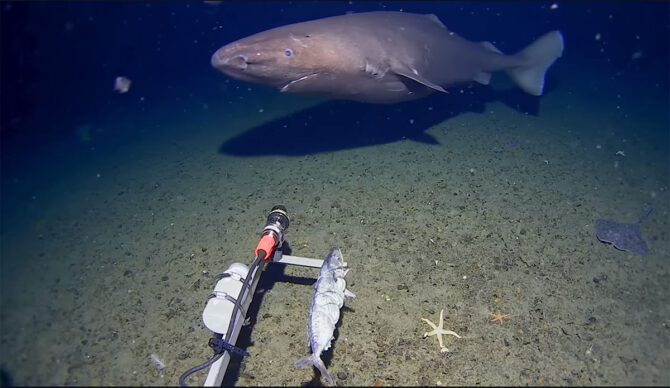
Researchers suspect it’s a female Pacific Sleeper shark, but it’s not a sure thing. Photo: YouTube//Screenshot

The frigid waters off the coast of Antarctica are surprisingly alive. What they generally aren’t alive with, however, is sharks. But last year, researchers spotted something surprising: a sleeper shark, some 12-feet long, cruising slowly at more than 1,600 feet below the surface.
The camera, which was set up by scientists from the University of Western Australia’s deep sea research center, caught the sleeper shark on film in early 2025. The point of the camera wasn’t to look for sharks, but to get a better grasp on what’s going on down there in the South Shetland Trough. The water in which the shark was spotted was around 36 degrees Fahrenheit, and wasn’t thought to be all that sharky. It is worth remembering that just because we haven’t seen a ton of sharks down there doesn’t mean there aren’t sharks — it just means we’re not looking.
“They probably are around in these areas,” Martin Collins, a marine ecologist and Britain’s scientific representative to the Commission for the Conservation of the Antarctic Marine Living Resources, told the New York Times. “It’s just that people haven’t put cameras in the right places in the past.”
It’s an exciting finding for the simple fact that there are almost no images of sleeper sharks so far south, but with technology getting better every day, our capacity to expand deep-sea research is increasing.
Should you ever find yourself 1,600 feet down in 36 degree water, you don’t really need to be worried about being attacked by a sleeper shark. Aside from the fact that you have much larger issues if you find yourself in that particular part of the ocean, sleeper sharks are slow moving and don’t consider humans to be food. There are a few types of sleeper sharks — the Pacific sleeper, Greenland sleeper, and the Southern sleeper, all of which look similar. The exact species of this particular animal isn’t known, but water samples were taken in the hopes that they’d find a bit of DNA floating around.
It might be easy to conclude that a sleeper shark swimming in waters its generally not seen in might have something to do with warming waters in the area, but the researchers are quick to say it’s too soon to know.
“They might have been there all along, and we just didn’t know,” said Lydia Koehler, a policy researcher focused on sharks at the University of Plymouth. “It’s another step in understanding these important, very valuable deep-sea ecosystems that need protection.”

