

Experts say that Californians can expect more great white sharks cruising their beaches this summer. Photo: Gerald Schombs//Unsplash

Experts say there will be an influx of great white sharks in Southern California this summer. Warmer waters caused by a marine heat wave and an incoming El Niño could drive sharks north from Mexico into California waters.
According to Chris Lowe, a professor of marine biology and director of California State University Long Beach’s Shark Lab, early signs are already present: baby great white sharks were spotted this February in Southern California, months ahead of schedule.
After a shark encounter closed a swath of Newport Beach last week, Lowe says California is likely to have a “sharky summer” to an extent not seen since the last major El Niño in 2015.
To learn about what this means for surfers, we gave Lowe a call to chat about what the latest science says about California’s great white population.
You say a marine heat wave is likely causing juvenile great white sharks to appear sooner than normal. What is it about warmer waters that makes great whites reproduce earlier in the season?
We think the warmer water is giving females a chance to give birth earlier. The temperatures are better for their pups. We don’t know that for sure. We just know that we started seeing babies around the end of February, which we typically don’t start to see until April. That suggests it’s going to be a sharky summer. The last time we had conditions like this was 2015, and that was a sharky summer because it got so warm in Baja that a lot of the juveniles that are normally born and live in Baja got pushed up into California.
Do great whites in Southern California generally migrate between there and Mexico? Do they always stick to the same route?
Multiple nurseries range from Baja all the way to Southern California, let’s say, south of Santa Barbara. When we have these unusually warm conditions, Baja gets too warm, and they get pushed further north. They even go further north than Santa Barbara. In 2015, it was the first time we saw baby white sharks in Monterey. And the other thing is, Monterey has been getting progressively warmer over the last 35 years, so we think that change is driving some of this northern expansion of habitat.
Oftentimes, in California, with lots of upwelling, ocean temperatures are coldest in April. But that’s when the sharks come searching for warm water? How do you make sense of that?
Really good point. But the water along the beaches is warmer than it is further offshore. So even though we do get upwelling, that upwelling water tends to be further offshore, and the water right along the beaches is warmest. That’s where we see a majority of these sharks, literally 100, 200 feet off the beach.
The shark lab is studying baby and juvenile great white sharks. Have you made any interesting discoveries?
We learned from our tagging and tracking that these nursery hotspots come and go. For example, the very first one we documented was in Santa Monica, off Will Rogers beach in 2011. Then that area died out. Then there was one by Manhattan Beach. Then we had one off Long Beach in Belmont Shore, inside Long Beach Harbor. That one went cold, then Huntington Beach, and then Dana Point in 2016, 2017. Around that time, we got a new hotspot that developed off Santa Barbara, and that’s been the longest-lasting one. That was where we saw the most. One day in the summer, I think this was three years ago, we counted 40 white sharks at one beach between four-and-a-half and nine feet long.
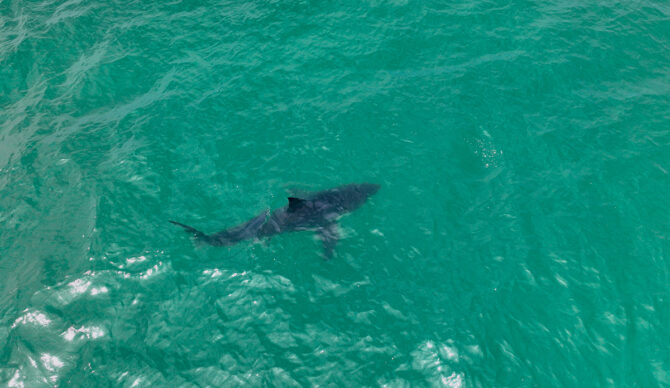
A great white shark spotted in the water off the coast of Carpinteria, California. Photo: Erick Morales Oyola//Unsplash
What makes a hotspot? An abundant food source that attracts sharks?
That’s the other thing we learned. We finished a big diet study, and what we found was these sharks prefer to eat stingrays, round rays, bat rays, small sharks, crookers, and surfperch — things that are found near the bottom. As these sharks are there, day and night, for weeks to months — and we’re talking about a lot of sharks, at least over 20 — they begin to feed down their favorite foods. And when those things get too low, that’s when we see the sharks start to move.
They’ll also move because of temperature reasons. We know they’re temperature sensitive, especially the smallest ones. They really don’t like water temperatures below 60; the sweet spot for them is between 65 and 70 degrees. For the bigger juveniles, they don’t like waters too warm, so when it gets over 72, 74 degrees, they move offshore or up north.
The thing that we found most fascinating is that they really don’t care about people. That was very shocking. We did drone survey studies at 26 beaches in Southern California over three years. We found that at these aggregation sites, 97 percent of the days that we surveyed there, we saw a white shark within 60 feet of a person. Those were busy beaches. Then we had some beaches that weren’t so busy, and it didn’t seem to matter. The sharks didn’t seem to care about people.
Is there any particular set of conditions or ecosystem where it’s more likely to find a great white shark in California?
These hotspots usually have lots of sand, some rock reef or even jetties, and the water tends to be pretty murky. We think that’s part of the allure for these sharks.
We have hypotheses as to why a baby will choose one of these beaches. The first one is when they’re born, there’s no parental care. We don’t know where females give birth, but (the babies) do prefer these shallow habitats. They don’t know they’re a white shark yet. They’re afraid of everything because they don’t know what can hurt them. Being in shallow water is a safe place. Plus, that water is warmer than it is further offshore.
We’ve also looked at social aspects. White sharks are interesting. They’re social, but asocial at the same time. They’ll group in these loose aggregations, but they don’t like to be right next to each other. In fact, they get a little pissy. Big ones will take swipes at small ones. We’ll see some scarring from getting into tussles. Nonetheless, they’ll form these groups, and in between those aggregation sites, you just don’t see groups of sharks. They don’t travel together, they don’t leave together. So it’s interesting how we’ve learned all these things from all the tools we’ve used, whether it’s drones or looking at their diet. We use eDNA for that.
What’s eDNA?
If you go and you take a liter of water at the beach, (it contains) everything’s DNA. It’s got DNA from sharks, stingrays, fish, humans, and dogs — everything that goes to the beach. We can filter that water and probe for all those different species’ fragments of DNA. We figured out that at a beach where there are lots of sharks, we find lots of shark DNA — but less stingray and small shark DNA. There was more DNA present of things that (we think) sharks don’t eat.
We share all this data with lifeguards because they’re the ones keeping people safe at the beach. They use all this newfound knowledge to manage beaches. To give an example, 10 years ago, if you decided an eight-foot white shark was swimming around a person at a beach, you would close the beach. Now, lifeguards, with our telemetry system, know that there could be a white shark, eight feet or bigger, off that beach day in, day out, and nobody’s seeing it. Therefore, they don’t close the beach because it’s being detected constantly during the day. They post signs and warn the public that it’s a shark habitat. That’s reduced beach closures. Every time a city closes a beach, it has an economic impact on that community. This is how we’re using that data, and how lifeguards use the data to more carefully manage beaches for the safety of people, as well as the safety of sharks.
Are there any estimates on how many great whites there are in California?
That’s the question everybody wants to know, and unfortunately, we don’t have good numbers. They’re so mobile — anywhere between 3,000 and 6,000 maybe.
Is that a healthy population? What are the biggest threats to great white sharks in California?
Yes, 3,000 to 6000 is pretty good, and it’s probably been increasing, mainly because white sharks’ biggest threat was fishing. They were being caught and killed in commercial fisheries, especially the small sharks. Prior to 1994, they were being sold at fish markets and restaurants. I tell people, “If you ate fish tacos prior to 1994, there’s a good chance you ate white shark and you didn’t know it.” The fishery they interacted with the most was the gillnet fishery, which was also heavily regulated. In 1994, voters passed a ban on the use of gillnets in nearshore waters because it was having an impact not just on white sharks, but sea lions, birds, turtles, and other fish that weren’t economically important. So as a result of pushing that fishery out three miles offshore, we’ve seen a pretty impressive recovery of the white shark population.
I recently wrote a story about Reunion Island, where they have been culling sharks to stave off attacks. Your lab has been communicating how low the risk is of a shark attack. How do you convince the public that sharks are not dangerous when the thought of a shark attack provokes such an emotional response?
My philosophy has always been: the best way to deal with fear is through knowledge. The reason why a lot of the public fears sharks is that they really don’t know much about them, and frankly, neither did the scientific community. In 2018, we received funding from the state to form the California Shark Beach Safety Program. It had a research component, but more importantly, had an education and outreach component. So as we were learning new things, we made them available to the public. The lifeguards are our partners in this work. On April 10, we’re having an annual lifeguard workshop where we update all the SoCal lifeguards on the newest information we’ve learned about white sharks so they can relay it back to their guards and to the public — techniques on how to keep the public safe, and what to do if someone’s bitten.
We still have bites. We still have fatalities. In fact, we had one in December. But the way the media responds, the way the public responds, is very different from the way we see, for example, in South Africa, Australia, or Reunion. (I’ve noted that) once a municipality starts funding shark culling, it becomes part of their culture, and it is very difficult to stop, even when the science says it may no longer be necessary. This is the amazing thing about the U.S.: there have never been shark control programs on the continental U.S., despite the fact that Florida has the highest number of shark bites anywhere in the world. I think the simple reason it comes down to is that while some people have tried to sue a municipality for a shark bite or shark fatality, those have always been considered acts of God, and they never went anywhere. From the “how do we keep the public safe” standpoint, I think it starts with knowing more about the sharks in your area — why they behave the way they do. The number one thing we always tell the public is, “Look, you’re entering a wild place, and you’re going into somebody else’s home. You need to think carefully about that.” It’s a wild place, and your safety is not guaranteed. It’s really up to you to be knowledgeable about how you use those areas.
Is it possible we’ll see more shark encounters and bites this summer due to the potential increase in shark activity?
That’s certainly a possibility. But we haven’t seen that. The statistics show that we have white sharks around people all the time, and yet, bites are pretty rare. So if sharks occasionally bite people because of mistaken identity, you would think it would happen a lot more often, considering that sharks and people are together a lot more frequently than we had ever imagined. But anything is possible. The ocean is changing. The climate is changing animal behavior. All of our data so far suggests that sharks are largely ignoring people.
You mentioned you don’t know where female great white sharks give birth. What are some of the biggest unknowns that you seek to answer?
That’s a big one, but that’s really hard to answer because the animals are so mobile. Researchers have put tags on them, and we know that they make an offshore migration, almost to Hawaii, and then they’ll turn around and start coming back in the spring. But the technology that we use really doesn’t tell us where exactly they’re giving birth. In Southern California, one of my sources of data is talking to old pilots. I always ask them, “When have you seen the most sharks?” And almost all of them will say they’ve never seen more sharks than in the last few years, even though they’ve been flying along the California coast for 50 years. Part of this is a phenomenon of there simply being more sharks. The other thing that they say is they really don’t see large sharks around Southern California beaches, and that suggests females aren’t coming to the beach to give birth.
My best hypothesis is that females are giving birth to pups in deeper water offshore, and they’re being incubated in a warm mom. White shirts are what we call endotherms. As long as they’re swimming, they can keep their body core warmer than the water. So that’s one of the reasons we think they seek shallow water, because it’s warmer. So it’s likely that those big females are going somewhere offshore, giving birth, and then those babies come into the beach. We just don’t know where.
What’s an action that someone could take to help protect sharks?
In California, there are a lot of protections for sharks. We’re seeing almost all shark populations recover, and that’s largely because we’ve done a better job at managing our fisheries. But a lot of those sharks swim between California and Mexico, and sharks aren’t nearly as well protected in Mexico. So knowing what you eat and where you buy it from is an important part of that. Because of our trade agreements with Mexico and Canada, the same species that a California fisher would be penalized for can be caught in Mexico, driven across the border, and sold at U.S. markets.
The other thing is, do a little homework before you go to the beach. Talk to the local lifeguards. We do our best to inform and educate them so they can share that information with the public, whether it’s stingrays, rip currents, all those things, the more the public learns about them, the safer they can be when they use the beach. The safer they are, the better off these populations will be, because that way people aren’t wanting to go out and kill them just because a person got hurt.
Wait, are people eating sharks in the U.S.?
No, but a few sharks are sold on the menu. Quite often it’s sold under a different name. That’s because Americans typically don’t have a taste for sharks. They’ll eat it if they don’t know what it is, but there’s no market for it. A lot of fish and chips, for example, in Europe and in the U.S., is actually dogfish. It’s a shark. That’s a common name; rock salmon is another term. They give them all these names because they just don’t want to call it shark, but quite often that’s what people are eating.

