
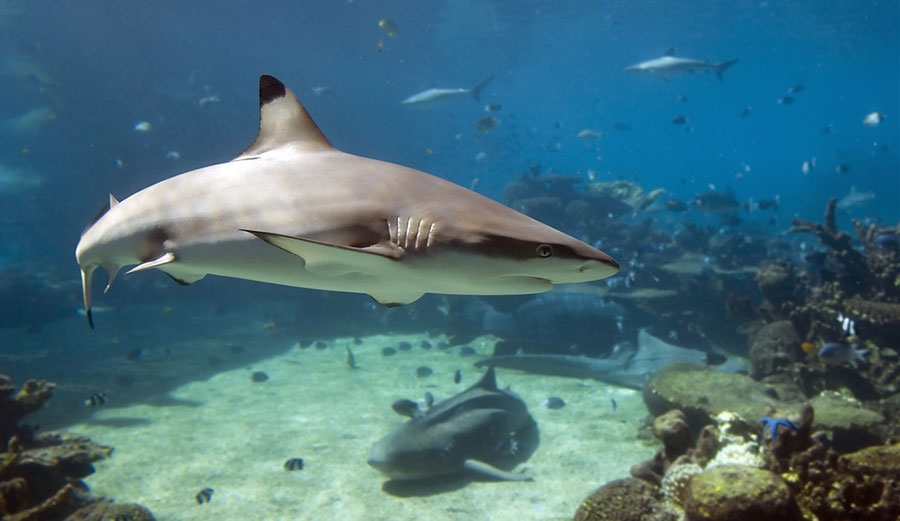
The WWF is trying to protect sharks at the Great Barrier Reef by buying a $100,000 commercial fishing license. Photo: Shutterstock

The Great Barrier Reef is widely considered to be one of the seven natural wonders of the world. It’s in severely dire straights, though, and if something isn’t done it’s going to go the way of the dodo. Or, perhaps more fittingly, the way of six of the seven ancient wonders of the world. That’s why the World Wildlife Fund recently did something pretty drastic to save it. They bought a AU$100,000 commercial fishing license. The license, according to Catch News, comes with a 1.2 km long drag-net and the right to drag it anywhere along the Great Barrier Reef, despite a marine park that’s supposed to protect the area.
Australia’s Great Barrier Reef is truly incredible. The size and scope of it isn’t transferable to a screen or through a word. It’s the largest coral reef system on the planet, stretching almost 1,500 miles in the Coral Sea. It’s comprised of almost 3,000 different reefs, and has an area of 13,000 square miles. You can see it from space. It is by far the largest structure made from living creatures, and it plays host to a staggering amount of marine life. Humans, as we’re rife to do, are fucking it up royally.
Although there is a large part that protected by the Great Barrier Reef Marine Park, it’s not enough. According to the Proceedings of the National Academy of Sciences, combination of the largest bleaching event in recorded history, excess runoff, and a strange population boom of a kind of starfish that feeds on coral, the Great Barrier Reef has lost over 50% of its coral since the mid-’80s. And it is a hot bed for shark activity–something that is necessary for the continued health of everything involved.
A survey in April found that things were even worse than most suspected. The entire ecosystem is teetering on the brink of disaster. “We’ve never seen anything like this scale of bleaching before,” said Terry Hughes, the lead researcher of the survey. “In the northern Great Barrier Reef, it’s like ten cyclones have come ashore all at once.”
According to the WWF, the same license they purchased allowed about 10,000 sharks to be caught every year, and as the owners, one can assume they’ll just sit on it. “We’re going to take it out of the water and make sure it doesn’t go fishing,” said Gilly Llewellyn, the conservation director at WWF. “We have a chance to help save some of those sharks. This will also prevent dugongs, turtles, and dolphins being killed as by-catch, and help the reef heal after the worst coral bleaching in its history.”
The Queensland Government released the numbers from their annual commercial shark catch, and the numbers are startling, to say the least. In one year, they went from 222 tons to 402 tons–nearly doubling from 2014 to 2015.
The World Wildlife Federation’s reasoning is sound, although it’s a bit of a kick in the balls for the Australian Government. “This is a shot across the bow to the management authorities and to the Australian Government that we believe they [sharks] should be protected,” Llewellyn told ABC.

