
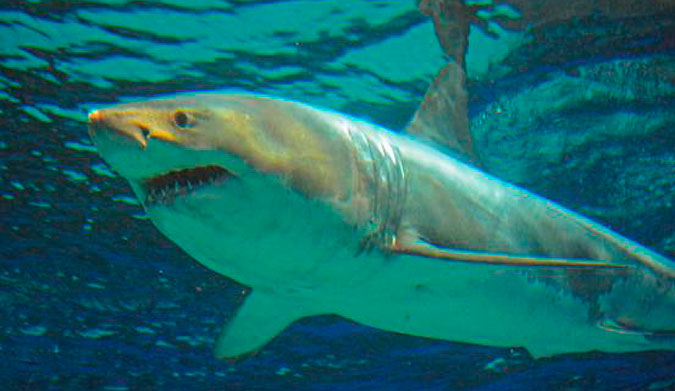
After the adult male great white was put in a tank in a Japanese aquarium, he died within three days.

There’s a place in Japan called the Okinawa Churaumi Aquarium. Early in January, a great white shark was captured in a net near Yomitan in Okinawa prefecture, and it ended up in the aquarium within a day. Just two days later, it was dead.
After it had the shark in a tank, the aquarium quickly began touting their exhibit as the first adult great white shark on display in the world, which was true, in a sense. Although the Monterey Bay Aquarium has had more than five great whites on display, none of them were adults. The longest lived in captivity for nearly 200 days before being released.
According to reports, the shark in the Japanese aquarium began exhibiting troublesome signs almost immediately. A keeper at the aquarium had said the shark hadn’t eaten anything since it arrived,” wrote Jun Hongo in the Wall Street Journal. “[It] was being taught how to swim inside the tank without crashing into the walls.”
Neither of those symptoms are surprising. In fact, they’ve been documented frequently in captive sharks. “Consider the effect of being held captivity has on a great white,” said an author at the Atlantic White Shark Conservancy, back in 2013. “For an animal used to swimming freely for hundreds of miles on end, being kept in close quarters is extremely stressful. Early attempts to keep great whites in aquariums ended when the sharks repeatedly bumped into the walls of their tank, or wouldn’t eat.”
Not surprisingly, the Okinawa Churaumi Aquarium terminated the great white shark exhibition. “We had been displayed [sic] the shark in “the Sea of dangerous sharks” tank from January 5th, 2016 but, the shark’s condition took a sudden turn worse [sic] and we confirmed it dead January 8th,” they wrote on their website.
While the sharks at the Monterey Bay Aquarium were actually kept in a tiny pen smaller than the Okinawa Churaumi Aquarium viewing tank, staff at the California research aquarium are much better equipped to care for a creature as sensitive as a great white. The main problem, though, is that we just don’t know enough about them to keep them penned up–but what we do know is that they’re considered to be a vulnerable species, and keeping them penned up often kills them.
Of course, people are pissed at the Japanese aquarium. “How could you think you could possibly facilitate a great white shark in a tank too small?” asked one user on Facebook. “How could you dare to be so dishonorable and disrespectful to an ocean creature, to treat it this way? Why does your country continue to abuse the animals of our planet this way?We people all over the world watch as you continue in the outdated practice of captivity and also consumption of whale and cetacean, of letting your corporate greed take over your senses. Shame on you all, one day you will pay for your cruelty.”
And that user is right, except a little misguided–it’s not just Japan that’s doing this, it’s nearly every country in the world. It’s not going to stop unless we stop paying to see it, so in a big way, it’s the fault of everyone that’s ever visited an aquarium. It’s about time we gave up on that, isn’t it?

