
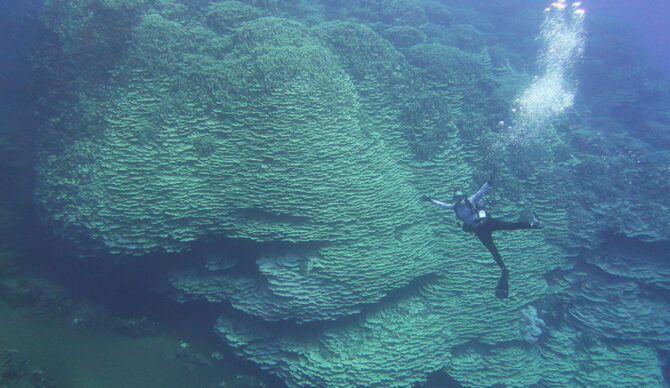
A NOAA researcher swims in front of the massive coral in the Mariana Trench Marine National Monument. Photo: NOAA Fisheries.

In recent years, it’s become very clear that corals around the world are in increasingly dire straits. Drawn-out bleaching events, warming and acidifying waters, and all manner of human-caused destruction are decimating coral reefs, so a recent bit of good news from the National Oceanic and Atmospheric Administration (NOAA) is a breath of fresh air.
A massive coral structure that’s part of a submerged volcanic caldera has been explored in the Maug Islands in the Mariana Archipelago. The coral, which was described as “cathedral-like,” was made by a species of stony coral called Porites rus. According to researchers, the structure was already known to locals, but during the the 2025 National Coral Reef Monitoring Program surveys, NOAA scientists got to see it firsthand. And it lived up to all their expectations.
“This coral was so big, we actually couldn’t easily measure it due to dive safety restrictions,” said Thomas Oliver, Ph.D., a chief scientist of NOAA’s National Coral Reef Monitoring Program.
The measurements show that the colony is some 14,500 square feet and stretches more than a 100 feet across at the top. At the base, it’s twice the size. Not only is it far bigger than the previously known biggest Porites coral ever recorded — over three times the size — but it’s also incredibly old.
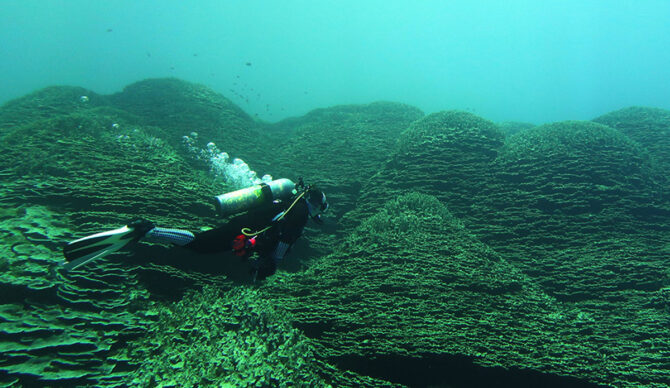
A researcher swims over dome-shaped structures at the top of the coral structure. Photo: NOAA Fisheries.
“It is difficult to tell the true age of this coral because it doesn’t produce growth bands like other corals,” said Hannah Barkley, Ph.D., a chief scientist of NOAA’s National Coral Reef Monitoring Program. “We roughly estimate that Porites rus grows outward about a centimeter per year, so one could imagine that a colony of that size is pretty old.”
After a quick bit of math, that works out to over 2,000 years old. The coral resides in a place that scientists have been interested in for ages. An underwater caldera in the Mariana Trench Marine National Monument that holds a stunning amount of life.
“The caldera is known as a ‘natural laboratory’ because of its unique carbon dioxide vents,” NOAA wrote. “In one area gas bubbles up from the vents and creates acidic oceanic conditions, allowing scientists to study how organisms, like coral, may respond to these conditions in the future. Notably, the acidic conditions only impact habitats within a few meters of the vents, and do not impact the massive coral thriving just a few hundred meters away.”

