

Sometimes my neighbor’s dogs follow me down the road when I leave the house. I always think it’s very sweet, but Maggie and Coco (or Maggot and Stinky Coyote, as they’re known around my house) inevitably give up within a few hundred feet. I used to forgive them for it because they’re old and I’m not theirs. No more, though–not after what this penguin does. It swims 5,000 miles every year to hang out with a man that saved its life.
Joao Pereira de Souza (no relation to ADS, I assume) was a brick layer and fisherman before he retired. Now, he’s 71-years-old and lives just outside Rio de Janeiro. A few years ago, back in 2011, he stumbled across the South American Magellanic penguin near his home. It was covered in oil and close to death, so de Souza decided he’d take it home, nurse it back to health, and let it go once it healed up. Oil’s a real son-of-a-bitch.
Joao named the penguin Dindim, painstakingly cleaned all the oil off its feathers, and fed him fresh fish every day. After a week, he tried to release the penguin, but it wouldn’t leave. Presumably not used to being so pampered, Dindim loved it. So much so, in fact, that he decided to stay for almost a year. Then he vanished. “He stayed with me for 11 months and then, just after he changed his coat with new feathers, he disappeared,” remembered de Souza. But Dindim wasn’t gone for long.
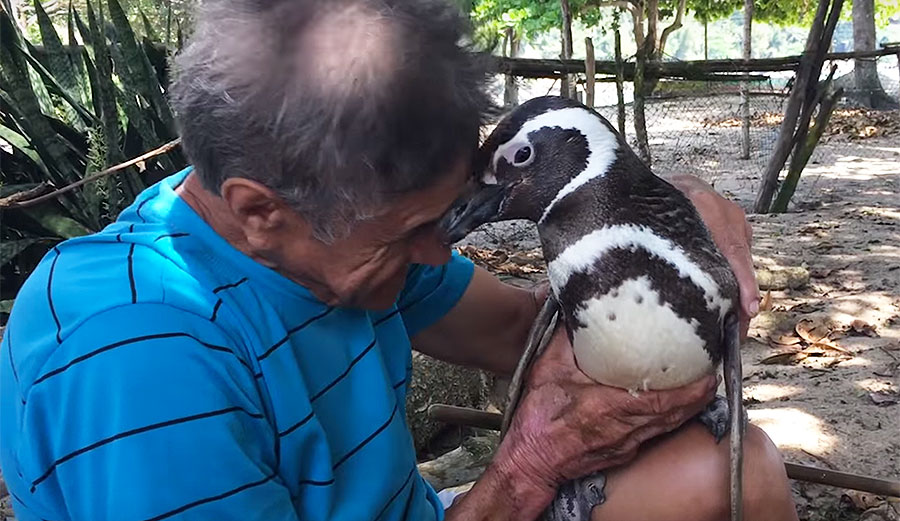
de Souza says Dindim won’t allow other animals near him. Now that’s love.
A few months later, the penguin showed up again, ditching his other penguin family in favor of the rescuer. Normally, Magellanic penguins from the Atlantic coast would migrate from Cape Horn to Brazil, sticking with their group. Dindim opts to spend his time with Joao, instead, staying with him for up to 8 months out of the year. “I love the penguin like it’s my own child,” said Joao, “and I believe the penguin loves me.” Penguins are well-known for their mating habits; they’re a creature that picks one mate and stays with them for life. “No one else is allowed to touch him,” said de Souza. “He pecks them if they do. He lays on my lap, lets me give him showers, allows me to feed him sardines and to pick him up.”
While it is a very sweet story, the conditions surrounding Dindim’s rescue are worrisome. Brazil’s coastline is famously polluted. Up until just over a decade ago, only about 30% of all wastewater was treated. Now, between oil spills, waste water, and warming ocean currents, Brazil’s beautiful coastline is becoming a hazardous place for many species. According to the Independent, between 2010 and 2013, there were over 180 cases of mammals stranded along the Brazilian coast.
“Every year the strong ocean currents from the Falkland region traps and brings many species of seals, whales, dolphins, turtles and penguins to the Brazilian coast,” saod Professor David Zee, an oceanographer from Rio de Janeiro’s State University. “This is becoming more problematic due to environmental changes and the increasing frequency of el Niño, in which the Pacific Ocean is warming up for prolonged periods of time.”
Sometimes I think about what would happen if we treated our homes the way we treat our environment. We’d all be living in squalor, contracting weird diseases, dodging fecal matter and poison with every step. Maggot and Stinky Coyote would be covered in toxic sludge, not able to chase me down the road when I left. Isn’t it crazy that we’ve created a world with so much garbage that that’s become an accepted way to treat the planet?

These two love me, but they wouldn’t chase me 5,000 miles.

