
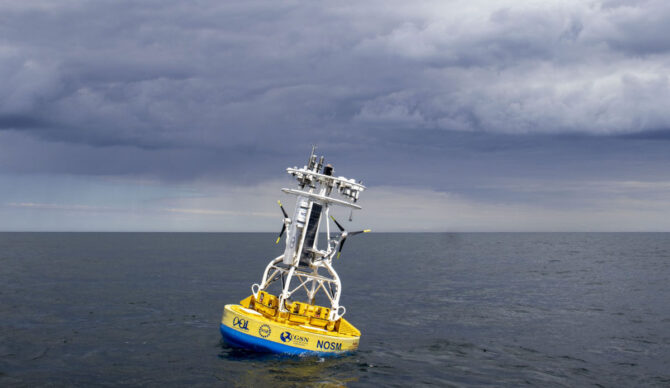
One of the many research buoys set to be pulled out of the ocean. Photo: Woods Hole Oceanographic Institution//OOI

The seas off of Oregon, Washington state, Alaska, North Carolina, and the Irminger Sea, a little patch between Greenland and Iceland, are homes to a $368-million, deep-ocean observation system called the Ocean Observatories Initiative. It is there to monitor things that affect the global climate, but the Trump Administration is tearing it all down.
According to the New York Times, the National Science Foundation will begin sending ships this month to begin the removal of nearly a 1,000 deep-sea instruments vital in keeping tabs on coastal environments, marine ecosystems, and currents, all of which affect the climate around our planet. Knowing what’s happening in the ocean is extraordinarily important in planning for what’s to come, so the move has many scientists worried.
“Scientists have used data from the system to understand how the ocean is absorbing greenhouse gases from the atmosphere, how changes in ocean temperature such as marine heat waves might affect fisheries or signal bigger shifts in the climate, and coastal flooding along the East Coast,” the New York Times wrote. “The station in the Irminger Sea has been key to understanding changes in the Atlantic Meridional Overturning Current, a global conveyor belt of water that some scientists are concerned may be weakening as a result of climate warming. A collapse of the current could have severe weather effects.”
The decision to dismantle the Ocean Observatories Initiative, according to Michael England, a spokesman for the National Science Foundation (N.S.F.), “aligns with N.S.F.’s wider strategy to have a nimbler approach to prioritizing support for evolving scientific priorities and emerging technologies as well as a deliberate approach to smart life cycle management within its portfolio of research infrastructure.”
The Ocean Observatories Initiative first fired up its proverbial engines in 2016, and was supposed to continue to operate for 25 years. Now, though, it will cease to exist just a decade after its inception. This worries many in the scientific community, one of whom was the acting chief scientist at the National Oceanic and Atmospheric Administration during the first Trump term.
“This reflects the further lack of understanding that the current administration has of scientific value and scientific merit,” Dr. Craig McLean told the New York Times. “By dismantling such a system, we push the United States back yet again into a rear seat in global scientific leadership.”

