
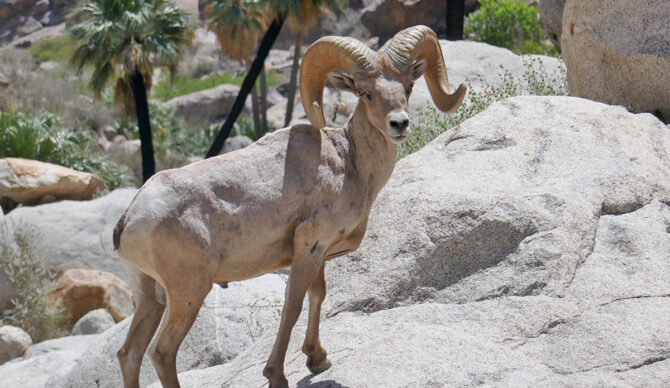
Despite opposition from conservationists, the federal government continues to place barbed wire fencing at the border, putting animals in danger. Photo: Evan Quarnstrom

Coils of barbed wire placed at the U.S. Mexico border ensnared an endangered Peninsular bighorn sheep in San Diego County earlier this month, according to an article in KPBS. Despite warnings from conservationists, the Trump administration continues to build a wall that poses a risk to wildlife.
For those who have never seen rural sections of the U.S.-Mexico border, it is not a continuous fence as one might imagine. Particularly in the rugged mountain terrain of San Diego County, where car-sized granite boulders hinder access, there are swaths of land without a wall. Since last year, the federal government has been acting to close those gaps, adding barbed wire in some places, such as the fence that killed the ram in the Jacumba Wilderness.
Christina Aiello, the biologist who found the deceased mammal, told KPBS that she’s been expressing her concerns about the lack of wildlife crossings to U.S. Customs and Border Patrol, although the agency hasn’t expressed any desire to take corrective actions.
The Peninsular Range, which crosses the border, is home to wildlife such as deer, mountain lions, foxes, and bighorn sheep. The sheep have been protected since 1971, as their numbers have fallen from around 1,100 in the ‘70s to 400 in 2000. The Department of Fish and Wildlife lists habitat fragmentation and loss, and human disturbance, as leading contributors to their decline.
The new sections of wall could also force wildlife towards busy roads, such as Interstate 8, which runs parallel to the border. Last month, a wild horse was struck by a car in the area.
“If they have completed the razor wire fence, if they’re doing construction on the border, you then have risks of that entanglement problem,” Aiello said. “If they leave that razor wire up, you have risks of death or interactions with construction vehicles.”
Bighorn sheep are an iconic species in San Diego and Imperial counties, particularly in the Anza-Borrego Desert State Park. While their habitat extends south into the mountains of Baja California, closing the remaining gaps in the border wall would divide those populations, potentially limiting access to food, water, and mates.

