
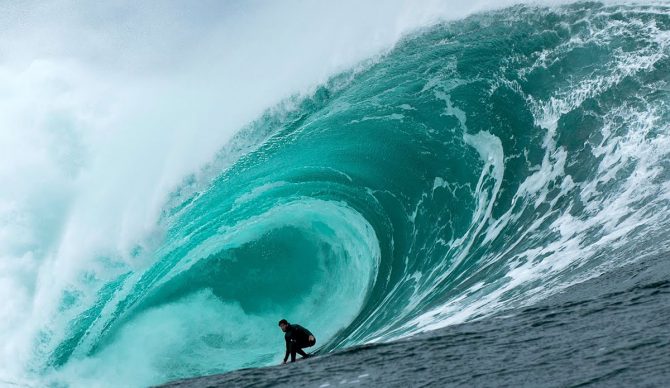
Nate Florence during one of his North Atlantic swell chases. Photo: YouTube//Screenshot

I’ve been watching a lot of videos lately, covering, from various angles, the series of massive, North Atlantic swells that rocked Europe’s and the British Isle’s western coastlines throughout the month of December. A lot of it I could at least relate t0 — I’ve surfed pretty big Mundaka. Not as big as during December’s onslaught on the Basque County’s premier break, maybe, but getting there. However, the footage coming out of Mullaghmore, that fearsome left reef break in County Sligo, Ireland, was something else entirely. As in, hard to fathom — at least by mortal men and women.
I found myself fascinated by each video release, wondering how it was that I missed the memo saying it was now okay to chase a giant swell to latitude 54.4°N, and clad head-to-toe in neoprene armor, take off deep and pull into terrifying, black-hearted, 40-to-50 foot barrels exploding yards in front of a barely covered rock shelf, in freezing cold water and in Beaufort-busting wind and weather, as one might on a friendly, head-high day at a local beachbreak. Pulling into super-sized barrels and, in many cases, getting annihilated by a monster foam ball the size of your average studio apartment in Malibu, then being sucked over the falls into what approximates as most people’s idea of oblivion. Only to emerge apparently unscathed, and eventually paddle, or get towed, back out for another try. No big deal.
But obviously a much, much bigger deal than I could ever handle. Thinking about the time I traveled to the northwestern coast of Scotland, the objective being to ride the right reef/point at Thurso East, considered, at the time, to be the world’s northern-most “perfect” wave. And on this trip it certainly earned its reputation — in the brief respites between a veritable conveyor belt of storm fronts I encountered some of the best waves I’d ever seen. Picture a cold-water Lance’s Right, but with a longer inside wall. Oh, and with nobody else out.
It was during one of the aforementioned gales, roaring down through the Pentland Firth like an express train, that I found myself trapped in my rental car, with no hope of getting in the water anywhere near Thurso: white horses, panicked by the howl of the tempest, stampeded across Dunnet Bay, running straight onto shore at the point. I had been told, however, about a spot called Gills Bay, only a 20-minute drive north along Caithness Shire’s crenelated coastline, where, I soon discovered, regardless of the wind direction, it’s blowing offshore somewhere.
Directions were sketchy — I really didn’t know where I was going. But if I found myself in the village of John O’Groats. It meant that I’d missed Gills Bay, on a loop that would take me around the northernmost point of Great Britain, then back on the main highway south.
John O’Groats was quite picturesque, even swathed in shrieking wind and rain. I U-turned and headed back the way I came. From this direction, the bight out of the coast was more obvious, and my car door rocketed open as I got out and into my rain gear, struggling with a jacket that flapped like a sheet-less spinnaker. Sheep trails wandered through the thigh-high heather and I worked my way out to a point where a view of the surf might be possible. Hood cinched down tight, rain pattering on the fabric.
I got to the edge of the cliff with my pants soaked to the knees. Here was a perfect panorama: Gills Bay, scalloped away to the east while a quarter mile offshore could be seen the low, uninhabited island of Stroma. Still visible on its lee shore, a ghost settlement, founded in the 17th century, abandoned in the 1950s, today reportedly the sole domain of puffins and drug smugglers. In the channel between were heaving swells, swept by the northwest wind, running a parallel course to the coast. But in the corner of the bay the same wind blew side/offshore, and there was a set of three lefts, fanning around the rocky point like spokes on a wheel. Hard to tell how big, at least from this vantage. Only one way to find out. I hustled back though the heather, opened the back hatch, and, standing in the rain, tugged and squirmed into my 5-4-3.
Trudging back to my lookout on the edge of the cliff, I couldn’t find a path to the beach, so traversing the headland I went looking for a gully, the wind buffeting my board so violently that I had to hold it with both arms. A mossy creek cut through the low heather ahead and I followed it, hopping down a series of small waterfalls to the rocky shore, its berm coarse-grained to say the least — with a couple million years of wave action, this beach might someday be a beach. As it was, the boulder zone was heaped with stinking mounds of kelp, thrown up by the high tide. But at least it was quiet down here out of the wind, enough that I could hear the tinkle of bells: a flock of long-haired Scottish goats, led by a wise, gray-bearded ram, picked their way through the littoral, daintily stepping around tide pools and munching on bright green algae. As I walked out to a jump-off spot the flock scattered, hooves clattering on the jagged, slippery sandstone. Old Graybeard lowered his curved horns in my direction, every aspect suspicious.
“You’re the last thing we thought we’d have to worry about, down here on a day like this.” he seemed to say.
I knew how he felt.
It was a long paddle from where the goats grazed, but I didn’t know enough about the size of the waves or the lineup to take the shorter route of jumping off the outside rocks. I could see lefts peeling along a shallow shelf and they certainly looked rideable. The best waves seemed to emerge from the cauldron outside and clean up once they hit the very tip of the point. All in all, with the climbing, rock dance and paddling, I had been watching the surf for 15 minutes, and the pattern seemed regular. From closer up, the waves looked fantastic.
On crowded days at Rincon, I’d grind my teeth at missing a good set wave. A single wave I let go by on Isla Natividad in 1988 still haunts me like lost love; the thought of what could have been.
Now I just sat in the channel, watching an entire set’s journey through the lineup, looking for the right take-off spot, watching the inside section. Then I sat and watched a second set, comparing notes. When you’re all alone at a new spot, individual waves seem to become less precious, the entire experience of finding and riding them so much more rewarding.
So I parked on the shoulder and watched perfect waves peeling toward me, a little like Graybeard, sniffing for danger. Then oh shit! A huge, feathering set loomed up from the outer maelstrom, blotting out the horizon and the view of Stroma offshore, standing up like a castle wall and then crashing down with a whoom!, burying me in black water and white foam.
I tried to duck-dive — I didn’t want to have to trust my leash this far from shore. But the wave quickly ripped the board out of my hands, the way an angry parent might take a toy from an offending child, spinning me down, up, around. After a few revolutions I opened my eyes to a dark world of boiling clouds, shafts of light stabbing down into the gloom of the deep. Pressure, pressure and no air. I hate being held underwater, especially in cold water.
But I’ve always come up, and I did, and there was a second wave, but this time I held onto my board, plunged into a whitewater rodeo: eight seconds of chaos. When that ride was over, I sprinted back outside, away from the impact zone, where, between gusting downpours, I tried to slow my heartbeat. Through a veil of spume I could see Stroma again, desolate and foreboding as only a forgotten island can be. Regiments of wind swell marched past Gills Bay, wide of the point, attacking some other front. I was a very, very small element of this storm. Yet at the same time, much more than just a witness; sitting there during a lull, rocked by the wind and lashed by the rain, I could feel the Earth’s’s breath on the water.
I dodged cleanup sets for the next hour. It was much bigger than it looked from the cliff, and the waves that hugged the point reeled along like a Scottish Cloudbreak, 10-to-12-foot spitting tubes that broke just yards from the dry rock. They looked perfect, but I just couldn’t work up the nerve to stroke over into the pit and take one. Getting caught inside over there would be awful. And what if they sucked dry after takeoff? Out here on my own, I couldn’t afford that kind of mistake.
Instead, I settled for a few wide ones, less steep and hollow, and carved long, fast tracks on my 7’4” Parmenter diamond-tail, banking up and down, covering ground. These waves were fun, exciting, even, but they were hardly the main event. Finally I waited until just after another killer set had rolled by, then gulped hard and paddled over onto the point, figuring to take the smaller first wave of the next assault. Then, of course, the biggest wave of the day charged in and I copped it right on the head, blasted off my board and dragged by my leash, arms flailing. When it finally let me up, gasping for air, I realized that I’d had enough, that this go-out was bigger than me. I took the next wall of soup on my belly, tobogganing out on the wave’s flattened shoulder where I eventually got to my feet and swooped the rest of the way to shore, racing the toppling slate wall. Then I got smashed in the shorebreak, wrapped up in thick, clinging kelp, battered on rocks, and eventually washed into a tide pool, where I lay on my back, trying to catch my breath. Old Graybeard was there, looking down at me with those wise eyes, shaking his head and wagging his scraggly beard.
“Don’t judge me,” I wanted to say. “Didn’t see you out there today. Or anyone else, for that matter.”
Instead, I just crawled out of my tide pool, picked up my board, threw the old guy a piece of kelp and began the trek back to my car, having just been served an experience that, while not even close to Mullaghmore, was still just as much North Atlantic storm surf as I could handle.

