
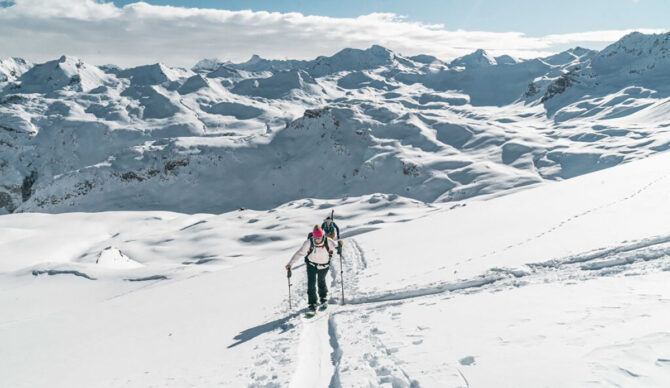
If you’re willing to hike a little, there’s no place like Val d’Isere. Photo: Val Media

Sure, France has its surf in Biarritz and Hossegor that get all the attention (not to mention hosting the Olympics in French Polynesia). But it also serves up world-class backcountry skiing and riding, and nowhere is it better than Val d’Isere, which, along with adjacent Tignes Ski Resort, mixes French charm and panache with some of the best off-piste ski terrain in the world.
Located smack in the middle of the French Alps and billed as the “Most Beautiful Ski Area in the World,” Tignes-Val d’Isere was formerly known as “Espace Killy” for world and Olympic champion alpine ski racer Jean-Claude Killy.
But it’s the terrain not the name that sets it apart from the crowd. Located in the heart of southeast France’s Haute Tarentaise Valley of the Rhône-Alpes, more than 60 percent of its land is protected by Vanoise National Park, the largest percentage in the world. Together, Val d’Isere and Tignes span more than 300 kilometers of piste trails, served by 78 lifts. But it’s the additional 25,000 acres of off-piste zones that beckon those up to the task of exploring its backcountry. Below are a few tips I learned from a self-guided visit early last spring.
Bring Your AT, Splitboard, and Avi Gear
Sure, it might not be quite as beefy when you’re skiing on piste, but bringing your backcountry kit — including beacon, probe, shovel, airbag, and wine-opener — opens up the doors for exploring more than 25,000 acres of untracked terrain beyond the ropes. In all, we hit 11 different backcountry zones in our seven days (each one capable of swallowing Vail whole), skinning into or out of seven of them, and traversing sidecountry back “inbounds” to lift-serve terrain on the others. Doing so enabled us to reach swaths of untracked those with locked heels couldn’t access. The week started by skinning to the Glacier de Pisaillas off the Montet T-bar, followed by a boot hike up to the Col de Pers and skiing down to a waiting bus at the Fornet bridge. Note: a lot of other tourers sported avalanche airbags (but we detached ours when we weren’t in suspect terrain, freeing up room for more baguettes).
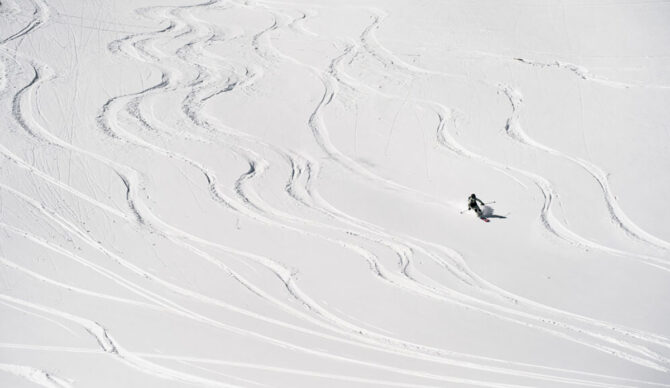
There’s lots more where this came from. Photo: Val Media
Don’t Follow All the Tracks
Eyeing an aesthetic ridge line above our chalet the afternoon we arrived, I headed up for a quick solo run in the Les Marmottes off-piste zone. Arriving at the top of the Solaise gondola for my first venture off-piste, I quickly learned lesson number one: the terrain is waaaay bigger than it looks from below. Trying to find the entrance to the line I had glassed from below, I skied left of the last set of tracks, only to see them disappear over a cliff. Only then did I realize they were from a paraglide-skier, not a normal earth-bound one, who touched down for only a turn or two before soaring off the precipice. Lesson number two: Don’t follow paraglider ski tracks.
It Gets the Snow
Thanks to something known as the “Foehn” winds, Tignes-Val d’Isere gets some of the most reliable snow cover in France. Like upslope winds on Colorado’s Front Range, these southerlies circle over the Mediterranean Sea, veer up towards Italy and then back up against the southern side of the Alps, stacking up at the top of the valley and unleashing on Tignes-Val d’Isere as precipitation. On our last night, such a storm rolled in, dumping a foot of snow up top. The next morning, before shuttling back to Geneva, we took the Laisinant lift to the Pyramides lift to the Signal poma to access Les Grande Vallons, an untouched off-piste area we lapped freshies in three times (hint: pending snow stability, traverse right about 200 yards before dropping in).
Skinny Skis (and Speedos) Aren’t Dead
Despite the trend of U.S. skiers schralping wider waists, in France, skinny skis are still all the rage. You’ll notice this at whatever base you start at: Euros of all walks traipsing by carrying skis as narrow as a pencil-thin mustache. I know that the industry is trending back toward narrower waists in the 88-100mm range and that these carvers might be well-suited for the piste, but if you’re venturing out of bounds, don’t be swayed by this custom. Also, if you hit the local AquaSportif Center for a soak afterward, be forewarned that the hot tubs aren’t really hot and Speedos are still very much en vogue.
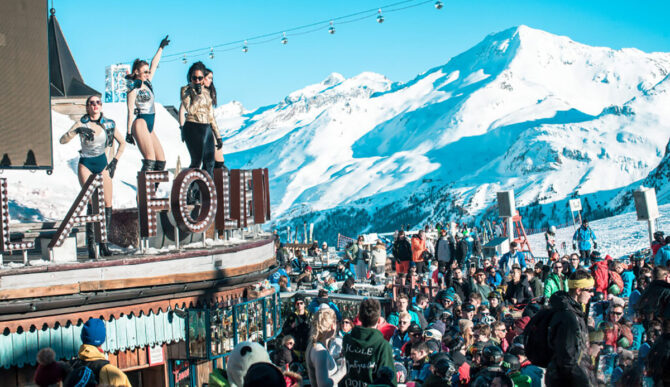
Where aprés is an art. Photo: Val Media
Bag Lunches Taste Better
For some reason, making a sandwich out of fresh baguettes, salami, local Brie cheese, and cucumber from a local Farmer’s Market just tastes a heckuva lot better than whatever you concoct and bring onto the slopes stateside. Get tired of salami? Switch to Jambon de Bayonne (France’s version of Italy’s prosciutto) for the last few days. Top it off with a bar of France’s Michel Cluizel chocolate (with a high cocoa butter content), and apple wedges with Camembert de Normandie cheese. And if you do ever order a croissant from one of its lodges, it’s fun to play the “Guess Who Ate the Croissant?” game (hint: look for crumb pile on carpet).
Take a Side Jaunt to a Refuge Hut
After taking one lap into the Cugnai backcountry zone below Pointe de L’ouillette off the Cugnai lift to familiarize ourselves with the terrain, we returned for lap two, this time traversing left and skinning up and over a col for a quick overnight in the 42-person Refuge du Fond des Fours and 8,323 feet in the Haute-Tarentaise Valley in the heart of the Vanoise National Park. All you need to pack is an extra set of sweat pants and shirt with your avi gear (they have slippers for you at the hut). They’ll serve you beer, wine, dinner, breakfast and lunch, sleeping dorm-style in bunks in a hut adjacent to the dining room. The mudrooms are small, so get used to changing in tight quarters; you can’t wear your ski boots in the lodge (unless you’re a guide); and grab the rope to help haul yourself into the top bunk. Hint: In the morning, your bowl doubles as your coffee cup. Bonus: We were able to ski right back from the hut to our chalet in Val d’Isère
Be Aggressive in Line
Euro ski lift lines are not the place to by shy and polite, and this holds true for those in France. Other schussers will go so far as to step on your skis to squish into the queue. My advice: Keep your elbows up and polish that hip check from hockey. The good news: If you’re wearing an avalanche airbag, they take up extra space, affording you a buffer zone in the crowd. Be forewarned that even though many of the lifts are quads, there are often only three turnstiles checking your ticket.
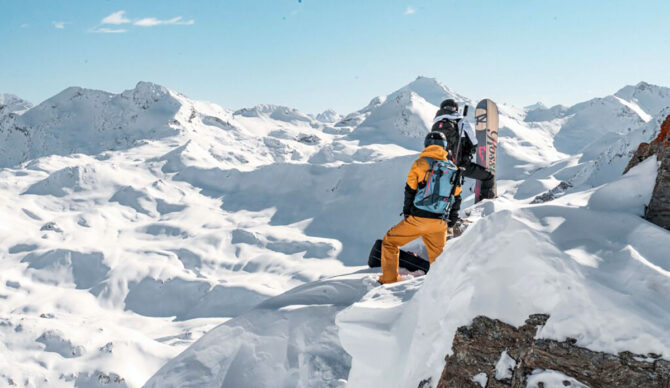
Val d’Isère, with vistas galore. Photo: Val Media
Lifts of All Walks
As with the ski outfits you’ll see, lifts at the two resorts come in all shapes and sizes. Together, Val d’Isère and Tignes serve up 78, from pomas and T-bars to six- and eight-packs. There are also a few you might not see elsewhere, like the stomach-dropping Leissières chairlift that takes you through a narrow notch in the Solaise mountains in Val d’Isère, and Tignes’ Funiculaire Perce Neige, an underground, 280-person train that whisks you up nearly 3,000 vertical feet through a tunnel to the bottom of the Grande Motte tram. From here, after a pastry and cappuccino at the lodge, climb aboard for a ride just shy of the summit of 12,000-foot-high La Grande Motte, with Italy off to the west. Here, thanks to beta from our guide buddy Henri, while most others stayed on piste we ventured off, into a couple-thousand vert run through powder as frothy as our cappuccinos. From there, we skinned back to the Col de la Leisse and a short traverse back in-bounds. The cat track we hit led us by a raging, techno-music aprés scene.
No Street Skiing
While it’s a good place for it, with steep roads strewn about the village, signs point out that there’s no street skiing allowed on them a la JP Auclair’s iconic street segment in Sherpas Cinema’s All.I.Can. Besides, there are enough other cliffs, ridges and couloirs to keep you plenty occupied. But if you hit the backcountry, several of the valleys dump you back into the main valley floor, where you can pole and skate your way down a series of Nordic trails to get back to the village.
Expect Accoutrements In your Airbnb
It’s France, so expect a few token amenities with your accommodations. Our Airbnb had more than 30 wine glasses hanging from a rack over the kitchen, special wine glass holders in the dish washer, a wine rack by the fridge, and no less than four wine openers. We also found a fondue maker, which we put to cheese-dipping use (shoot for a 2:1:1 ratio of Gruyère (or Beaufort), Emmenthal and Comté). The one thing that could use improvement? The toilet paper was a little coarse.
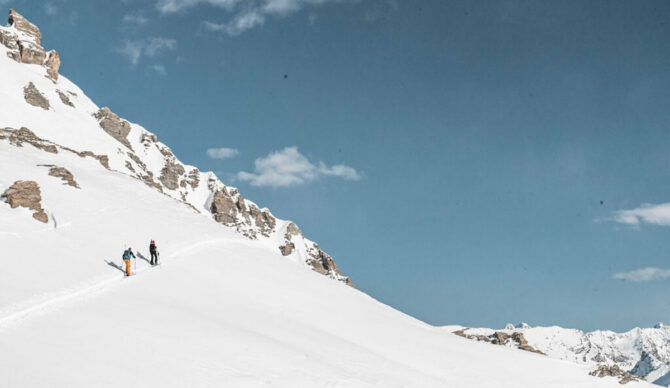
Another skin track. We’re sensing a theme. Photo: Val Media
Get Some Beta
Ours came from Henri, a U.S. skier who has ski bummed here for a few years and now makes it his home, working as a ski guide and avi gear rep. We’d ping him every day for his suggestions on where to go, taking his advice to heart. And you do want some inside knowledge, especially if it socks in or the light gets flat. You can pay upwards of $500 a day for a guide, which is safer and more efficient, or you can bumble around like we did if you have the right gear and experience. If the latter, don’t expect to nail it every time. When skiing down from the Col de Pers, we found the skin trail okay, but missed a lower line, resulting in billy-goating down some tufts of grass near a small waterfall — all while a French guide skied below us with his clients, saying, “And that’s why you hired moi.”
Après is a French Word
You might as well embrace it; aprésing is as much a part of the experience as the region’s backcountry and baguettes. We ended one day in Fornet and took the red line bus right to an outdoor beer and wine garden downtown, complete with frothy mugs, pretzels, and an adjacent salami and cheese mart. Try the local Kronenbourg beer as a refreshing lager, the local red wine Mondeuse Cavaille Vin de Savoie Vielles, or shots of Genepy des Alps, a local liqueur made from the Genepy flower that’ll warm your innards. At tables nearby you’ll see ski instructors basking in all their glory, tourists from Lyon in one-piece suits, and aprés revelers gyrating to queen of French pop Angèle, highlighted at the Olympic closing ceremonies. And on your walk home, you’ll invariably stop by the local boulangerie (bakery) for fresh croissants for breakfast and baguettes for your bag lunch.
Other Beta
Lift tickets are cheap, with a variety of options, from half days for touring to multi-day deals. For the latter, expect to pay in the neighborhood of $70 per day, a bargain by U.S. standards. Hint: Evacuation insurance costs an extra $3 per day, a sound investment considering the terrain.
Getting There
Chambéry is the nearest airport to Val d’Isère, about a two and a half hour drive, followed by Geneva and Lyon Saint Exupéry, both about three and a half hours away. Regular buses and shuttles serve all the airports, with private transfers often the most convenient and efficient, especially if traveling in a group. We took a shuttle from Geneva and forsook renting a car, with a great bus system running between Val d’Isere and Tignes. You can also train close to Val d’Isère, with the Bourg St. Maurice train station just 20 miles away, where you can bus or taxi to Val d’Isère.

