
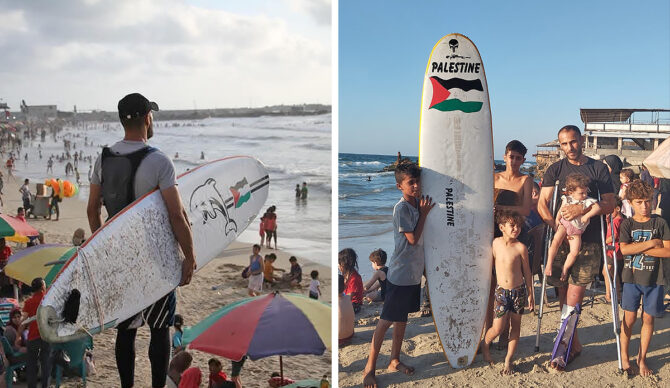
Taha Baker’s surfboard is one of the last remaining in Gaza after 30 months of war. Taha can be seen with crutches on the right. Photos courtesy of Taha Baker.

Matt Olsen estimates there were around 30 surfers and 30 surfboards in Gaza before the war started in October 2023. During the torrent of bombings, some members of Gaza’s surf community have been killed. All have lost family members. Survivors are displaced, some seriously injured, largely living in squalor — tents without running water, electricity, or a sewage system. And their passion, surfing, has all but ceased to exist. Only a few boards are known to have survived the bombardments.
Olsen, who founded the Gaza Surf Club in 2008 as the director of the non-profit Explore Corps, has stayed in touch with 15 members of the surf community. When we last spoke with Olsen two months into the war, information on the whereabouts of Gaza’s surfers was sparse. Now, Olsen is well aware of the fates of his friends and the challenges they’ve faced over the course of the war.
“Everyone that I am in touch with has lost their home,” Olsen told The Inertia on a phone call. “One or two of the (Gaza surf community members) are renting apartments that survived. But that changes because rents are constantly shifting, and people can’t come up with funds. Everyone else is living in tents, in front of the rubble on their street, or on the beach.”
Mahmoud Ledah, a community member who owned a kiosk on the beach, was killed by shelling. Ahmed Abu Hassira, one of Gaza’s founding surfers, went out in search of food one day and never came back. His family learned months later that he had been killed by an airstrike. Muhammad Abu Jayab survived a direct hit on his house, but nearly his entire family was injured. He secured a medical evacuation to Qatar for his daughter, who lost a leg, and remains there with her. His wife, suffering a broken pelvis, and his son, with shrapnel lodged in his lung, have been unable to obtain the medical clearance to join them.
“None of these guys are fighters; they’re surfers,” said Olsen. “There’s no overlap.”
View this post on Instagram
While Gaza’s borders have become more open to imports, the surfers have few prospects for earning money, and most rely on financial assistance from overseas, whether through donations or money from family members abroad. Others have successfully created influencer status and raised funds on social media. Prices have fluctuated wildly throughout the war. A heavy tent, Olsen says, can cost up to $2,000, only for a new evacuation order to force a family to leave it behind, walk across the country, and then need to buy another one.
Since the war began, Olsen has cut back on work to spend more time raising funds for the surfers. He estimates he’s sent around USD $120,000 to Gaza to cover medicine, surgeries, and food, and recently launched a fundraiser to pay for the medical school tuition of the son of Ahmed Abu Hassira, who is now the sole breadwinner for his family following his father’s death.
One of the recipients of Olsen’s fundraising has been Taha Baker, 36, a photojournalist and surfer who was injured in July 2025. While Baker was at one of the flour collection points, he says an Israel Defense Forces soldier shot him in the leg, shattering his bones. He’s since had rods placed in his leg, but requires further surgery that he cannot receive in Gaza.
“My dream is to get healthy so I can surf again,” Baker wrote me in a WhatsApp message. “I always dreamed of representing Palestine in surfing all over the world, raising my country’s flag high in the sky, but Israeli soldiers deliberately shot me so I would be disabled and unable to achieve my dream.”
Baker says he first saw surfing on Israeli television as a child, which inspired him to become a lifeguard and surf on styrofoam boards. He received his first board from Olsen, which he called the “best gift of my life.”
Surfing has not completely disappeared during the war. A bomb struck Baker’s building, but his board, stored on the ground floor, survived. Through more than 10 moves around Gaza, he carried it with him. Some surfers have even dared to get in the water. An AP article from December showed two surfers taking to the waves with rubble and crowded tents in the background. But Baker warns that entering the sea remains risky.
“A small number, no more than five people, have been surfing for the past two years,” Baker said. “But there’s a great danger. Fishing and swimming are prohibited in the sea. Surfing can cost an athlete their life because of gunfire from Israeli warships off the coast.”
Rawand Abo Ghanem, 30, considered the first female surfer of Gaza, managed to get back in the ocean during a ceasefire in October 2025 — but her board had been destroyed in the rubble of her home. Ghanem is now living in a tent with her children, including an infant born during the war. She describes the conditions as abysmal: mice, mosquitoes, no clean water, no electricity, and lack of sleep due to the noise of warplanes and drones overhead. She says that at one point during her pregnancy, she fainted from malnutrition.
“This war prevents me from my freedom,” she told The Inertia. “I am looking forward to having a surfboard again and riding waves to return my smile, my happiness, and freedom.”
View this post on Instagram
As the war approaches its fourth year, Olsen says funds have been getting harder to come by. The surfers are stuck in tents on the beach, unable to earn a living or leave the country, entirely dependent on donor support. In places where the shelling has stopped, Hamas is already back in control.
“(The surfers) still have internet access and can go online every day,” Olsen said. “So they can spend all day on Instagram, messaging people, and reading the news — only to be reminded that the world has forgotten about them. It’s a horrible situation to be in.”
Baker, who has lived his entire life on the coast of Gaza, stressed that the civilians caught in the conflict had no part in the October 7 attacks. Even though he can no longer walk with his injuries, he still keeps his sights on the sea.
“We are so tired of war,” Baker said. “We have lost so many friends and family members, and our homes have been destroyed.”
“I hope the war will stop and peace will prevail throughout the world,” he added. “I hope the sea will be accessible and become a place for sports and peace, not death.”
To support surfers in Gaza, visit the Gaza Surf Club’s website. You can donate directly to Rawand Abo Ghanem here. Donations to Taha Baker can be sent through the club’s surfer relief fund — just note that your donation is intended for him.

