
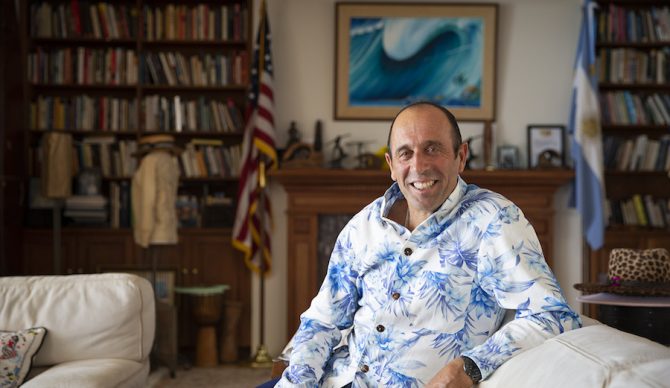
ISA President Fernando Aguerre at home. Photo: JP Van Swae

Surfing’s Olympic future rarely moves quietly, and last week was no exception. On Friday, the International Surfing Association (ISA) confirmed significant changes to the qualification pathway for the Los Angeles 2028 Olympic Games, immediately triggering a wave of reactions across the professional surfing world. Within hours, elite surfers from the WSL Championship Tour, as well as Ryan Crosby, the CEO of the WSL, were publicly criticizing both the direction of the changes and what they described as a lack of meaningful athlete involvement in the decision-making process.
Much of the frustration centers on how the qualification spots are distributed and what they demand from surfers. Under the updated system, the CT will provide fewer direct Olympic qualification places, limited to a small portion of the 2028 season rather than a full year, while the 2027 season carries no Olympic weight. At the same time, athletes may now need to compete in additional ISA events to secure qualification. For surfers already balancing an intense global tour schedule, the prospect of additional competitions that they may realistically need to enter — combined with reduced certainty through the CT — has become a major point of concern.
That tension, between expanding global representation and preserving a clear pathway for the sport’s elite, sits at the heart of Olympic sport, and surfing is now navigating it in real time.
To better understand the reasoning behind the decision, we spoke with ISA president Fernando Aguerre. He addresses the criticism coming from athletes, explains the principles guiding the federation’s approach, and outlines why the ISA believes the new system ultimately strengthens both Olympic surfing and opportunities for surfers worldwide.
Is the ISA happy with the decision to change the qualification format?
It was a good decision, which was approved by the IOC. It was designed to find a balance between all interests — the national federations — while also meeting two IOC principles: geographical universality, which is part of the Olympic spirit, and, at the same time, bringing the best athletes in the sport. The best professionals (from the WSL) and the best from the continents.
These are two important principles that sometimes people don’t understand. They think the Olympic world is simply the best in the world, period — with no limits. But there are limits. It’s like thinking that in the 100 meters you would have 15 Jamaicans; you won’t have 15. There is always a limit.
And what were the main objectives behind these changes?
These changes have a dual and very concrete objective: to improve access for professionals and, at the same time, improve universality — those are the two key goals. We presented all of this to the IOC, they accepted it, and now they have confirmed it. They agreed.
Beyond universality, we also had to try to ensure multiple opportunities for professionals, not only through the CT, but also outside the CT. Within the hierarchy, the CT will continue to be number one. The 2028 CT will be number one on the list.
When did you start working on these changes?
When the Paris Games in Teahupo’o ended, we began talking with athletes and national federations, listening to the interests from all sides… knowing that the goal was to improve what was already being done.
But athletes — especially those on the CT — haven’t reacted well to the changes
Is everyone going to be happy? No — everyone will never be happy. There’s no way to please everybody. It’s impossible. But that’s not my job. My job is to make sure that the 24 men and 24 women competing represent both the best athletes in the world and geographical universality.
They’re saying it’s very bad, but it’s not bad. They started complaining before even seeing the proposal. They also said that two proposals had been rejected by the IOC, and that’s not correct. That doesn’t exist — none were rejected by the IOC. The IOC decides when the vote happens. They decided it would be now, and that’s what they did.
Now that everything is official, and everyone has access to all the details, they can call me, call the ISA, and ask whatever they want to know.
We know you have a relationship with IOC President Kirsty Coventry. Did she play any role in this change?
No, no… Can you imagine that? The President of the IOC? The relationship is good, of course, very good — working together, colleagues for eight years. But she, as a global leader in sport, has many more important things to focus on and decide. She has a lot of work, but she comes with an interest in making changes in general… But nobody likes change, right? Everyone wants yesterday to stay the same.
Do you truly believe these changes will be better for the sport?
I work for all of surfing. I don’t carry flags. I think what’s best for surfers who are interested in the Olympic Games is that surfing continues in the Olympic Games, and that we pursue evolution. Now everything is on paper, black and white.
Athletes will have the opportunity to qualify for three national spots now. In the past, it was only two per country, but nobody sees that. We managed to unlock that. That means that, in practice, the strongest countries in the world will have a much greater chance of having three athletes. Suddenly, there could be three or four countries with three spots. It could be that half the field belongs to four countries — now that’s possible.
I think that was the biggest achievement; removing the limit of two spots. That’s a major achievement! It will help the bigger countries. For me, it’s a huge benefit that people haven’t seen yet.
And regarding how the qualification spots are now distributed?
Another good thing is that with qualification in 2028, the Olympics won’t have the best athletes from last year. They will have the best athletes from today, from that same Olympic year.
In 2028, we have 10 spots through the CT; two months before, we have several spots available through the ISA Games. In 2026 and 2027, spots through team events… It’s a huge benefit for surfers from major countries. On top of that, we also have the continental spots in those years, through the European, Asian, and Pan American events.
Before, there was one door, which was the CT — 10 men and eight women, which could even look like gender discrimination. Now there isn’t. It’s five and five. The rest will come in however they qualify — through 2028 with an extra spot, through 2027, through a continental event, or even 2026.
Is there anything else you think is important that hasn’t gotten as much press?
In the past, it already happened that an athlete earned an individual spot and then lost it — it happened twice. Now, it won’t happen anymore. When you earn an individual spot, it’s yours and you can’t lose it anymore. The country spot, yes, that can be lost. If there are three Brazilians who qualify through the CT or the 2028 ISA Games, those three are in. And the spot Brazil might have earned through team events in 2026 and 2027 passes to the second team. Individual spots are no longer lost.

