

For nearly 50 years, the Great Trango Towers have stood as a proving ground for the limits of human perseverance at altitude. When British climbers first forced a line up the Nameless Tower in 1976, their hard rock work proved that vertical big-wall climbing was possible at 20,000 feet.
In the decades that followed, the Karakoram granite drew an international procession. Norwegian, Japanese, American, Slovenian, Italian, and German mountaineers pushed higher standards of commitment, difficulty, and style. Names like Wolfgang Güllich, Kurt Albert, Voytek Kurtyka, Michel Piola, Jeff Lowe, Catherine Destivelle, Alex Lowe, and Mark Synnott mapped routes onto the towers’ faces, often at the cost of weeks on the wall, violent storms, and close calls documented in the American Alpine Journal.
Throughout all of this, the Trangos were dreams owned by climbers. Skiers could marvel at the steep, eye-catching abruption to the landscape, but this was aid climbing terrain, conjuring up ideas of portaledges and fixed ropes as opposed to somewhere you imagined clicking into skis.
All of that changed on May 9th, 2024, when Jim Morrison and Christina Lustenberger completed the first-ever ski descent of the 20,623-foot West Face of the Trango Towers. The historic descent was executed after years of planning, two expeditions, and nearly 70 days of waiting in base camp. The documentary, simply titled Trango, directed by Leo Hoorn, captures their journey and is available to stream beginning February 13th.
For Morrison, the descent sits alongside his most iconic achievement: becoming the first person to ski Mount Everest’s North Face via the Hornbein Couloir. That line, which is long considered one of the most audacious challenges in high-altitude skiing, cemented his reputation. Trango, by contrast, was not necessarily focused on pushing the envelope, as one might expect. The trip — and the success – was about skiing a place that had lived in his imagination long before skis entered the picture.
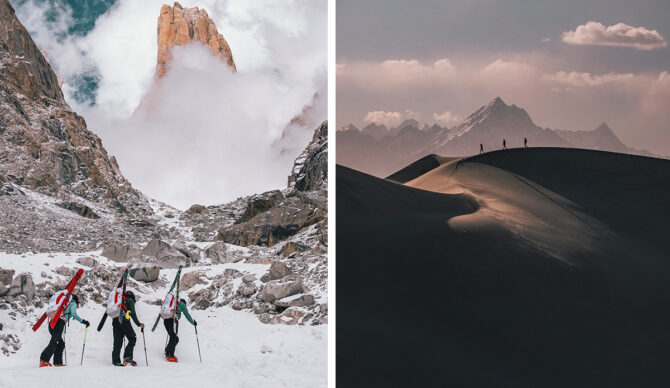
There was a lot of walking involved in the Trango expedition. Photo: North Face
“I grew up listening to stories about the Trango Towers,” Morrison said. “It was only the craziest rock climbers in the world that would go to these places and climb these vertical walls at 20,000 feet. It just seemed inconceivable.”
Raised in Northern California, Morrison honed his climbing and skiing craft in the Sierra Nevada, racing at Palisades Tahoe (then Squaw Valley) before discovering granite and big walls. He built his life intentionally, with a custom home construction business in Tahoe City alongside an obsessive personal relationship with the mountains.
Over time, his objectives grew taller: Ecuador, Russia, Denali, the Himalayas. By 2018, he had skied Lhotse from the summit with his partner Hilaree Nelson, summited Everest and Cho Oyu in the same season, and become one of the most esteemed high-altitude ski mountaineers alive.
In 2022, Morrison suffered one of the greatest losses of his life when Nelson died on Manaslu whil with him. The mountains didn’t disappear after that, but their meaning changed.
Trango did not begin as a ski project. It came through the normal expedition channels of The North Face athlete team when Christina Lustenberger proposed a trip to the Baltoro Muztagh region of Pakistan. Much earlier, Lustenberger had asked Nelson and Morrison to join, and after Nelson’s death, Lustenberger kept returning to Morrison with the idea.
Morrison agreed on one condition: that they walk to the Trango Towers. He had heard through friends Andres Marin and Anna Pfaff that the terrain might be skiable. “When I figured out I could put the two together,” Jim said, “I was like, ‘this sounds awesome.’”
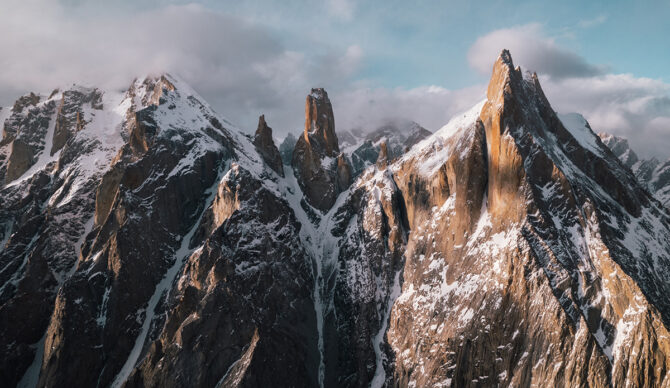
Trango Towers sit are hard to miss from afar. Photo: North Face
Lustenberger was the right partner for this kind of expedition. A former Canadian Olympic alpine racer, she had expanded her career as a big-mountain skier, and then as a full-spectrum alpinist who was comfortable climbing ice, managing rappels, and skiing lines of consequence.
“She’s not afraid to climb up something and ski down and have to rappel over a bunch of seracs and ski farther,” he said. “Most people would look at that and say, ‘I don’t even want to ski that.’”
But there was another reason Morrison trusted her. Before her death, Nelson had skied with Lustenberger and returned overflowing with praise. “[Lustenberger and I] skied together quite a bit before that to get an understanding of whether Hillaree should go on this trip,” Jim said. When Hillaree went on a group ski trip with Christina to Baffin Island, “they had an exceptional time, and Hillaree came back and was just like, Lusti, Lusti, Lusti, Lusti,” Jim laughed. “She was just really excited about her. Her technique and her skills and the way she looked at the mountains.”
So when Lustenberger asked Morrison to go to Pakistan, there was only one answer. “It seemed like something Hilaree would want,” Jim said.
Reaching the Trango Towers is an expedition in itself: flights to Islamabad, onward to Skardu, days of travel by road and then foot, hundreds of checkpoints and permits, and the hiring of local fixers, porters, and horse teams to move thousands of pounds of equipment into the Baltoro. Morrison emphasized how dependent the team was on local support, specifically Balti porters whose labor made the entire project possible.
Once in base camp, the real work began: waiting. “We were ultimately in base camp for 68 days,” Morrison said. “To ski one run.”
There is no avalanche forecasting in the Trango Towers, nor any neighboring teams to compare notes with. One year, the closest thing to a snow study was a villager sending photos after storms, offering the only glimpse of accumulation higher in the range.
The first attempt pushed high before a massive crevasse forced a retreat. “I spent another year of my life and another month in base camp, trying to get a minute and four seconds of skiing in,” he laughed, remembering.
A second attempt ended when waterborne viruses left Lustenberger dangerously sick. Morrison called it immediately, focusing on getting her down.
Fear also played its part. Above them, thousands of feet of unknown snowpack on a massive face. Convincing a team to move upward into uncertainty is a feat on its own. That time, the team went home without a summit.
“Some of these really hard objectives take more than one try,” Morrison explained. “There’s so much to learn just to get started on the route.”
Beneath technical complications and workarounds, Morrison’s headspace changed dramatically between attempts. “The first year I went there, I was pushing myself really hard to go on an expedition and get into the mountains and go do this, and I was excited about the prospect of being in the Trango Towers,” Jim said. “It was really nice for me to have this goal to train for and stay focused on.” But as he got closer to the finish line, things got harder. “Once I got there, spending time in a tent alone without Hillary and going through the whole process of being on an expedition without her, when I’d just been doing everything with her for so long, was really, really hard for me,” he said.
The second year, Morrison returned changed. “I don’t think my grief or my situation was preventing us from summiting,” he said. “I was super motivated for that part of it. But I did have a much more open heart and positive mindset, and was a little bit further along in my grief process. The second year, it was nice to see that growth from myself.”
The summit of Great Trango Tower is small enough to feel improbable, a granite fin rising above the Baltoro, with K2, Broad Peak, and the Gasherbrums spread across the horizon. Morrison had stared at it for years, then for months, then for days from directly below.
“Walking onto that summit after so much waiting was super emotional,” he says. “To look straight down at base camp, right below my feet, after staring up at it for so long.”
Morrison and Lustenberger skied from the summit back to the crevasse that had stopped them the year before. The skiing ranged from excellent to terrible. High on the face, conditions were good, while lower down, the team skied in the dark on refrozen snow, navigating their way back to camp. Morrison carried just one pair of skis: Black Crows Solis, 100mm underfoot.
Compared to Everest, Jim said, Trango was less of an endurance challenge. “Everest had no breaks,” he said. “Every part of it was a no-fall zone. Trango had intense moments, but also places to stop, to lie down in the snow.”
Making the film required bringing a full production team into one of the most complex mountain environments on earth. Morrison felt responsible for them in the same way he felt responsible for his ski partners. “It complicates it,” Jim said. “There’s more planning, more people to take care of.”
However, unlike other high-performance professional athletes, filming didn’t affect Morrison’s mindset the way it so famously did Honnold while free soloing El Cap. “I’m never doing it for the camera,” Jim said. “I’m not worried whether there’s a camera there or not.”
After the team successfully descended the West Face of the Trango Towers, Morrison described perhaps the most emotional moment of the years-long ordeal. “I got back to camp, put my head in my sleeping bag, and felt like, ‘okay, I got this,’” he said. “I’m doing positive things. I’m moving forward.”
Morrison is excited about the film’s incredible cinematography and its ability to bring visuals from the adventure back to share with the world. “It’s really cool we get to let people experience what it was like to be in these truly otherworldly mountains,” he said.
But Morrison also hopes viewers walk away with something beyond the beautiful extremity. “People may have heard about us climbing and skiing the Great Trango Tower, and think it was some sketchy, skittering down the mountain, crazy, difficult descent,” he said. “I think when they watch it, they’ll be like, ‘Whoa. These guys kind of shredded. That was cool. And I hope that will inspire people to go do other things. There’s an endless amount of mountains to climb and first descents to be had across the planet,” he said. “There’s this idea that everything’s already been done. In climbing and skiing, we haven’t even scratched the surface.”

