


Not all backcountry sites are created equal, and neither are all backpacking tents. Photo: Nathan Lemin//The Inertia

Camping is always worth it, but there’s something special about backpacking. Getting deep in the backcountry and finding a near-untouched slice of wilderness is what we’re all about. But getting out there and sleeping comfortably are two different things. There’s immense value in a well-made backpacking tent. Backpacking tents feature reduced weight and speedier setup, so you can carry your shelter easily and get comfortable quickly. Our favorite options this year balance weight, interior space, weather protection, and features.
Navigate To: Comparison Table | How We Tested | Buyer’s Guide
Related: Best Camping Tents | More Backpacking Gear Reviews
Editor’s Note: We updated this guide in July 2025 with refreshed links and a new pick and removed an old model tent.
The Best Backpacking Tents of 2025
Best Overall Backpacking Tent: Nemo Dagger OSMO 3P
Best Budget Backpacking Tent: Kelty Late Start 2p
Runner-Up Best Backpacking Tent: REI Co-op Half Dome 3
Most Livable Backpacking Tent: MSR Hubba Hubba LT 3
Best Ultralight Backpacking Tent: Gossamer Gear The Two
Jump to More Great Backpacking Tents
Best Overall Backpacking Tent
NEMO Dagger OSMO 3P ($580)
Packaged Weight: 4 lbs 7 oz
Floor Area: 42.8 sq ft
Peak Height: 44″
Other Versions: 2P
Pros: OSMO fabric now solution-dyed, tent got lighter, excellent blend of weight, space, and features
Cons: Expensive
The latest version of the Nemo Dagger OSMO 3P continues a long tenure as our top-rated backpacking tent. While we used to recommend the 2-person model, we now prefer the 3-person option due to a marginal weight increase and a ton of added space. Our team especially loves the overhead design: NEMO has figured out how to maximize headroom in a small, lightweight shelter. The tent is now solution-dyed, features even stronger material, features 100% recycled fabrics, and has our favorite vestibules on the market. The Landing Zone tub-floor vestibule organizer keeps items like your pack or boots dry, even if you leave them outside of the tent.
At 88″ by 70″, the Nemo Dagger OSMO 3P is a seriously spacious tent, especially when you consider you can reduce the packed weight to a few ounces less than four pounds. For most people (especially those with dogs), a 3-person tent will be more comfortable, but even the 2P model fits two wide sleeping pads. We opted to name the 3P version our favorite because it adds versatility if you want to use it as a camping tent, but we still highly recommend the 2P.
Of all the tents we tested, the NEMO Dagger OSMO 3P isn’t the lightest, the most spacious, the easiest to set up, or the most protective. Why is it our favorite, then? Because the Dagger has the absolute best combination of all those features, boasting an ideal blend of weight, durability, overhead and floor space, ease of use, and features. Plus, all of the sustainability and functionality improvements in the latest model make it more than worth that admittedly steep price.
Check out our full review of the NEMO Dagger OSMO.
Check Price on REI Check 2P Price on REI
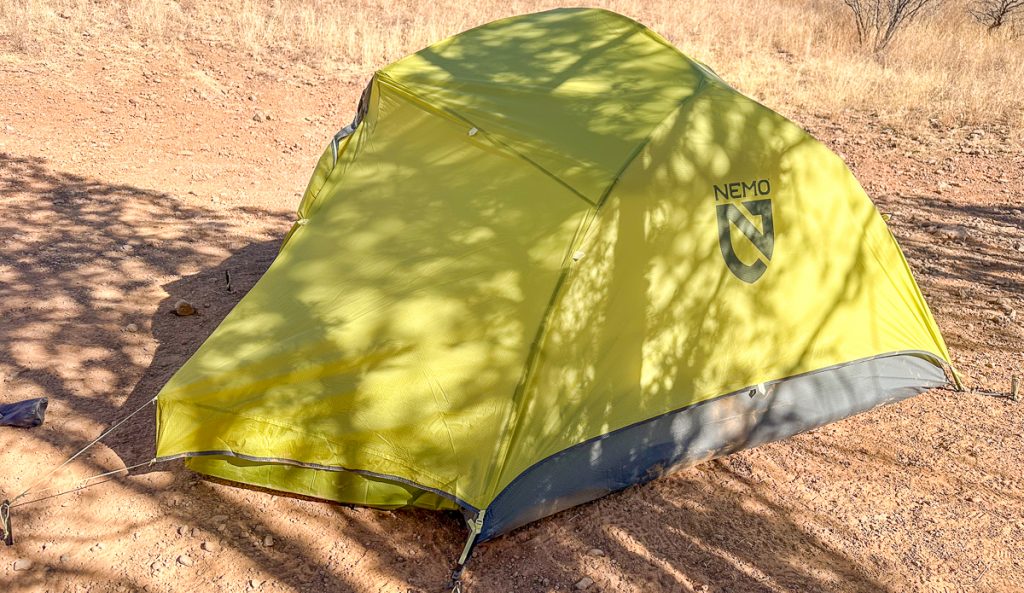
The NEMO Dagger OSMO 3P is impressively spacious for around four pounds. Photo: Nathan Lemin//The Inertia
Best Budget Backpacking Tent
Kelty Late Start 2 ($160)
 Packaged Weight: 4 lb 12 oz
Floor Area: 30.6 sq ft
Peak Height: 42.5″
Pros: A breeze to set up, nice views from the inside
Cons: Poles did not seem as durable as others
If sleeping under the stars is your biggest draw to backpacking, but the bug situation requires you to stay in a tent, the Kelty Late Start series has one of the best, most unobstructed views. The tent gets its name from people who maybe don’t get to the trail at the crack of dawn and need to play catch-up by having a tent with a fast setup time. The Late Start succeeds there, using two poles in the classic crisscross design but having sleeves instead of grommets to ensure they don’t come out during setup. Then it’s just a few clicks and wham — you’re in business.
It’s by no means a luxury tent, but the price matches the simplicity. The poles also felt a bit weaker than some of the premium models, so they would require a bit more care and consideration to ensure they didn’t get bent. But for an easy-to-set-up and relatively light tent for a respectable price, we were happy with everything this tent had to offer.
Best Value Backpacking Tent
REI Co-op Half Dome 3 ($399)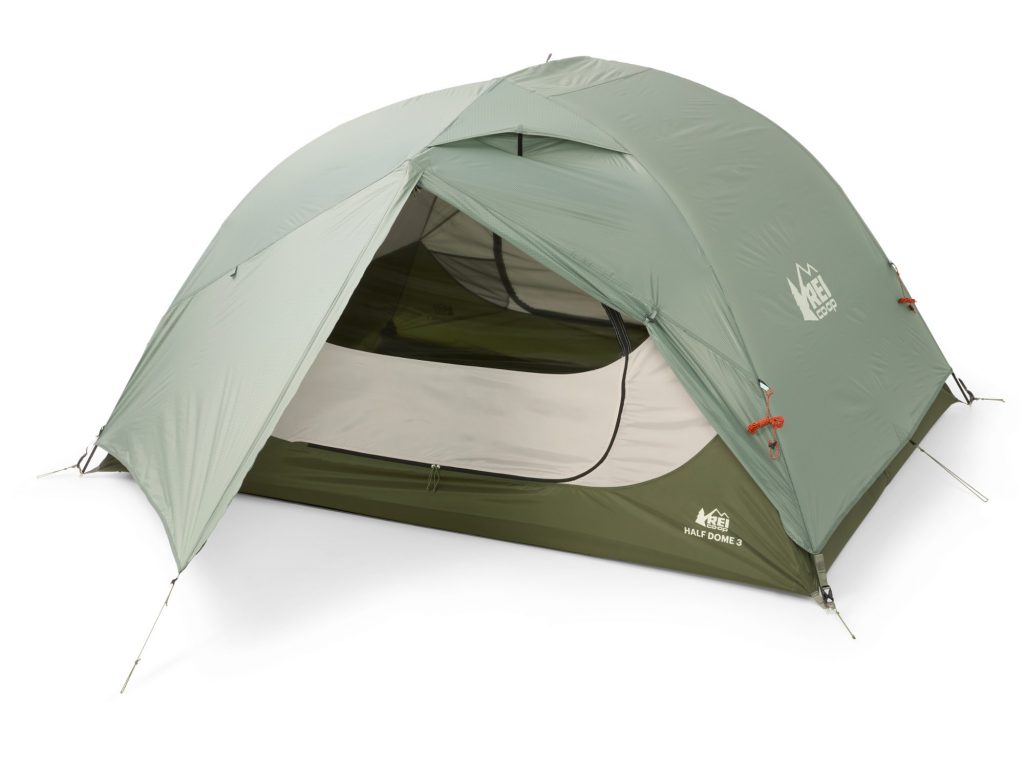
Packaged Weight: 7 lbs. 2.5 oz.
Floor Area: 43.7 sq ft
Peak Height: 44″
Other Versions: 2
Pros: Super spacious, comes with footprint
Cons: Heavier than previous version
The latest REI Co-op Half Dome 3 is another in a long line of really good tents for the money. Sure, this update is a bit heavier than the outgoing Half Dome, but it’s also cheaper, and because the poles feel thicker, we’re hoping it’s more durable too. The latest version is pretty much exactly the same as far as setup and included features go, and we like that they added back some of the pockets we missed in the SL version. Stakes are improved, tie-outs are aplenty, and there is a ton to love about this tent, especially that it doubles as an excellent camping tent.
The 90-inch length was one of the longest head-to-toe lengths we tested, so if you’re on the taller side, you will appreciate the extra headroom. It’s not the lightest tent we tested, but again, it did come down in price. Because it’s over 7 pounds packed, we recommend leaving some of the organization bags (especially the main carrying bag) at home, as they seem to add quite a bit of weight. We also skipped a couple of stakes, as we found we could set it up plenty sturdy with just six. Finally, the inclusion of the footprint is super nice, so you don’t have to buy one (and it really does extend the life of your tent), but for lighter loadouts, you can also leave it at home to save pretty significant weight.
Check Price on REI Check Half Dome 2 Price on REI
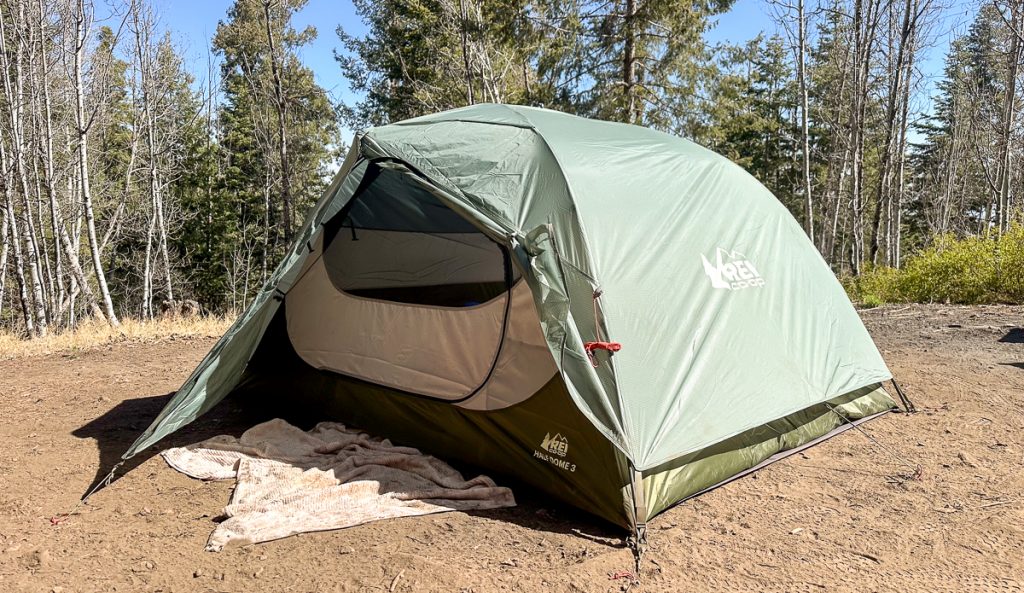
The REI Half Dome 3 is an affordable and versatile tent that’s a bit heavy, but very durable. Photo: Nathan Lemin//The Inertia
Most Livable Backpacking Tent
MSR Hubba Hubba LT 3 ($630)
Packaged Weight: 4 lbs 13 oz
Floor Area: 47 sq ft
Peak Height: 42″
Pros: Incredibly spacious (can be used as 4-person tent), subtle improvements over prior version
Cons: Pricey
The updated MSR Hubba Hubba LT 3 features gigantic interior space, especially for the weight and packability. This three-person backpacking tent is one of our favorites from any brand, and indeed one of the best backpacking tents we’ve used to date. It’s incredibly spacious, maintains a competitive weight, and can even double as a 4-person tent in a pinch.
Our testing team was of a few to get early testing samples of the updated Hubba Hubba, now dubbed the LT, and we got out as soon as we could. Set up, to be expected, was very similar to the previous Hubba Hubba: quick and easy. Of note, the new tent has all-metal hardware (buckles, pole connections, etc)—a nice touch in failure-prone areas. Best of all, the new floorplan is 90 inches by 75 inches, making it well-suited to three wide (~25-inch) backpacking sleeping pads in the standard orientation; however, in a pinch, you can actually fit four standard-width (~20-inch) sleeping pads in the other orientation, allowing this tent to be used as a 4-person option.
Other improvements to note: The more upright walls make this tent feel a lot more spacious near the head/feet. A new rain gutter above the fly door helps funnel moisture away from the opening (plus the more vertical walls keep water out of your tent on opening, an issue with the previous model). Much larger vents on the fly and more mesh on the tent body increase breathability and keep condensation down.
We were already huge fans of the MSR Hubba Hubba (see below), but this update really only got better, and we’re stoked to get it out more this year and continue to review the MSR Hubba Hubba LT 3.
Check LT 3 Price on REI Check LT 2 Price on REI

We couldn’t wait to get the new MSR Hubba Hubba LT out in the backcountry, and it did not disappoint. Photo: Nathan Lemin//The Inertia
Best Ultralight Backpacking Tent
Gossamer Gear The Two ($320)
Packaged Weight: 30 oz
Floor Area: 84″ x 48″ (head) / 42″ (feet)
Peak Height: 43″
Other Versions: The One
Pros: Excellent livability for UL tent, more reasonably priced than competitors
Cons: Not the lightest or smallest UL option
For years, Gossamer Gear has been producing excellent ultralight options in the backpacking space, and the popular Gossamer Gear The Two is our favorite UL shelter this season. With very spacious livability, The Two comfortably sleeps, well, two, and it all comes in under two pounds (excluding trekking poles, which you’ll need to pitch this tent). Setup is simple, vestibules are spacious, and the price is right—The Two is less than half the cost of the Zpacks Duplex Lite, below.
We found this to be an awesome option for both bikepacking and traditional ultralight backpacking. The stuff sack is quite reasonable to pack in its entirety, but we opted to save space (and a tiny bit of weight), and stuffed the tent parts separately into our pack. We were stoked on how well it performed. Plus, our dogs’ toenails didn’t puncture the very thin (but durable) 10D floor material. Some UL tents don’t have seams taped to save weight—we’re happy The Two does, as it adds rain protection and is worth a very small weight penalty.
Check Price on Gossamer GearMore Great Backpacking Tents
Runner-Up Best Ultralight Tent
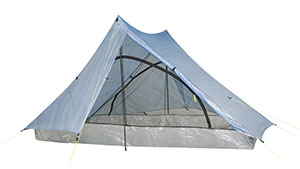
Zpacks Duplex Lite ($669)
 Packaged Weight: 15 oz
Floor Area: 25 sq ft
Peak Height: 48″
Other Versions: N/A
Pros: Incredibly light, yet durable
Cons: Setup takes some practice
For those who count every gram and want to crush long distances but still need good shelter from storms and wind, Zpacks has come up with a real winner. An updated version of Zpacks’ classic Duplex, the Lite is spacious with a high-walled bathtub-style floor that is waterproof enough not to need a footprint.
Trekking pole tents cut weight by using your trekking poles as supports instead of packing a set of tent poles. That structure, combined with Dyneema Composite Material that is totally waterproof but doesn’t stretch, results in a bit of fiddling during setup. As such, you want to practice setting this up a few times at home before taking it into the field. But once you get it, you’ve got it. The result is a tent that weighs less than a pound, although that weight is without stakes, which aren’t included.
Another Excellent Value
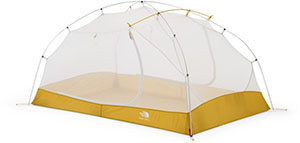
The North Face Trail Lite 2 ($325)
 Packaged Weight: 5 lb 2 oz
Floor Area: 29 sq ft (vestibule)
Peak Height: 41″
Other Versions: N/A
Pros: Roomy and spacious inside, large vestibules
Cons: Not much ventilation when fully zipped up
The North Face makes expedition gear that has been to all corners of the globe. The Trail Lite 2 is not exactly something you’d want to summit Everest with, but it can take you to some pretty cool places thanks to its design. With an easy setup and ample headroom, the two-person tent felt much roomier than similar models. This is partially thanks to the large vestibule space on both sides that can keep your pack out of harm’s way and also serve as cooking space in bad weather.
We gave this tent the “Best Value” pick due to its functionality at a great price point. The Trail Lite 2 comes in at nearly half the price of the more premium models in this list. Price is definitely a big consideration for most when it comes to shelters, and we feel that for the durability and spaciousness, it’s a great compromise for something so affordable.
Although a great backpacking tent, it was also one of the heavier options on our list, so the ultralight crowd might turn their nose up at this. It also felt a bit stuffy with the fly fully zipped, so make sure you give it a bit of breathing room underneath. That same fly, however, felt like it could withstand whatever weather it encountered — as long as the guylines were fully staked. So the tradeoff, we think, is worth it to have either a well-protected rainfly or a huge viewing area with it off.
Lightweight Freestanding Backpacking Tent
Big Agnes Copper Spur UL2 ($550)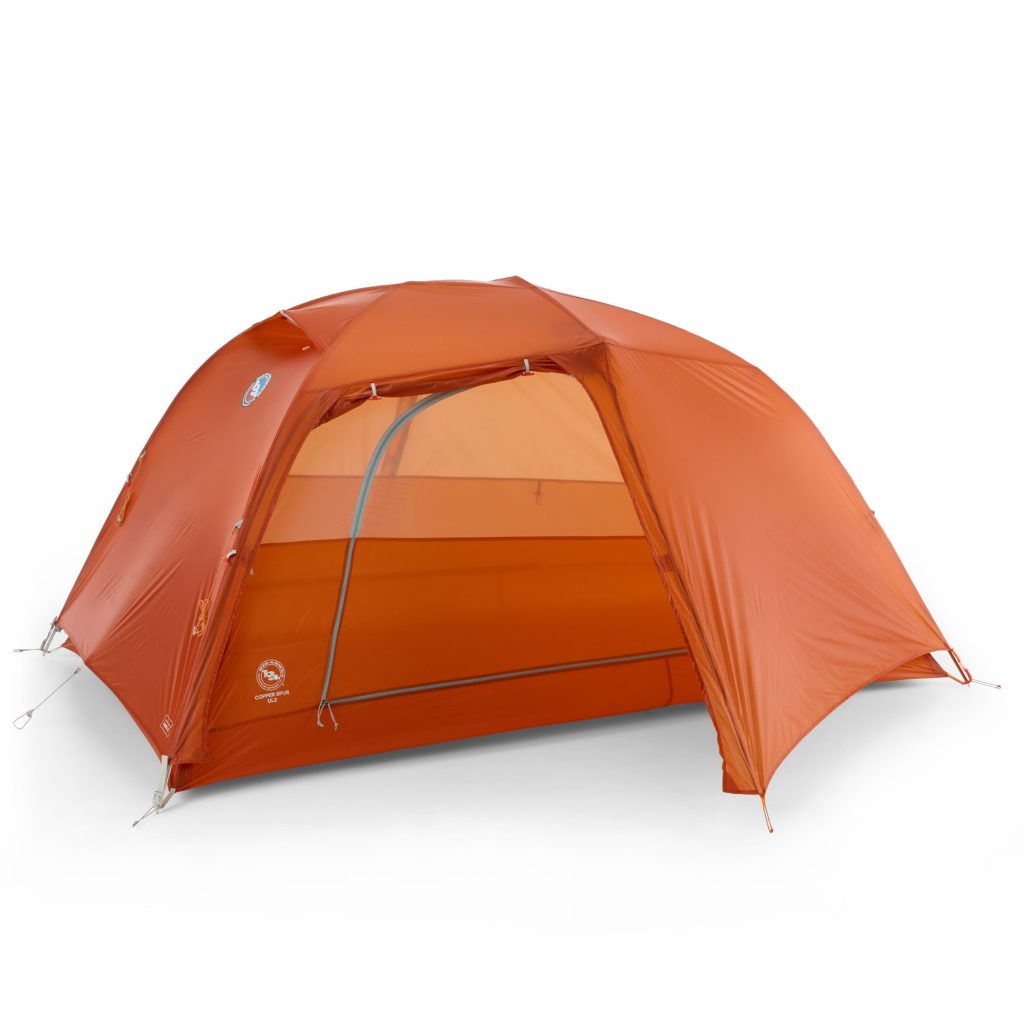
Packaged Weight: 3 lbs
Floor Area: 29 sq ft
Peak Height: 40″
Pros: Lightweight and packable but has all the bells and whistles
Cons: Expensive
We believe this is the best ultralight freestanding backpacking tent around. For years now, the Big Agnes Copper Spur UL line has boasted impressively low weight with spacious, freestanding designs. And the latest version (seen here) continues the trend. It’s nearly three pounds, set up is a breeze, it has excellent storage and use of space, and it simply screams fast, light movement for long treks. Now even lighter (just 3 pounds packed), the latest Copper Spur is for serious backpackers who don’t want to sacrifice creature comforts.
The Copper Spur series is known for its great pockets for all the thru-hikers. This means sunglasses pockets, journal pockets, headlight pockets, and more. It is engineered to place everything every night, then pack up and go the next morning, and it does this well. The vestibules aren’t gigantic, but there are two of them and two doors, which is plenty for that sub-three-pound base weight you’ve got.
Check Price on REI Check Price on Backcountry
Best 1-Person Backpacking Tent
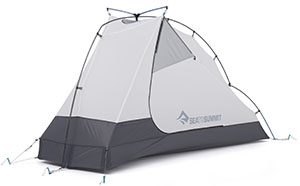
Sea to Summit Alto TR1 Plus ($410)
 Packaged Weight: 2 lb 11 oz
Floor Area: 19.5 sq ft
Peak Height: 42″
Pros: Multiple setup options, great headroom
Cons: Might be too narrow for larger bodies, expensive
Versatility is the name of this tent’s game. The thoughtful design allows for a variety of setup options, from the fly only when you just need some respite from the rain to the full vestibule setup with plenty of space to stash your pack and other necessities. The Sea to Summit Alto TR1 version we tested isn’t very wide, but the headroom makes up for it. The setup was a cinch thanks to the unique proprietary “Tension Ridge” design, which was one of the fastest setups we encountered.
The tent is full of wise ways to reuse the stuff sacks for gear pouches and a soft-light lantern you can hang inside. Although it’s not in the same weight class as other ultralight tents, it’s still incredibly light, especially considering you don’t need trekking poles to pitch it. For a good self-contained unit that is comfortable and easy to pitch, the Alto TR1 has a lot going for it.
Check out our full review of the Sea to Summit Alto TR1.
NEMO Dragonfly OSMO 2P ($500)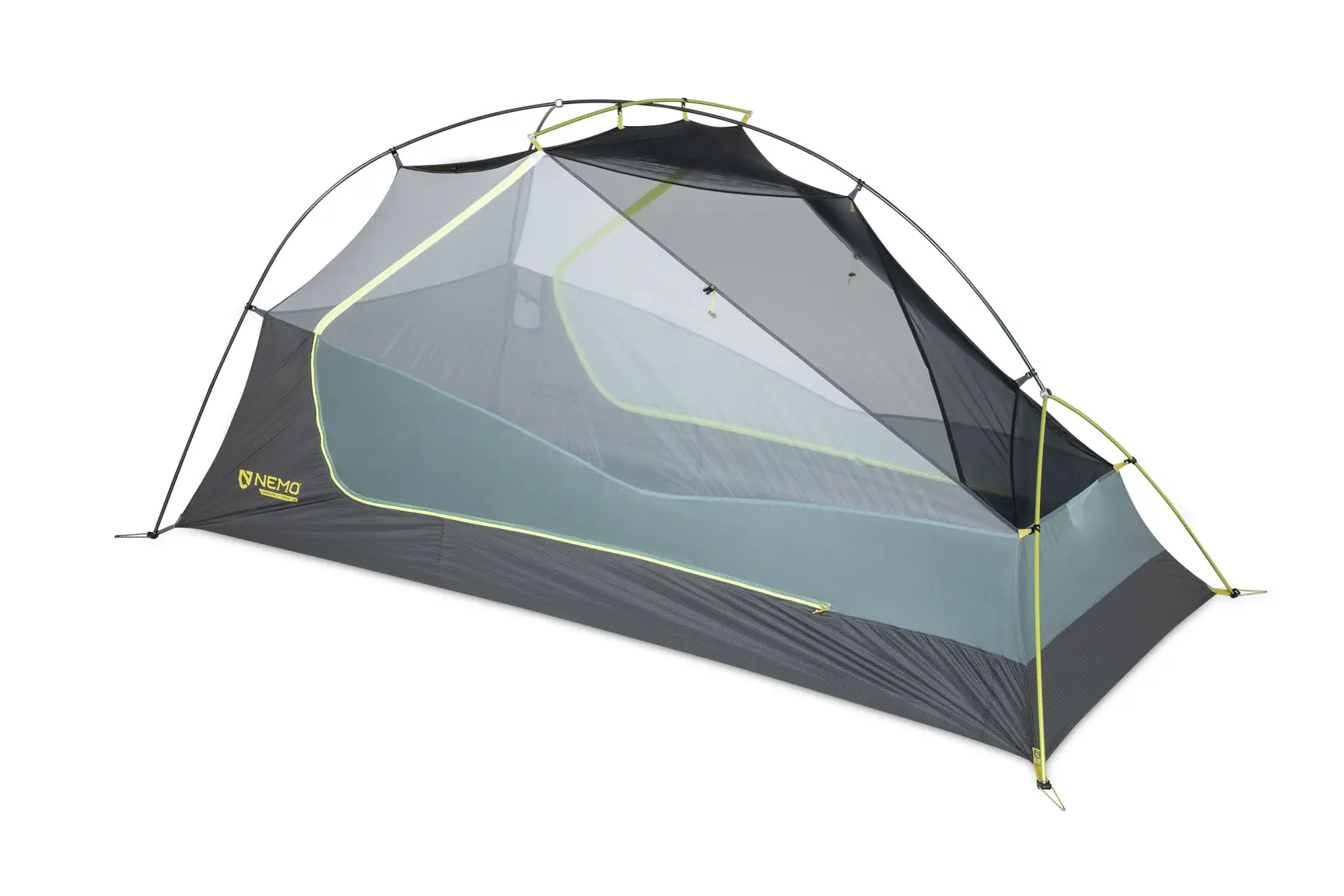
Packaged Weight: 3 lbs 2 oz
Floor Area: 29 sq ft
Peak Height: 41″
Pros: Very light for full free-standing tent
Cons: Not quite as liveable as slightly heavier tents
If you’re looking for an incredibly lightweight backpacking tent for two, look no further than the Nemo Dragonfly OSMO 2P. Weighing in at 3 lbs 2 oz, the Dragonfly has a floor space of 29 square feet and packs down to 19.5 x 5.5 x 3.5 inches. Although getting the Dragonfly set up is fairly straightforward, we encountered a few hiccups on our initial go. But once you get it figured out, it’s a breeze. The lightweight poles easily clip into the tent, and the rainfly is quick and simple to attach.
The Dragonfly is made from quality materials and features Nemo’s trademark 100% recycled OSMO fabric. The fabric is PFAS-free, repels water four times longer, and stretches three times less when wet. The fly and floor materials were also sustainably produced and adhere to strict ecological and chemical requirements. The result is a lightweight yet durable material that is well-suited for life in the backcountry.
Although the Dragonfly is a tight squeeze for two, it has enough room for two sleeping pads to fit side by side. This tent is very similar in quality and specs to the Big Agnes Copper Spur UL2. It also has two doors with vestibules on both sides for storing any extra items. And the NEMO stuff sack remains one of the most packable ways to store a tent, both at home and in your pack.
Read our full review of the NEMO Dragonfly OSMO 2P.
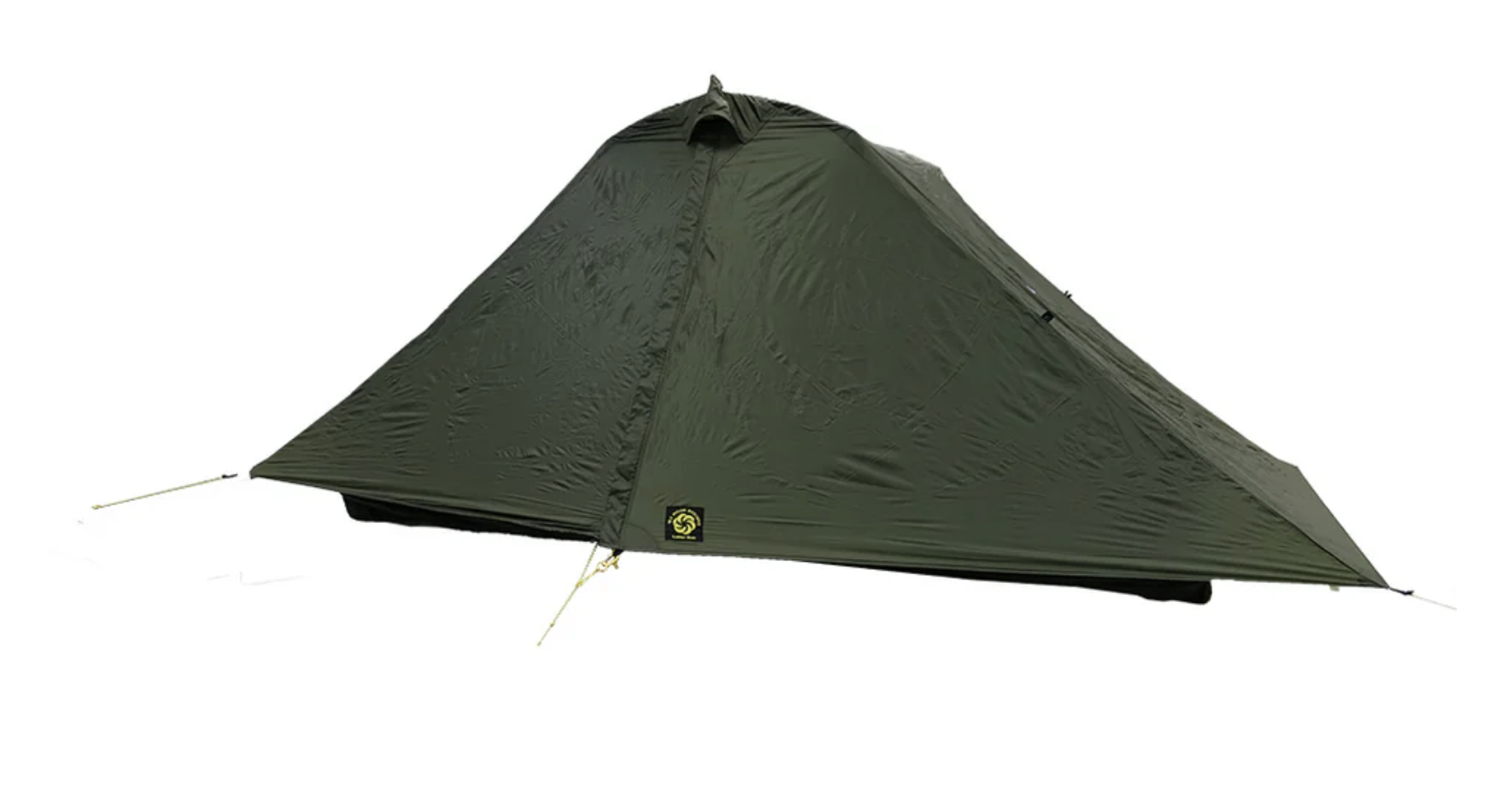
Check Price on REISix Moons Designs Lunar Duo ($395)
Packaged Weight: 2.8 lb
Floor Area: 34 sq ft
Peak Height: 45″
Other Versions: Solo
Pros: Spacious for weight, protective for UL
Cons: Poles and stakes not included, seams not sealed
The Six Moons Designs Lunar Duo is a great lightweight tent that works for both backpacking and camping. However, there is a learning curve when it comes to getting the tent set up, so we’d recommend practicing at home before setting out. The tent doesn’t come with poles or stakes, but you can purchase them or use a hiking pole.
The Lunar Duo offers an exceptional amount of space for two despite its lightweight and compact packing size. It also has two doors and vestibules so you can stash gear outside if you need to. The Luna Duo has a floating canopy for weather protection that can be set to different heights. Unfortunately, the seams aren’t sealed so in order for the tent to be fully waterproof you must seal the seams. Although the tent doesn’t come with everything you need, we like the fact that it is light and versatile and works for both car camping and the backcountry.
Check Price on Six Moons Designs Check Price on Amazon
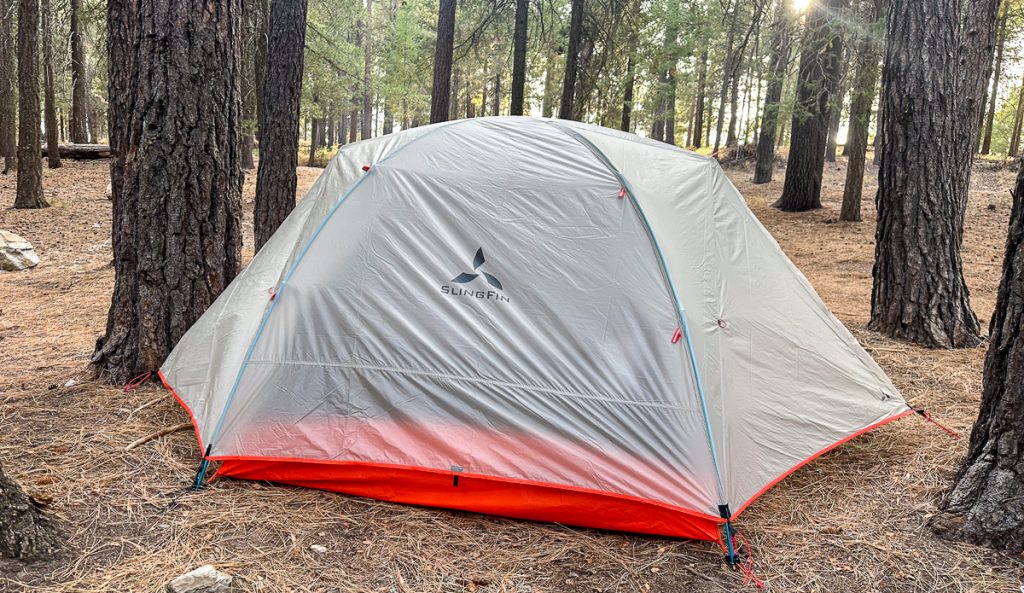
Finding a perfect place to set up your backpacking tent is one of life’s great pleasures. Photo: Nathan Lemin//The Inertia
Backpacking Tents Comparison Table
| Name | Price | Packaged Weight | Floor Area | Peak Height | Other Versions |
| Nemo Dagger OSMO 3P | $580 | 4 lbs 7 oz | 42.8 sq ft | 44″ | 2P |
| Kelty Late Start 2 | $160 | 4 lbs 12 oz | 30.6 sq ft | 42.5″ | 1P, 4P |
| REI Co-op Half Dome 3 | $399 | 7 lbs 2.5 oz | 43 sq ft | 44″ | 2 |
| MSR Hubba Hubba LT 3 | $630 | 4 lbs 13 oz | 47 sq ft | 42″ | LT 2, LT 1 |
| Gossamer Gear The Two | $320 | 1 lb 14 oz | 84″ x 48″ / 42″ | 43″ | The One |
| Zpacks Duplex Lite | $669 | 15 oz | 25 sq ft | 48″ | N/A |
| The North Face Trail Lite 2 | $300 | 5 lbs 2 oz | 29 sq ft | 41″ | 3P |
| Big Agnes Copper Spur UL2 | $550 | 3 lbs | 29 sq ft | 40″ | 1P, 3P, 4P |
| Sea to Summit Alto TR1 | $410 | 2 lbs 11 oz | 19.5 sq ft | 42.5″ | TR2, TR2+ |
| Nemo Dragonfly OSMO 2P | $500 | 3 lbs 2 oz | 29 sq ft | 41″ | 1P, 2P, 3P |
| Six Moons Designs Lunar Duo | $395 | 2 lbs 13 oz | 34 sq ft | 45″ | Solo |
How We Tested Backpacking Tents
Testing backpacking tents means going backpacking as much as possible. Because as much fun as it is to set up and take down a bunch of tents in your backyard, hanging out inside them and sleeping overnight in the wilderness is the true test of what a backpacking tent is made of.
Our testing team for this guide is comprised of Steve Andrews, Nathan Lemin, and Rebecca Parsons. All three are experienced backpackers with hundreds of miles logged on the trail. We tested these all over the United States and Canada, from the Coast Mountains of British Columbia to the blooming desert on the Arizona Trail. With more testers spending more time with these backpacking tents, we re-ordered our picks with added context. We’re confident this list represents an excellent selection from the current backpacking tent market, but we’re always keeping an eye out for new innovations and updated tent models, so we’ll keep this guide updated to reflect any changes we see.
We’ve updated this guide many times throughout 2024 and 2025. We re-ordered our list after more time spent with each backpacking tent. We also shifted some former picks from our Best Camping Tents guide that better fit this guide. We’re continuing to test new tents and updates to existing tents to keep this guide up to date and complete with the best backpacking tents on the market.

The REI Half Dome 2 tent has plenty of headroom for tall folks or those needing a bit extra space. Photo: Lindsay Gough// The Inertia
Backpacking Tents Buyer’s Guide
The right backpacking tent can make or break your experience in the backcountry. It’s your portable shelter, a cozy refuge after a day of exploring, and protection against the unpredictable elements of nature. But with so many options out there, how do you choose the best backpacking tent for your needs? This guide is here to help you navigate the vast world of tents and find the perfect one for your needs and wants.

High-end tents like the Snow Peak Minute Dome Pro Air are nice but expensive. Photo: Rebecca Parsons//The Inertia
What to Look For in Backpacking Tents
Tent Materials
Most tents are made from synthetic materials — either nylon, polyester, or Dyneema Composite Fabric (DCF). A higher denier count means more durability, but it will add to the thickness and weight. Ripstop is a technique that reinforces the weave to help with durability.
Both nylon and polyester stretch somewhat when wet, but polyester stretches less and absorbs less water than nylon. Meanwhile, nylon is available in thinner deniers, leading brands to use it to produce lightweight tents without the price point of DCF.
DF is becoming more common for the ultralight set. It is strong and completely hydrophobic, meaning it won’t absorb water or stretch out overnight. But it’s certainly the most expensive tent material out of the three. We love the OSMO solution-dyed fabric in the latest Nemo Dagger OSMO 3P, it’s durable, waterproof, and doesn’t sag.

We like tents that feature a singular pole hub, which helps with easy setup and tear down. Photo: Nathan Lemin//The Inertia
Poles
Higher-quality poles are lighter and stronger but will come with a higher price tag. Still, you don’t want the poles to fail out in the backcountry (they are a pain to repair in the field), so it’s worth having quality. Aluminum is the most common material, while carbon fiber is lighter and stronger but much more expensive. Fiberglass poles are more brittle and heavier, so we don’t recommend those for serious backpacking tents.

Although just a one-person tent, the Sea to Summit TR1 had a nice-sized vestibule to fit a backpack with room to spare. Photo: Steve Andrews//The Inertia
Floor Area
This is the real estate you’ll find inside the tent. While it’s nice to have a general overview of the area, it’s also wise to know the dimensions of the tent, especially if you’re on the taller side, just to be sure that you’ll fit comfortably from end to end. The Nemo Dagger OSMO 3P had a ton of floor area for the weight.
Vestibule Area
This is the area outside the tent that is under the fly and is (presumably) protected from the elements. Most tents will offer enough space for your pack and dirty boots. Some can even provide enough space to cook in when the weather is too ugly to be exposed to the elements (always use caution when doing this!). A larger vestibule area offers more liveable space in bad weather; however, the trade-off is a larger overall footprint, making it more difficult to find ideal campsites. Our favorite tent vestibules? The Nemo Dagger OSMO 3P.

Dual vestibules with usable space are key for storing your pack and shoes. Photo: Nathan Lemin//The Inertia
Packaged Weight Vs. Minimum Trail Weight
We’ve listed the packaged weight here, but oftentimes, a company will also include the “minimum trail weight” on a tent. This is the bare minimum that a tent can safely work out in the field, so that means no stuff sack, guy lines, and sometimes even stakes. Since the amount of acceptable comfort is different for each person, we opted just to include the packaged weight with everything involved. That said, a heavy tent like the REI Co-op Half Dome 3 can be pared down quite a bit from its 7 pound packed weight.
Peak Height
The peak height of a tent is the highest point in the interior. This is important for those who prefer to sit up or move around without feeling cramped. Taller peak heights increase comfort but may also add to the weight and profile of the tent.
Seasonality and Weather Resistance
While most backpacking tents are designed for three-season use, consider the specific weather conditions you’ll encounter. Four-season tents offer enhanced protection against snow and high winds but are usually heavier and offer less ventilation.
Ventilation
Look for tents with good ventilation to prevent condensation buildup inside. Mesh panels and adjustable vents can help maintain airflow and reduce moisture inside the tent.
Color and Visibility
Your tent’s color can affect visibility in different environments. Brighter colors are easier to spot in emergency situations, while more subdued tones blend into natural surroundings.

Visibility is crucial in the backcountry, and we prefer brightly colored backpacking tents. Photo: Nathan Lemin//The Inertia
Key Considerations When Buying Backpacking Tents
Cost
One aspect of purchasing a backpacking tent that’s easy to overlook is the cost. And we understand: Backpacking tents are not cheap. We do believe, for the most part, that you get what you pay for in terms of quality. Because of that, we always look to purchase big-ticket items like tents during seasonal sales. The REI Co-op Half Dome 3 is an example of a high-quality tent at a great price. Beyond that, think about how frequently you will use your backpacking tent throughout the season. If you only go once or twice per year, a budget or value pick might suit you better than a more premium option. However, top-tier tents like the Big Agnes Copper Spur UL2 are designed for frequent, long-lasting use.
Weight
When you’re carrying your home on your back, every ounce counts. Look for tents that strike a balance between weight, livability, and durability. Ultralight tents are great for long treks, but make sure they can withstand the rigors of the trail. The Gossamer Gear The Two and Big Agnes Copper Spur UL2 are impressively lightweight.

Some of our top picks for backpacking tents. Photo: Lindsay Gough//The Inertia
Size and Capacity
Are you a solo explorer, or do you prefer the company of a fellow traveler? Backpacking tents come in various sizes, from snug one-person shelters to spacious three-person abodes. Consider your space needs, and remember, a little extra room can be a luxury in the wilderness.
Single Wall vs. Double Wall
Most of the tents in this guide are double-walled, meaning they have mesh sides and a solid bottom, all supported by a structure that a rainfly clips onto. The Zpacks shelter is single-walled (as many DCF shelters are), meaning the rain fly and sides are all sewn together. Single-walled shelters are lighter but suffer from more condensation than double-walled shelters.
Seasonal Versatility
Most backpacking tents are designed as 3-season shelters, perfect for spring, summer, and fall. If you’re venturing into winter wonderlands, a 4-season tent with sturdier poles and less mesh can provide the warmth and protection you need.

The Trail Lite 2 from The North Face was our favorite value backpacking tent for its durability and space for the price. Photo: Steve Andrews//The Inertia
Livability Features
A tent is more than just a place to sleep. Look for features that enhance your comfort, like ample headroom, storage pockets, and vestibules for stashing gear. A well-designed tent can feel like a cozy retreat after a day of adventure.
Ease of Setup
After a long day on the trail, you don’t want to wrestle with a complicated tent. Opt for models that are straightforward in their setup to save you precious time setting up camp. The tents we have listed here were all chosen partly due to the fact that setting them up is a breeze. The Nemo Dagger OSMO 3P and REI Co-op Half Dome 3 were two of our favorite tents to set up.
Ease of Entry/Exit
Multiple doors or larger doors can make it easier to enter and exit the tent, especially for two or more occupants. Because backpacking tents aren’t designed with extra interior space, we choose two-door tents when possible. Consider the door design and placement for convenience and comfort.

Tent pads at backpacking campsites help protect your investment. Photo: Nathan Lemin//The Inertia
Environmental Impact
Some tents are made with eco-friendly materials or practices, reducing their environmental impact. If this is important to you, look for tents with certifications (such as Bluesign) or commitments to sustainability.
Repairability
Check if the tent comes with a repair kit or if replacement parts are easily available. Repairing minor issues in the field can extend the life of your tent. DCF tents are easier to repair in the field than nylon or polyester models because the fabric doesn’t stretch and DCF tape patches are widely available.
Return To: Comparison Table | Top Picks
Editor’s Note: Looking for something more spacious? We’ve also reviewed the Best Camping Tents. Going backpacking? Check out the rest of our backpacking gear guides. For other gear we cover, click here. For the most recent gear reviews and features on The Inertia, click here.

The Best Backpacking Stoves


