
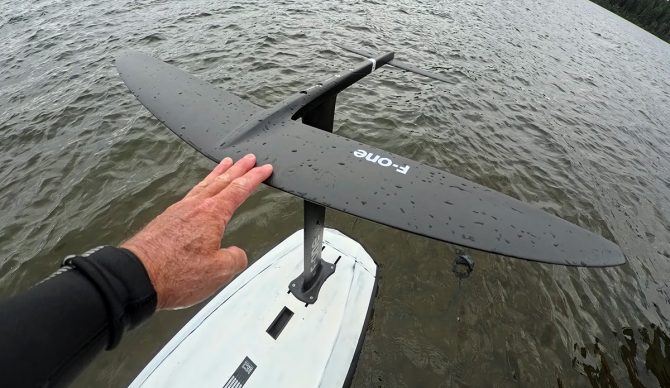
The slender front wing of the Eagle series, this particular version, the 1090. Photo: JC

If you’ve somehow been stuck under a very large rock lately, foiling is gaining both popularity and acceptance in the surfing world. Why? Because you don’t have to sit in a lineup. Or surf a wave near shore. Downwinding, or as I like to call it, “wilderness surfing,” allows you to enjoy swell created by wind far out in the ocean, on a river, or in any lake. Flying from point A to point B is about as much fun as you can have on a board these days. It feels like you’re surfing a cloud, you can absolutely rip, and you’re mostly out there alone, surfing on your own – a very valuable thing in today’s world of overcrowded, post-COVID surf communities.
And foiling is no longer a one-size-fits-all endeavor. Brilliant people working at longstanding, reputable windsport brands are creating insanely rad gear to fit any playing field and ability level. I recently spent a few weeks of my summer testing a foil setup from F-One. The Eagle line of foils from the French brand is built specifically for downwinding and glide, and boy, does it deliver. Read on to learn more.
Check Price on Mackite
Foil shape matters a lot. Aspect Ratio doesn’t tell you everything about a foil, but it’s a good rule of thumb to start with. Photo: F-One.
Foil Sizing
First, an uber-dummy’s guide to foils. Basically, the bigger the front wing and tail piece, the easier it is to get on foil and fly. But also, with that girth, it makes the foil much less maneuverable and more difficult to make tight turns on. Think of a surfboard: the bigger it is, the easier it is to catch waves, but the tougher it is to perform on.
In general, the size of foil you use is catered to the conditions you find yourself in, as well as your weight and ability level. Sizes from company to company are most often measured in square centimeters, and usually increase in 100-square-centimeter increments. A 1400 would be a good-sized front wing for intermediate riders, or smaller beginner riders. An 800, well, would be small, and best-suited to those with the skills to make use of the speed and turnability of such a slick ride.
Another factor in how the foil performs is the Aspect Ratio (AR). High-aspect foils, like the Eagle with an AR of 9.5, are best-suited for downwinding, racing, and glide, due to the narrow profile that slices through the water. Low-aspect foils, like the F-One Phantom with an AR of 6.5, provide smoother turning and better lift at slower speeds, while sacrificing some of the glide of a higher-aspect foil.
Mast sizes these days vary, from smaller masts around 70 cm for surf foiling or towing behind a boat, where speed is less of an issue, to larger masts of 80, even 90 cm, for foiling in high-wind conditions where bouncing over windswell and heeling over for speed are important.
Like I said, an uber-dummy’s guide (you can also check out our full buyer’s guide to foils, here).
Testing the F-One Eagle 1090
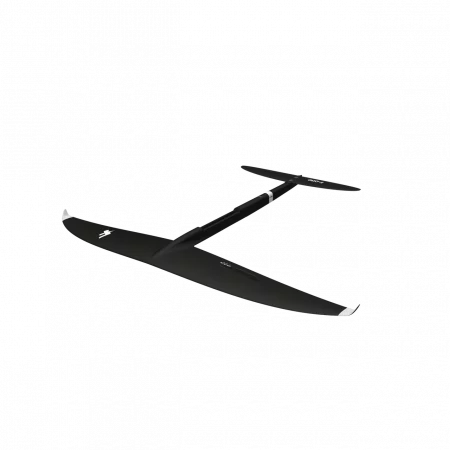
Available Sizes: 690, 790, 890, 990, 1090, 1290 cm
Aspect Ratio: 9.5
Material: Monobloc High Modulus Carbon
Recommended Stabilizer: DW210
Best For: Downwind, Wing Foil, Parawing
F-One’s Eagle line is built for speed and glide. Namely: catching swell, making turns, and then being able to maintain glide and get into the next bump to continue your flow. With my testing conditions, I used the Eagle 1090 front wing, with the 210 rear wing, just because I need a little more lift as a larger human being. I combined the two with the 80 cm Carbon 14 mast.
Ho Nelly, was it ever fun. The float, glide, and smooth feeling of this lightweight carbon setup was so nice. In my testing location, there is not a shuttle option (where riders coordinate to drive upwind and then foil downwind), so I had to foil upwind for almost a mile to make my downwind laps. The upwind capabilities of the Eagle series are solid as well, and I had no problem making the upwind trek.
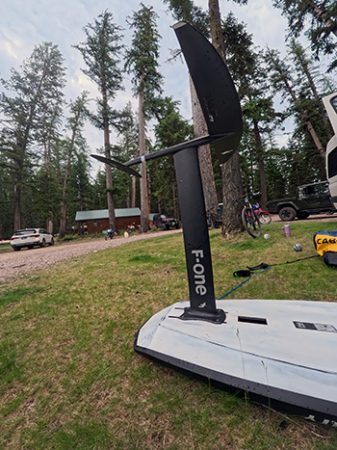
While the narrow nature of the front wing might make it a tad more difficult for the uninitiated to get on foil to start, once up, there was no denying the downwind agility of this foil setup. Turns were so silky, and dropping the wing and still making it bump-to-bump was really fun. I can’t emphasize enough how smooth the Eagle setup felt. The full carbon wing and mast were right around eight pounds.
Other Foils from F-One
From a technical standpoint, the Eagle series really wants a bump of swell or some sort of power source to truly be in its element. I think there are other foil setups from F-One you can look into if you’re not running downwind (or catching tanker waves), like the Phantom for all-around riding and freestyle, or the SK8 for surf. More experienced downwind foilers should look at the thinly profiled Eagle X series, which increases speed, both top and average.
Final Thoughts
F-One is one of the top manufacturers of the foiling world, so this setup is not cheap (just over $2,000). But if you’re ready to make a real investment in “wilderness surf,” whether it’s wing, SUP, or parawing foiling, then the Eagle foil rig will provide you with many happy returns.
Check Price on MackiteRelated: The Best Wings for Wing Foiling | The Best Foils | More Foil Gear Reviews

