
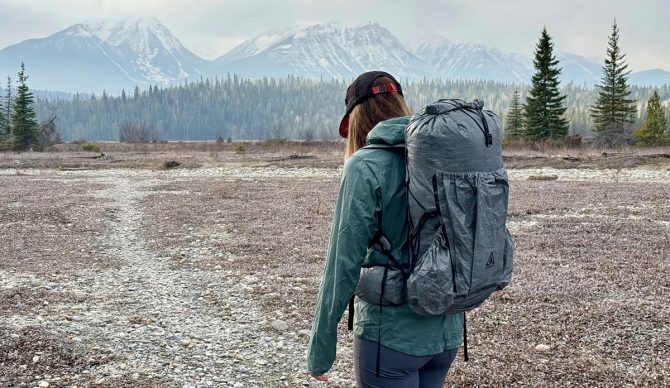
The pack with the new material is available through Durston. Photo: Durston//Aluula

Enjoying a remote slice of nature is constantly getting more comfortable and convenient. The days of lugging bulky, heavy supplies into the backcountry are long gone as technology makes equipment lighter, more durable, and more practical. One of the latest innovations is a new type of fabric that is light, stronger than steel, waterproof, recyclable, and soon coming to backpacks near you. It’s called Graflyte.
Produced by the Canadian start-up, Aluula Composites, Graflyte is primed to set a new standard in the backpacking market thanks to a state-of-the-art construction process. The fabric is woven using ultra-high-molecular-weight polyethylene (UHMWPE for short), which in itself is not a new material, but Aluula has created a new heat-bonding process that doesn’t require adding polyester film to the UHMWPE, as the current market leading material, ‘Ultra,’ does. The result is a lighter material with, according to Aluula’s in-house testing, a superior strength to weight ratio that is eight times stronger than that of steel.
The fabric weighs in at, depending on the version, between 1.53 and 2.89 ounces per square yard. (Note that no official testing data has yet been released to the public.) Ultra, on the other hand, weighs between 3 and 3.5 ounces per square yard.
There are also other reasons to be excited about this breakthrough. Graflyte doesn’t need to be sewn together. It can be heat-bonded to itself, which could be used to create 3D structures with a single piece of fabric and completely change the way backpacks are constructed. The tech is already being utilized in wings used for foiling in the wind. Plus, given that the fabric is composed of a single material, it is able to be recycled, as opposed to other competing fabrics that use multiple materials, which renders them un-recyclable. The recycled material could, in theory, be used for backpack suspension systems or for applications in other industries.
“If you want a waterproof bag, right now you have to cut it, sew it, and seam tape it,” said Dave Westwood, Aluula’s Director of Partner Innovation & Design. “As you get more advanced bonding techniques, that’s going to change. I think our fabric is a step closer to that.”
Graflyte will not be available on the open market for manufacturers to purchase. Aluula will, instead, seek out partnerships with existing brands to give them exclusive access to the fabric. Preorders on a Graflyte-containing backpack are already available via a partnership with Durston.
“We want to have a really solid group of partners that we can develop with,” said Westwood. “Our launch process is going to be measured, and we want to make sure it’s right when it goes out the door.”
In the world of backpacking where every ounce (or even gram) carried is an extra burden on your body, a new, lighter material will surely be welcomed to the market. We will see how this plays out when Graflyte-constructed packs start appearing on the open market and undergo the scrutiny of adventure.

