
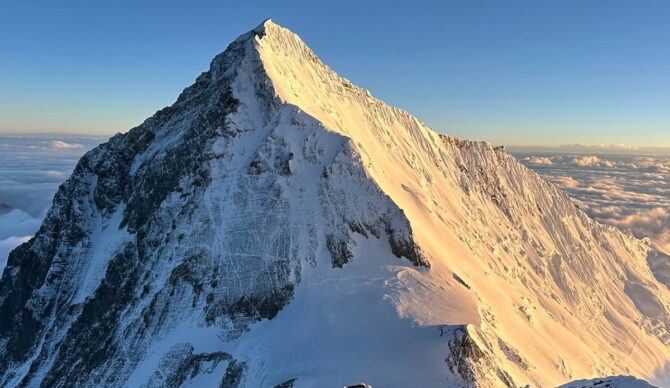
At least one Everest guide thinks not enough is being done to mitigate risk on the world’s highest mountain. Photo: Furtenbach Adventures//@herbertwolf6401//Facebook

A Mount Everest guide thinks sweeping changes are necessary on the world’s highest mountain after a Sherpa guide was abandoned without a search operation. More climbing experience and mandatory safety measures are among the recommendations.
Lukas Furtenbach, the founder of the mountaineering guiding company Furtenbach Adventures, who made headlines last year for his use of experimental gases, posted a list of 12 changes he wants to see on Everest to increase safety. Of the 496 Everest climbing permits issued in Nepal, Furtenbach’s company safely got 71 clients to the summit without any accidents. Five climbers in total perished on the mountain in the past weeks.
An expedition with Furtenbach’s team to Everest costs between €77,000 to €200,000 (USD $88,000 to $231,000), more than other operators who charge fees as low as $45,000.
The miraculous survival story of Dawa Sherpa triggered the call for reform. The 52-year-old guide went missing on Everest on May 29 above Camp 3. He was considered deceased, and no search and rescue effort was carried out until six days later, when a different guiding company dispatched a helicopter. The guide was discovered on June 4 at the Khumbu Icefall above Base Camp. Despite falling into a crevasse, he had managed to climb down the mountain under his own power and is reportedly in stable condition.
“The incredible survival story of Hillary Dawa Sherpa made one thing painfully clear: Everest needs change,” Furtenbach wrote.
Furtenbach believes that the mountain would become safer if novices were removed from the equation. He thinks it would be reasonable to require climbers to summit a 6,500-meter (21,300 feet) mountain before being eligible to climb Everest. He also believes that guides should be required to have training and meet certain qualifications, which he says are generally practiced by Western guides but not entirely by Sherpas. In the case of Dawa, he was a camp cook who, for unknown reasons, was asked to guide clients to the top of Everest.
View this post on Instagram
Improvements in gear and protocol safety would also mitigate risk, Furtenbach said. Those include minimum oxygen requirements, improved rescue infrastructure, mandatory rescue protocols, independent oversight at basecamp without commercial interests, and backup oxygen systems. He also said that no one — guide nor client — should be left alone, stating that clients are also responsible for guides’ safety when in need.
“Everest will never be completely safe,” Furtenbach said. “That’s not the nature of high-altitude mountaineering. But many tragedies are preventable if the industry, operators, and authorities focus less on politics and profit, and more on realistic safety standards, accountability, and experience. We owe that to every person on the mountain — and to those who never came home.”

