
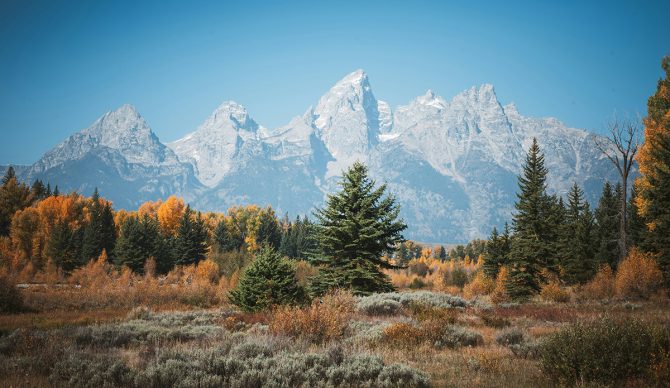
Cutting new trails up the Grand Teton? Definitely a no no. Photo: Clayton Chase//Unsplash

A federal court found runner Michelino Sunseri guilty of cutting a switchback during his speed record attempt of Wyoming’s 13,770-foot Grand Teton. The judge has ruled out jail time, but the misdemeanor carries fines of up to $5,000.
The incident occurred on September 2, 2024, when Sunseri completed the 13.1-mile route with 7,000 feet of elevation gain in two hours, 50 minutes, and 50 seconds, beating the previous record set by Andy Anderson in 2012 by two minutes.
However, Sunseri’s accomplishment was short lived. His own Strava recording and admissions showed he had taken a closed trail to bypass one of the mountain’s largest switchbacks, cutting about half a mile from the route. “I would 100 percent make the exact same choice,” he wrote on Strava, explaining that he took the shortcut to avoid a line of hikers and because past conversations with record-holder Anderson led him to believe it was acceptable.
Fastest Known Time, the de facto record-keeper for speed runs, declined to recognize Sunseri’s Grand Teton effort because of the shortcut. His sponsor, The North Face, initially congratulated him on Instagram but later deleted the post as the controversy grew.
More than a month after the incident, Grand Teton National Park pressed charges against Sunseri, igniting a year of legal proceedings. The National Park Service attempted to walk back their charges, calling it “over-criminalization,” but federal prosecutors went ahead with the case. Legal experts have called the case an example of using “criminal prosecution as a tool for public messaging.”
The specific code that Sunseri violated says, “Leaving a trail or walkway to shortcut between portions of the same trail or walkway, or to shortcut to an adjacent trail or walkway in violation of designated restrictions is prohibited.”
Sunseri’s legal representatives say they intend to appeal the verdict. They argue that the decision is government overreach and that the trail closure was not sufficiently marked.
View this post on Instagram
The closed trail is marked with two signs. At the top, a sign facing uphill reads “shortcutting causes erosion,” and at the bottom, a sign facing downhill reads “closed for regrowth.” Signage has reportedly been installed since the 1980s to indicate the trail closure.
Sunseri’s legal team acknowledged that he was offered several plea deals that would have resulted in admission of guilt or a ban from the park, which they deemed unacceptable because the Tetons are an “integral part” of Sunseri’s life.
Grand Teton National Park has published material that classifies cutting switchbacks as a violation of “leave no trace” policy.
“One step leaves little trace, but many steps degrade or destroy resources quickly,” the park says. “Stay on existing trails. Feet trample plants and compact soil leading to erosion. One misplaced step can destroy a tiny 100-year-old plant.”

