
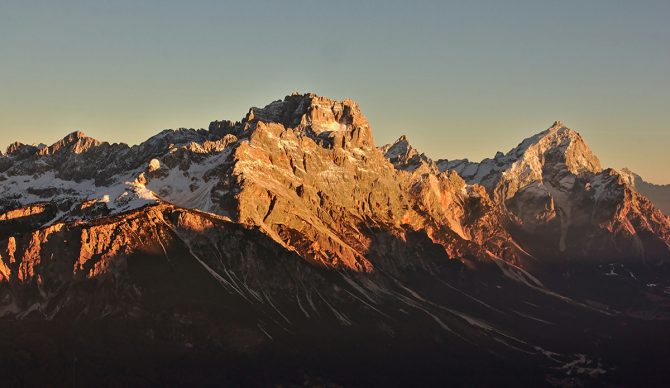
Sunset in the Dolomites. Fair warning: don’t get stranded on closed trails in Italy. It’ll cost you. Photo: Marco Bonomo

A 60-year-old British hiker made a costly mistake when he knowingly entered a closed trail in the Italian Dolomite mountains. The hiker, whose name has not been released, called for rescue due to dangerous rock falls on a trail that had been closed for that precise reason.
Italian rescue crews stuck the hiker with a €14,225 (USD $16,500) fine for their operation that included two helicopters and a dozen specialized staff. The severity of the fine was reportedly a result of the U.K.’s exit from the European Union; two Belgian hikers rescued in the same area a week prior were handed a much smaller bill.
Italian rescue crews said the man passed four warning signs, crawled around a barrier, and ignored other hikers’ advice to turn around. He eventually became stuck on the trail at an elevation around 7,900 feet.
According to the local rescue organization, Veneto Alpine and Speleological Rescue (CNSAS), more than 80 hikers died in the Italian Alps and Dolomites between June 21 and July 23 this year, and five people are still missing. They add that rescue calls have risen by 20 percent compared to last year, in part due to exceptionally extreme weather.
“The operation was made necessary due to hikers neglecting existing signage, which was evidently insufficient to stop people, either due to inattention or an underestimation of the risk,” CNSAS said in Italian on Facebook. “This measure is intended to protect the safety of those in transit, as well as the rescuers themselves, both the helicopter rescue crews and the teams on foot.”
Rescuers took advantage of the situation to warn other hikers.
“What happened (with the British hiker) warrants some reflection,” Giuseppe Dal Ben, the commissioner of the health authority, told reporters. “Helicopters are essential for time-sensitive operations in harsh environments. Precisely for this reason, it is important that they are not used as taxis, endangering not only those who are providing the assistance but those who actually need it.”
Hikers having to pay for their rescues is a policy that’s been gaining popularity at parks around the world.
In May, a Japanese mayor called for off-season hikers to pay for their own rescues on Mount Fuji. Hikers in a closed area of Alberta, Canada were asked to pay $18,000 when rescuers deemed they weren’t in danger. In 2021, New Hampshire hikers were fined $5,000 for a rescue. U.S. states such as Hawaii, Idaho, Maine, Vermont, and Oregon have all passed varying legislation allowing them to shift rescue costs onto those requesting assistance.

