
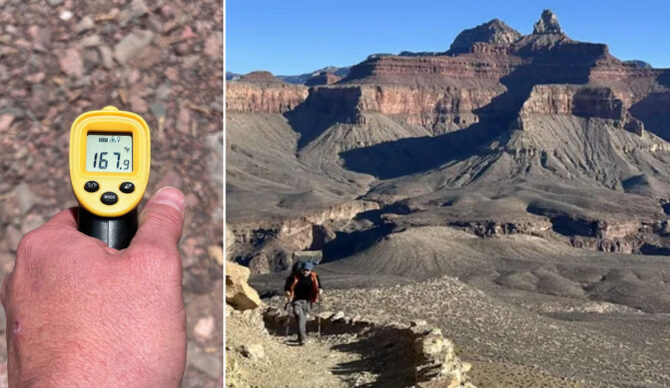
Three hikers died over the course of a few days due to skyrocketing temperatures in Grand Canyon National Park. Photos: NPS

Three hikers died in a matter of days after temperatures skyrocketed in Arizona’s Grand Canyon National Park.
According to reports, the first of the hikers to succumb to the heat was a 72-year-old man who suffered from “symptoms of heat-related illness” on June 12 while he was hiking the South Kaibab Trail. Four days later, a man and a woman died on the North Kaibab Trail. The latter pair were 67 and 68. None of the victims’ names had been released at the time of this writing.
“In both cases, the deceased hikers were hiking trails in the Inner Canyon, where temperatures can exceed 109 [Fahrenheit] in the shade during midday hours,” a June 19 press release from Grand Canyon National Park (GCNP) explained. “Despite rapid response and aerial support, all three individuals were found deceased when responders arrived.”
All three of the bodies were taken to the Coconino County Health and Human Services Medical Examiner’s Office in Flagstaff, Arizona. While temperatures in Grand Canyon National Park are known to be dangerous at times, it’s still relatively early for temperatures to be this extreme.
“Summer temperatures in the Inner Canyon have reached dangerous levels, creating conditions that can quickly overwhelm hikers during the hottest parts of the day,” the GCNP said.
In the wake of the deaths, the National Park Service is asking would-be hikers to stay off the Inner Canyon Trails during the hottest parts of the day.
“Grand Canyon National Park is reminding visitors that summer hiking below the rim should be limited to the early morning and evening hours,” a press release from the National Park Service reads. “Due to a recent influx of heat-related incidents and forecast extreme temperatures, visitors are strongly advised to avoid strenuous hiking between 10 a.m. and 4 p.m., when Inner Canyon temperatures can soar to 109°F (43°C) in the shade.”
The park is huge, and despite the skills of emergency responders, accessing anyone in trouble can be a struggle.
“Heat-related illnesses can develop suddenly, and a visitor’s condition may deteriorate rapidly,” the press release continues. “Visitors should be prepared to self-rescue by recognizing the signs of heat illness and taking immediate steps to slow or stop its progression. Symptoms of heat-related illness include, but are not limited to, headache, disorientation, and confusion. If you or someone you know is experiencing these symptoms, stop activity and seek shade immediately. If you suspect someone is experiencing a heat-related illness, do not leave them alone if it can be avoided.”

