
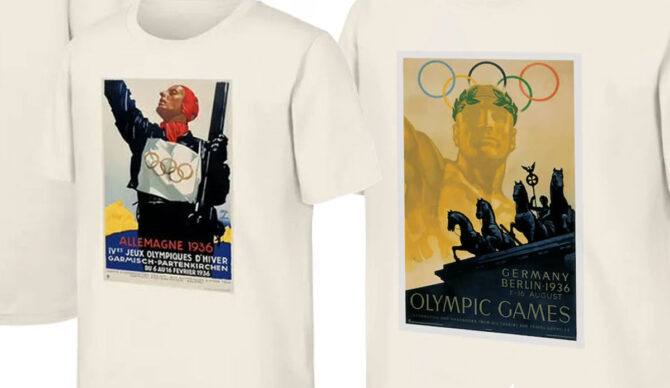
These shirt designs have led to criticism of the IOC: Left, the 1936 Winter Games shirt, and right, the 1936 Summer Games shirt. Photo: Olympic Games shop

The International Olympic Committee (IOC) removed t-shirt products from its online store featuring images of the 1936 Summer and Winter Olympic Games after receiving criticism from groups within and outside of Germany for their connection to Adolf Hitler and Nazi ideology.
The shirts in question feature posters from the 1936 Berlin Summer Games and the Garmisch-Partenkirchen Winter Games (they took place in the same year). The Berlin shirt depicts a male with a laurel wreath behind the city’s iconic Brandenburg Gate. The Garmisch-Partenkirchen shirt features a skier with skis in his left hand, and his right arm extended to the sky, out of the frame, in what resembles a Nazi salute.
The IOC initially defended the shirts in media reports, acknowledging the horrors of the Nazi regime, but highlighting the thousands of athletes who competed in those Games. Before being taken down, the shirts were listed as “out of stock,” prompting questions as to who would collect such Nazi-era items.
“While we of course acknowledge the historical issues of ‘Nazi propaganda’ related to the Berlin 1936 Olympic Games, we must also remember that the Games in Berlin saw 4,483 athletes from 49 countries compete in 149 medal events,” an IOC spokesperson told The Athletic. “Many of them stunned the world with their athletic achievements, including (American sprinter) Jesse Owens. The historical context of these Games is further explained at the Olympic Museum in Lausanne.”
“For the 1936 edition, the number of T-shirts produced and sold by the IOC is limited, which is why they are currently sold out,” they continued.
When The Inertia reached the IOC for comment, they said using the artwork from the 1936 Games is a question of property rights.
“The IOC has a responsibility to safeguard Olympic Intellectual Property (IP) and ensure it is managed respectfully over time,” a spokesperson said via email. “This stewardship relies amongst other things, on IP rights, including trademarks, which are held for all editions of the Olympic Games and their respective key assets, including for Berlin 1936. The validity of these trademarks depends on their actual use. If they are not used by their owner, other parties could use them for their purposes.”
“As part of this responsibility, the IOC maintains an Olympic Heritage Collection that reflects more than 130 years of Olympic art and design,” they continued. “This collection presents assets such as emblems, pictograms, posters and mascots from every edition of the Games as historical artefacts. Maintaining a use of these historical elements also helps ensure they are not abused. In recent years, this stewardship has enabled the IOC to reduce widespread unauthorized third-party use of 1936 Games related assets.”
The IOC did not clarify why the item is no longer listed in the online store.
While the 1936 merchandise has nothing to do with the 2026 edition of the Games taking place in Milan and Cortina d’Ampezzo, Italy, the spotlight of the Games led to the scrutiny of the online store.
Klara Schedlich, a spokesperson for sports policy for the Green Party faction in the Berlin House of Representatives, told the German press agency, DPA, that the image choices were “problematic and unsuitable.”
“The 1936 Olympic Games were a central propaganda tool of the Nazi regime,” said Schedlich.
Christine Schmidt, co-director of the Wiener Holocaust Library in London, also publicly criticized the shirts to CNN.
“The Nazis used the 1936 Olympics to showcase their oppressive regime to the world, aiming to smooth over international relations while at the same time preventing almost all German-Jewish athletes from competing, rounding up the 800 Roma who lived in Berlin, and concealing signs of virulent antisemitic violence and propaganda from the world’s visitors,” Schmidt said.
“The Nazis’ fascist and antisemitic propaganda infiltrated their promotion of the games, and many international Jewish athletes chose not to compete,” she added. “The IOC would be minded to consider whether any aesthetic appreciation of these games can be comfortably separated from the horror that followed.”
Editor’s note: This article was updated with the IOC’s response on February 19 at 8:05am PST.

