
Investigators are looking at clues from the Skull Rock trail to locate where the historic Palisades Fire started. Photo: CalFire

An investigation team from the Bureau of Alcohol, Tobacco, Firearms and Explosives has started examining the source of the Palisades Fire to determine the cause of the devastating blaze. However, preliminary research has already created two leading theories: It was either started by human activity or a flare-up from a previously extinguished fire on New Year’s Eve.
In a recent report published by the LA Times, anonymous sources said that early indications suggest that the fire appears to be caused by human activity unrelated to the New Year’s Eve fire. The source of the blaze is near a popular hiking destination called “Skull Rock.” The sources also noted that the investigation is ongoing.
Videos posted online show a group of young men running from the blaze shortly after it started. The man who posted the video had at first agreed to speak with the New York Times, but then stopped responding to messages and deleted his account on X (Twitter). The videos do not show any indications that they started the fire, just that they were near the scene when it ignited.
The Washington Post published a report that leans more into the flare-up theory. On New Year’s Eve firefighters responded to a brush fire in the same vicinity as the source of the Palisades Fire. This first, smaller blaze is known as the Lachman Fire and is believed to be caused by fireworks. It was successfully extinguished within four hours without any damage to nearby homes.
On Tuesday, January 7, blustery Santa Ana winds of 80 miles per hour were howling over the Lachman Fire’s burn mark. Experts who spoke to the Washington Post said it’s “conceivable” that the winds reignited the fire, pointing to a research paper that shows fires can smolder for up to ten days after they have been put out. The devastating 2023 fire in Lahaina, Maui started in this fashion with the blaze spreading several hours after the initial incident had been extinguished.
L.A. Fire Department Captain Adam VanGerpen said in an interview that it’s not common protocol to leave firefighters to monitor an extinguished blaze, especially a week after a fire. Thus, there were no subsequent check-ups on the burned area of the Lachman Fire once it was determined to be safe.
Downed power lines do not appear to be a leading culprit early in the investigation. The nearest poles to the blaze were photographed still standing when the Palisades Fire had already started, and according to the Post’s conversations with the Los Angeles Department of Water and Power, “the lines (in question) had been de-energized for five years.”
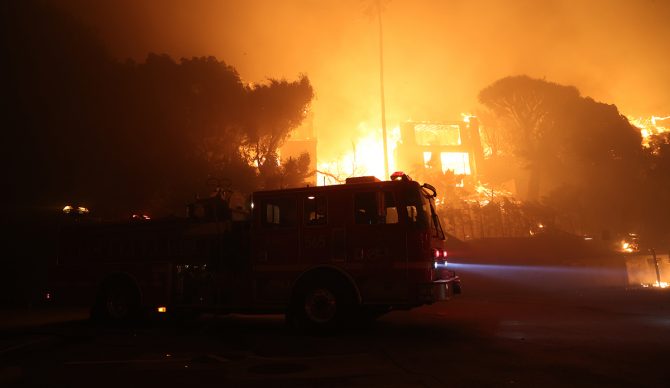
As of the morning of January 13th, the Palisades Fire has reached nearly 24,000 acres, destroyed an estimated 5,000 structures, claimed eight lives, and is 14 percent contained. The scope of the damage is yet to be fully assessed. The ongoing fires in Los Angeles are on pace to be the costliest in U.S. history with a loss of up to $150 billion.
For information on how to help those affected by the fire, click here.

