
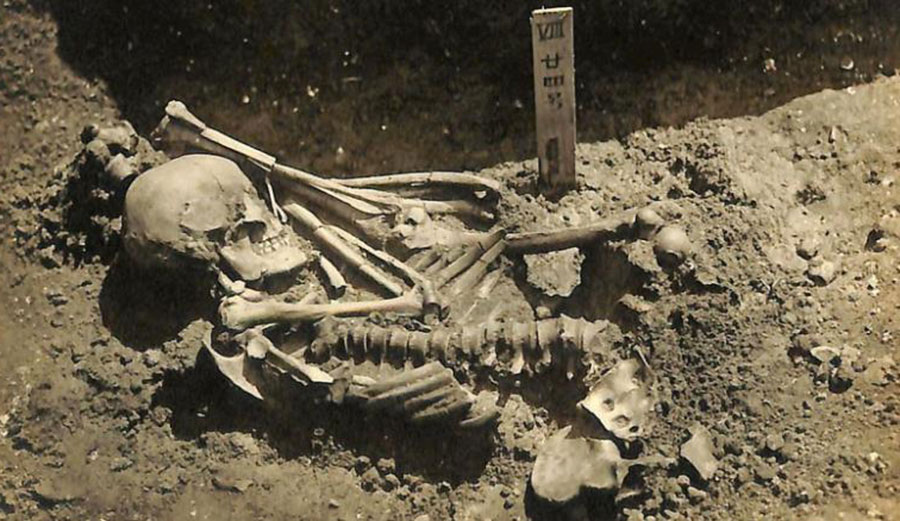
The man is the oldest known victim of a shark attack. Photo: Laboratory of Physical Anthropology, Kyoto University

Sharks have been around for about a hundred million years. That’s a long time, and in all those years, they have evolved into one of Earth’s most perfect hunters. Luckily for us, with our flailing arms and legs and ridiculously bad swimming skills — relatively, at least — we would be the easiest of prey. And about 3,000 years ago, researchers believe a man became the earliest victim of a shark attack ever found. Radiocarbon analysis shows that the man died between 1370 BC and 1010 BC.
Scientists from the University of Oxford found the man while they were excavating the Tsukumo site near Japan’s Seto Inland Sea. Upwards of 790 injuries were found, including, “traumatic injuries to his arms, legs, front of chest, and abdomen.”
When they first found the remains, researchers were baffled. Nearly 800 wounds is a lot of wounds, after all. “We were initially flummoxed by what could have caused at least 790 deep, serrated injuries to this man,” said researchers J. Alyssa White and Rick Schulting in a statement. “There were so many injuries and yet he was buried in the community burial ground, the Tsukumo Shell-mound cemetery site.”
After examining the remains, the researchers came to the conclusion that the man was likely alive at the time of the attack. His left hand was missing, which is likely to be a defensive wound. After the attack, his body was retrieved and buried.
“We suspect that the man was probably out fishing with some companions in the Inland Seto Sea in southern Japan. They could have been fishing from a boat, or diving for shellfish,” Schulting explained. “Perhaps they were even hunting sharks, as shark teeth are sometimes found in Jōmon archaeological sites. One or more sharks — we suspect one but can’t be certain about that — attacked the man either while he was already in the water, or perhaps he lost his balance and fell, or was pulled overboard if the shark was on a fishing line. This would not have been a small shark.”
According to CNN, the injuries were sharp, deep, and v-shaped. Before they decided it was a shark attack, they eliminated every other option. Three-thousand years ago, the Jōmon culture hunter-gatherers who lived in the area used metal tools that could have caused the injuries, but the timeline didn’t quite match up. They also looked at land predators, but those tooth-marks weren’t consistent.
The researchers say it’s most likely that the attack was either a tiger shark or a great white. We have only a handful of confirmed shark attacks dating far back on the historical record. Since humans weren’t in the sea nearly as often as now, shark attacks simply didn’t happen very often. Much like today, sharks just weren’t interested in humans, either. But as humans venture into the sea more frequently now, the frequency of shark attacks has risen — and it’s still extraordinarily low.
“There are very few known examples of shark attacks in the archaeological record,” Schulting told CNN. “The main reason that so few cases are known is simply because they were so rare. Even today, with so many more people in the world, only a handful of lethal shark attacks occur each year.”

