
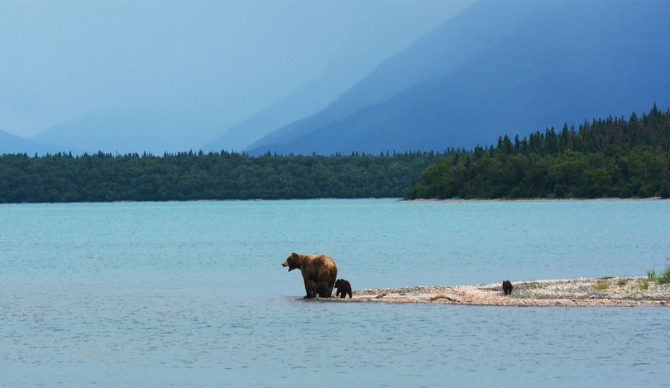
A mother bear teaches her cubs to swim on the edge of Naknek Lake, in Alaska’s Katmai National Park. Photo: Unsplash

On October 2, an elk hunter just outside of Cranbrook, British Columbia was attacked by a sow grizzly. Although he managed to escape with his life, his injuries were so severe that he succumbed to them on October 25.
Joe Pendry, who was 63, put up one hell of a fight. The CBC said that his “rare survival from the initial attack was chalked up to his experience as a boxer and outdoor hunting guide.”
The attack happened after Pendry accidentally came across the mother bear and her two older cubs. Bears, and especially grizzly bears, are fiercely protective of their young. According to Pendry’s wife Janice, her husband did manage to shoot the charging bear once in the leg but was unable to stop it. She told the Canadian Press that ” he punched and even bit the animal’s ear as he fought for his life, suffering gruesome injuries that include his lips and part of his scalp being torn off, losing a finger and a broken nose, broken cheekbones, two broken arms and broken ribs.”
After the bear left him alone, he was able to call 911 as well as his son. He was flown to the hospital in Kelowna, a city about 170 miles from Cranbook. Once there, he underwent multiple surgeries in an attempt to repair the damage done by the bear, but sadly, he developed a blood clot and passed away.
The B.C. Conservation Officer Service reported via social media that it found a dead grizzly bear in the area a few days later.
“The COS recovered the bear and through DNA analysis were able to confirm that this was the bear involved in the attack,” the service wrote in its post. The bear died of sepsis, likely from the gunshot would.
The cubs, which were not newborns, could be old enough to survive on their own — generally grizzly bears will stay with their mother for four or five years — but it’s not known for sure exactly how old the young grizzlies are.

