
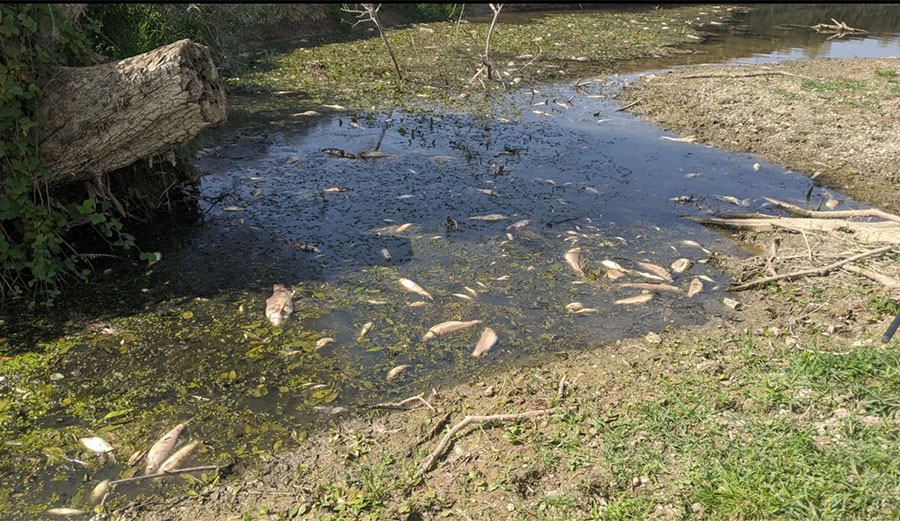
Several tons of dead fish washed up in a river downstream from a Nestlé plant in France. Photo: Ardennes Fishing Federation/Facebook

In early August, several tons of dead fish washed up along a river downstream from a Nestlé plant. Now, Nestlé’s getting sued. The Ardennes Fishing Federation has filed a complaint against Nestlé France “for pollution and violation of article 432.2 of the environmental code.”
A few days ago, I was diving for crayfish off our dock. They’re fun little critters to catch, with tiny little snapping tails and minuscule pinchers, and if you catch enough, they’re delicious. I often throw a few chunks of raw chicken or bacon off the dock, let it sink to the bottom and, after a few minutes, grab as many as I can. Another thing I use to bait them is a partially-opened tuna can. A month ago, I threw one in, caught some crays, and promptly forgot about the can. Two days ago, I dove down to get it. It was there, 20 feet down, partially buried, so I brought it to the surface. My first inhale included a wave of rancid tuna. Incredibly rancid, made worse by the sudden influx of oxygen. I gagged, choking on the smell. It was horrendous, as you can imagine. Now, imagine that smell if it was multiplied by a few thousand and baked in the sun. That’s the smell that likely permeated the air in northeastern France recently.
According to the French department of Ardennes, just over two tons of dead fish were removed from the Aisne River. They’d been there for a while, and Europe has been hotter than average this year. That, of course, means all those fish were rotting, and the smell was… bad.
For days, volunteer fishermen and firefighters were tasked with the cleanup job, carting away the stinking carcasses truckload after truckload. A local fishing federation looked into what may have caused the massive die-off, pointing their scale-covered fingers directly at Nestlé. They say that wastewater from the Nestlé factory in Challerange, which makes powdered milk for Nescafé Dolce Gusto coffee pods, dumped a bunch of fish-killing stuff directly into the river.
“I’ve been with the federation for 40 years and I’ve never seen pollution this bad,” Michel Adam, president of the Ardennes Fishing Federation, told Agence France-Presse (AFP). “Everything is dead in an area seven kilometers long and 30 meters wide,” he said. “We have three tons of dead fish. On top of that, there are 14 protected species that have been affected such as the eel or lampern.”
In a possibly related incident, several more tons of dead fish were found in Belgium. Nestlé admits they played a role in the spill, telling AFP that there was an “overflow of biological sludge effluents, without the presence of chemicals” from its wastewater treatment plant on the evening of August 9.
“As soon as we learned of the report on Sunday at 11 p.m., we immediately stopped production and put an end to the spill,” said Nestlé site director Tony do Rio. “This spill was occasional over a period of fewer than three hours on Sunday evening.”

