
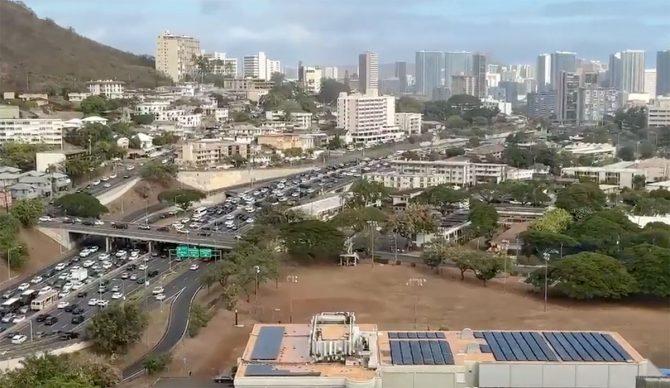
The H-1 was jammed as people in Hawaii fled the coastline under a tsunami evacuation order. Photo: YouTube//Screenshot

After one of the strongest earthquakes ever recorded hit Russia’s far east on July 29, tsunami warnings were issued for Hawaii, Japan, and parts of the U.S. West Coast. Thankfully, no major damage has been reported.
The earthquake, which measured 8.8 (previously recorded as 8.0 and then 8.7) on the Richter scale. For comparison, the 2011 Tohoku earthquake in Japan was a 9.0. It caused a tsunami that famously caused meltdowns at the nuclear power plant and killed nearly 20,000 people.
Now, a day later, it appears that the worst has passed for the U.S., Russia, and Japan. Although thousands fled to higher ground in the affected areas and parts of Russia’s Kamchatka peninsula flooded, only a handful of injuries appear to have occurred.
In Hawaii, streets were jammed with traffic as people attempted to leave coastal areas. In Japan, evacuation centers were packed, as were many of the hilltop parks.
Although tsunami advisories are still in place at the time of this writing, U.S. Secretary of Homeland Security Kristi Noem said the worst was over.
“We were fully deployed and ready to respond if necessary but grateful that we didn’t have to deal with the situation that this could have been,” she told reporters.
Now, unusually strong currents especially in places like the San Francisco Bay Area are expected. Russia’s Oceanology Institute reported tsunami waves as high as 10 to 15 meters (30 to 50 feet) along the Kamchatka coast, but the area is sparsely populated. The earthquake itself hit at 11:24 a.m. in Kamchatka at a depth of 13 miles, about 80 miles from Petropavlovsk-Kamchatsky, Kamchatka’s regional capital. As is generally the case, it was followed by multiple aftershocks, the strongest of which measured at a magnitude of 6.9.
Hawaii downgraded the tsunami warning to an advisory level early on Wednesday morning, and evacuation orders on the Big Island and Oahu have been lifted. Still, though, residents and tourists are being warned to remain vigilant.
“As you return home,”said James Barros, administrator of the Hawaii Emergency Management Agency, “still stay off the beach and stay out of the water.”

