
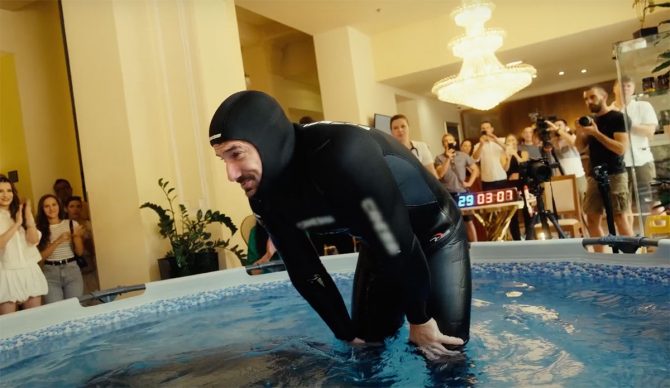
Vitomir Maričić moments after holding his breath for an incredible 29 minutes and three seconds. Photo: YouTube//Screenshot

Vitomir Maričić, a freediver from Croatia, did something incredible on June 14: he held his breath for 29 minutes and three seconds, shattering the previous world record by nearly five minutes.
For context, a bottlenose dolphin can hold its breath for about 8-10 minutes. Not to take away from his achievement but Maričić did have a bit of a leg up in the form of pure oxygen, which he breathed for 10 minutes before the attempt.
Maričić, achieved the record in what essentially looks like a pool set up in a hotel banquet room. You can hear what he has to say about the record in the seven-minute video covering the event, below. It was definitely an incredible achievement.
But perhaps the most interesting aspect of it all is the breath holding, and the science behind it. There are tiny clusters of cells in the brain and neck called chemoreceptors, which react to the level of carbon dioxide (CO2) and oxygen (O2) in the blood. They’re supposed to maintain the correct balance, and they tell the body when it needs to regulate that balance. When you’re holding your breath, the CO2 levels rise while oxygen levels drop. Weirdly, though, we actually have quite a bit more time than the body would lead us to believe. After a certain point, the body begins to fire the diaphragm, contracting it involuntarily in a way that you’ve probably felt if you’ve been held under for an uncomfortable amount of time. Usually, an untrained breath holder will listen to that signal and begin to breath, but you’ve generally got more time before you actually need to take in air.
But when you huff pure oxygen, as Maričić before his record attempt, a few things happen. First, that involuntary contraction of the diaphragm is delayed, but there’s no signal of dropping oxygen. The blood is still full of it. It should be noted here that breathing pure oxygen is extremely dangerous and can lead to oxygen toxicity, which can be fatal. Don’t do it unless you’re a competitive freediver under close medical supervision.
“Still, even with 100 percent O2, CO2 (the primary stimulus for breathing) rises during the breath hold,” explained Anthony Bain, an associate Professor of Kinesiology at the University of Windsor. “However, fortunately for the oxygen-assisted breath holder, elevated blood O2 blunts the chemoreceptor response to CO2. The combined effect of an absent O2 response, and a dampened CO2 response, allows someone to hold their breath for much longer.”
That’s not to say that you or I could hold our breath for half an hour if we breathed pure oxygen. Even without breathing pure oxygen, Maričić can hold his breath for around 10 minutes. He’s a freediving world champion with a wildly impressive competitive record that includes, for some reason, a 240 kg squat at a depth of 10 meters.
Maričić explained on Instagram that when he began his dive, he had roughly five times more oxygen in his body than average. He didn’t just do it for the record, though. He wants to raise awareness for ocean conservation in the process via Sea Shepherd’s “Fit for the Ocean” fundraiser. It’s something he’s been deeply invested in for a long time now.
“I am involved with Sea Shepherd campaigns and I try to help in any way that I can,” he said in an interview for Seen Blue, a storytelling organization that shares ocean and water conservation stories to inspire positive action. “I am very familiar with current ocean challenges and I am worried, to be honest… Seeing plastic pollution as a big issue is really popular but in my opinion, it is not the greatest threat oceans face. In my opinion and according to some research, overfishing is the number one challenge…It will all come back to us and we will be the ones to experience the consequences of everything we did and did not do today. I feel obligated to try and share this as much as possible with the community and the world.”

