
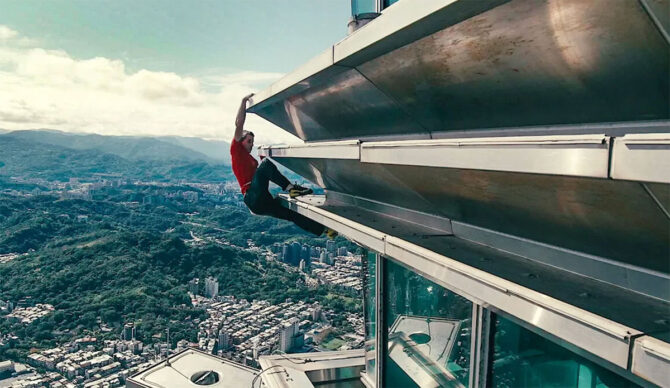
Alex Honnold didn’t die, thank God, but there was a very real possibility that he would. And profiting off of that possibility isn’t cool. Photo: Netflix

When Alex Honnold climbed Taipei 101 live on Netflix, he was risking his life. Millions of people tuned in to Skyscraper Live — 6.2 million, to be exact — and I was not one of them. Oh, I was interested, just like the millions of others. But it felt gross to me. Gross because it seemed that Netflix was capitalizing on the possibility that Honnold could fall to his death.
I’ve spoken with Honnold a few times here and there. He’s a very nice guy. Humble as can be. Confident in his abilities without being cocky. Aware that he’s different, but completely okay with being that way. He’s one of the most self-assured people I’ve ever talked with, and when he was offered the chance to climb a 1,667-foot, 101-story skyscraper, he leapt at it. Not to impress anyone. Not for the money (an “embarrassingly small amount,” according to him). He did it because, in his words, “Any time you could find yourself in a James Bond movie, you should say yes.”
To be very clear: I applaud Honnold for saying yes, because he would’ve climbed Taipei 101 for free. I do not applaud Netflix for airing his climb live to a breathless audience. Honnold, a father of two, faced quite a bit of criticism for his decision to participate in the event, but in his self-assured way, he explained why he was doing it.
“There’s definitely a lot of hate online,” he said on Climbing Gold with Alex Honnold. “Like, ‘this is selling out; this is too risky,’ or whatever. Like, ‘think of the family, think of your kids’ and all that kind of stuff. But what I think people should do is put themselves in my shoes, which is basically that I’ve always loved climbing anything that I’m allowed to climb on. I generally try and say yes to any kind of interesting life experience… I remember someone once telling me that you should live your life according to James Bond principles. If you have an opportunity to ride in a helicopter for some reason, you should always say yes. Someone invites you to a black tie gala, you say yes. You just always say yes to life experiences. Between a deep love of climbing and a say-yes attitude, yeah, you just say yes to something like this.”
One might think that a live event added unnecessary pressure onto Honnold’s shoulders — and that certainly might be the case for someone concerned with what an audience thinks — but Honnold simply ignored it all. The live aspect, however, is exactly what made this so tantalizing to viewers – could the greatest climber of this generation make a mistake and fall to his death on live television? Yes, he certainly could. That’s at least part of the reason that many in the audience watched. That’s part of what paid the bills for Netflix. It would have been a JFK moment: people of that generation still remember where they were when they found out Kennedy was assassinated. It’s a morbid time stamp, and do we really need more of those? Like it or not, however, that is a reality of the media space we find ourselves in.
For Honnold, it was all just a fun experience that Netflix was willing to pay him to do. But again, it was an example of the lengths media will go for views. We here at The Inertia — or any media outlet, for that matter — are not immune to the chase for clicks, so this might seem a little hypocritical, but there are levels to it. This was on a whole different level. There was a plan in place if Honnold fell. The broadcast ran with a 10-second delay so that the viewers might not see the awful ending. According to the Hollywood Reporter, “Coincidentally (and morbidly), it’s exactly as long as a free fall from the top of Taipei 101 would take.”
Even with the delay that ensured that Honnold’s death wouldn’t be broadcast live to the world, the audience would still see a cut to black and their imagination would fill in the blanks. The morbid thrill in the knowledge that he died would still be there. Elle Duncan, the host of Skyscraper Live, explained that she was handed a notecard in the moments before going live telling her what to say in the event of an accident.
“There’s something to be said when five minutes before you go on air, someone slides you a card of what you’re going to say if a person falls off the building and dies,” Duncan explained on the Awful Announcing podcast. “That was certainly not an experience I had ever had before.”
Thankfully, Honnold completed his climb without an accident. But still, the very fact that watching a man fall to his death on a live broadcast was a possibility feels… bad. It feels bad because although I’m absolutely sure there were people who watched it to see him succeed, there were also people who were rooting for him to fail. Rooting for him to plummet to his death in front of their eyes — and Netflix profited off of that.
I guess, though, it’s not entirely on Netflix. It’s on the viewing public, too. Netflix is a business that exists to create things people want to watch. If it bleeds it leads, as the saying goes, but that doesn’t make Skyscraper Live feel any less gross to me. It might even make it more gross.

