
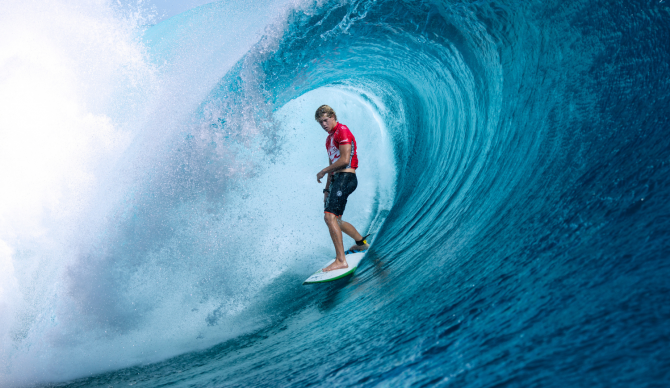
John John Florence looking anything but ridiculous in a Teahupo’o cylinder. Photo: WSL

One of the brightest jewels in the World Surf League’s championship crown is this year’s Tahiti Pro, slated to begin in the second week of August at Teahupo’o, arguably the world’s most spectacular surf spot. Yet regardless of the event’s outcome, competitive surfing fans — at least those passionate enough to comment online — will be sure to find something to complain about. The conditions, the judging, the commentary…Filipe Toledo. It’s as if no matter what happens during the event, even here at Teahupo’o, in these fan’s eyes it will somehow fall short of some arbitrarily established standard of expectation.
Of course, this only shows how little these very demanding competitive surfing fans know about competitive surfing history, which, throughout the decades, and despite occasional moments of high surf and high drama, triumph and tragedy, epic fails and exceptional performances, has always been slightly ridiculous.
Like the time back in the mid-1980s, when the sanctioning powers-that-be held a world championship tour event in Florida, at Sebastian Inlet…during the summer. As in, the flattest season of the year. So flat, in fact, that at one point in the competition, event organizers hired a 45-foot cabin cruiser to motor back and forth outside the torpid lineup, with the hope of kicking up a wake big enough to be considered “contestable.” The sight of future two-time Pipeline Master Tom Carroll sitting on his board in the shorebreak, waiting for the S.S. Minnow to pass by, just might be the most ludicrous moment in competitive surfing history.
Then again, there was the Herbie Fletcher Los Cabos Classic, held in 1991 in fine conditions at Zippers, in Baja’s San Jose del Cabo. Having assembled an impressive lineup of regional competitors, including Kelly Slater, Taylor Knox, Christian Fletcher, Vince del la Piña and Sean and Brian McNulty, Fletcher’s contest had it all…except any tents, flags, a PA system or any kind of timepiece to regulate the length of the heats. Eventually borrowing a Casio watch from surf journo Matt George, Herbie felt the contest was ready to go, until a concerned competitor with better-than-average math skills pointed out that, as scheduled, there were not enough daylight hours in the weekend to complete the event. Herbie’s response?
“Hey, man, you guys are just gonna have to surf faster.”
Surfing fast or not, competitors in the early Makaha International Surfing Championships (1953-1973) only had to worry about surfing farther. For the heats of 15, flags were buoyed offshore at various points in the lineup, and the surfer who connected the most buoys on their ride to shore won the heat. Compared to contemporary WSL priority rules, the idea of more than a dozen competitors jousting for pole position can hardly be imagined; unfortunately, the protocol for settling photo-finishes has been lost to history.
And you want to talk about commentary? At the 1983 Rip Curl Bells Beach Pro, contest organizers sat Aussie legend Terry Fitzgerald in the commentary booth to provide color for a quarter-final heat that just so happened to feature several of his sponsored team riders. Fitzy, his voice amplified, and having a long, storied history at Bells, seemed perfectly justified in pointing out, merely for the benefit of fans on shore, mind you, that “…as you can see, at Bells it’s the third, THE THIRD wave in approaching sets that are generally the biggest. I repeat, THE THIRD WAVE IN THE SET!” I’m sure you get the picture, because Fitzy’s team riders certainly did.
While on the topic of big sets, there was the 1974 Smirnoff Pro, which during a massive winter swell shifted its contest site from Sunset Beach, on Oahu’s North Shore, to Waimea Bay — the very first time a competitive event would be held there. For good reason, at least on this particular day, when a series of fearsome closeout sets prompted a loosely-arranged protest from a number of well-known competitors, both local and international, who questioned the wisdom of sending anyone with scant Waimea Bay experience out into these conditions. Even Waimea pioneer Peter Cole counseled against proceeding. This proved too much for contest director (and 1968 World Champion) Fred Hemmings, who, already having a number of successful Waimea seasons under his belt, dramatically stripped off his shirt, reached for a board, and, to paraphrase, browbeat the trepidatious pros. “Right, if you guys are too chicken,” Hemmings thundered. “Then I’ll go out there and show you how to surf the place.”
Understandably, the protest died…almost as did several of the Waimea virgins, who later suffered the worst wipeouts of their lives.
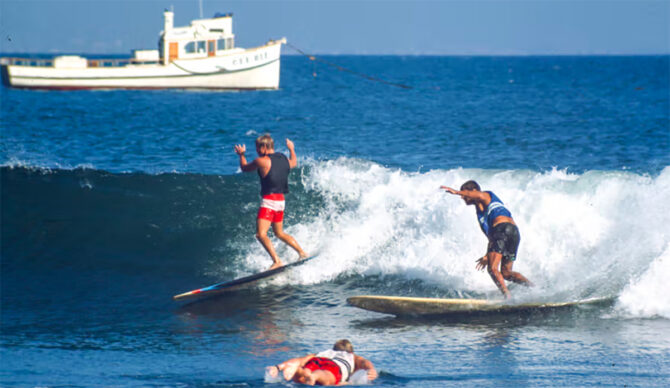
No love lost between Fain and Dora. Photo: Encyclopedia of Surfing
Threats to life and limb, not to mention decorum and personal dignity, were the order of the day at the 1965 Malibu Surfing Association Invitational. First mistake was allowing bitter rivals Johnny Fain and Miki Dora to enter. Second mistake was doing away with any sort of interference rule, actually endorsing an “anything goes” competitive approach. Third mistake was actually holding a final with Johnny Fain and Miki Dora in it. Oh, did I already mention those two? The ensuing SURFER magazine article was titled “The Day War Came To Malibu,” and it sure looked that way from the beach, with Dora shoving Fain off his board, the pair aiming lethal kick-outs at each other’s heads, and, at one point, Fain hurling rocks at “Da Cat” from shore. Despite all the mayhem, however, the dastardly duo must’ve squeezed in some pretty impressive surfing: Dora placed third and Fain runner-up to eventual winner Butch Sutphin (who?), whose strategy of steering clear of the Malibu top-dogfighting obviously paid off.
A different sort of warfare — or at least the sound of it — marked the 1981 Waimea 5000 Pro, held at Prainha Beach, outside Rio de Janeiro in Brazil. Long the acoustic signature of competitive surfing in progress, the irritating, often startling blare of the hand-held pneumatic air horn has traditionally signaled the beginning and ending of heats. Not so at the ’81 Waimea 5000. For some reason, contest organizers chose to use hand-held signal rockets — yes, signal rockets — designed for use by those lost in the Amazon rain forest, when potential rescue depends on being able to shoot three cherry bomb-sized exploding charges high above the dense arboreal canopy. Meaning that, throughout the entire event, international competitors, at least, were never sure if their heat was on, or if the contest site was under a terrorist attack. (Take it from me, a competitor at the event, you never got used to it.)
Then there was this: By the closing round of the 2001 Op Pro Boat Trip Challenge, a free-floating, specialty event held at various breaks in Indonesia’s Mentawai Archipelago, the six pampered men’s competitors had apparently tired of the event’s $127,500 winner-take-all format, deeming it incongruent (although they didn’t use that word) with the traditional bro-vibe of an Indo boat charter. Expressing their solidarity in the finals, held in flawless, six-foot Macaroni’s lefts, Bruce and Andy Irons, Shane Dorian, CJ Hobgood, Tim Curran, and the previous year’s Boat Trip Challenge winner Mark Occhilupo all agreed to surf switch-foot, putting on an impressive, albeit supremely disrespectful, display of surfing.
No ride was judged, however, until late during the allotted time period, when Occhilupo, unbeknownst to the surfers sitting outside, caught two medium-sized waves and ripped them to the channel in his normal, goofy-foot stance. “Know what just happened?” said two-time world champion Damien Hardman, just one of the outraged judges. “Occy just realized that the first-place thirty thousand U.S dollars is almost half the price of a house on the Gold Coast.” By this time, Occy had won his second OP title. In contrast, the women contestants, including Layne Beachley, Serena Brooke, Rochelle Ballard and Keala Kennelly, were all perfectly well mannered throughout the event, with Keala taking home the $22,5000 first-place prize.

