
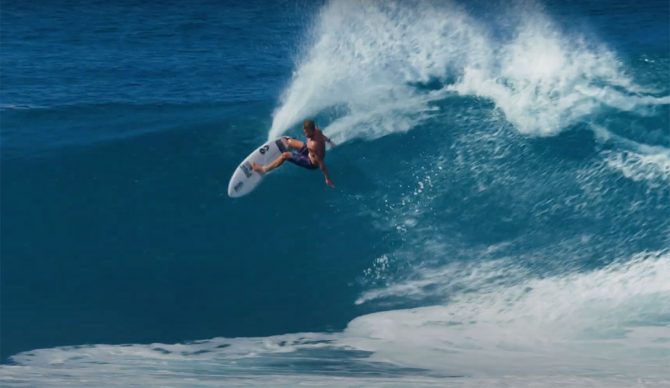
We’ll watch this freesurfer any old day. Photo: Screenshot

The year 2026 started off with a bang as the surfing world (at least that portion of it so fervently covered by pro surfing fanboy sites) was rocked by the news that semi-retired, three-time world champion and eponymous surf brand magnate-to-be John John Florence abruptly reversed his recent decision to jump back on the World Surf League merry-go-round, with the announcement that, after giving it some thought, he was jumping back off the tour.
He’s leaving in favor of provisioning his cruising catamaran and, with his young family on board, sailing around the world in search of adventure and uncrowded, semi-secret surf spots. Having manifested a lavish lifestyle that affords him, so far as being a professional surfer, at least, unprecedented freedom of choice, and by successfully doing so embodying a post-modern incarnation of the “freesurfer.” An archetype that, while often presented as relatively new, does, in fact, have a history that goes back…well, okay, a few decades at least.
Used to be except for the price of hardwood, and later balsa, all of surfing was free. That was its appeal. With the exception of early 20th century professional surfing pioneers George Freeth and Tom Blake, both of whom appeared to earn a living doing nothing but surfing, but who in actuality worked hard putting on demonstrations, lifeguarding, and, in Blake’s case, promoting personal brands, getting paid solely to do so never entered the picture. Even with the advent of organized surfing competition in the 1950s and early-1960s, cash only flowed in one direction: you paid to compete, your three-dollar entry fee, for example, buying you the privilege of paddling out in the Makaha International Surfing Championships with up to 10 fellow competitors in a 15-minute heat.
Beginning in the 1950s, the first surf movies introduced a version of the “freesurfer.” Filmmakers like Bruce Brown and John Severson would occasionally recruit a few of their star performers, occasionally springing for tickets to Hawaii and all the rice and SPAM they could eat. For Brown’s Surfing Hollow Days, California stylist Phil Edwards even got a surf trip to Australia. But otherwise, the cameras were just pointed at whomever happened to be out in the lineup at the time.
In wake of the post-Gidget surf boom in the early 1960s, competition gained more importance as a method to establish the sort of status necessary to sell surfboard models like the Weber Performer, Nuuhiwa Noserider, Farrelly Stringerless and Peck Penetrator. Surf stars of the era were compelled to compete in events sanctioned by organizations like the USSA (United States Surfing Association) and ASA (Australian Surfing Associations) in order to maintain a status that justified their model royalty payments, usually doled out in pennies per board. A few stalwart competitors like California’s Corky Carroll augmented their endorsement deals with an actual salary, but they were definitely the exception — nobody actually got paid just to surf.
A sea change occurred during the late 1960s, as surfboards got shorter, hair got longer, and competition got uncool, man. Although for all the counter-culture, “Country Soul” posturing, it never disappeared entirely. While two culturally tone deaf “World Contests” (Oz in’70, San Diego in ‘72) threatened to render competition a moribund relic of the past decade, those events held on Oahu’s North Shore at spots like Sunset Beach and Pipeline still appeared relevant. Yet these events were basically just side-gigs for top surfers who otherwise paid their rent by shaping boards or smuggling pot. The period’s only surfer who made what passed as a living solely by competing was Jeff “Surf Muscle” Hakman, who, dominating the 1972-1973 winter season, took home a whopping five grand.
With the establishment of the modern pro tour in 1976 came the dream (of a handful of the sport’s top surfers) of being paid to travel the world competing in various international events, again using competitive rankings to bolster endorsement deals with trunks-and-t-shirt brands in the burgeoning surfwear industry. Seemed like a lot of fun, until the reality of having to surf in a demoralizing number of Sunday afternoon finals held in blown-out beachbreak, while their hard-working (or hardly working) buddies were back home surfing perfect Kirra, Ala Moana and Rincon during their off-hours, made professional surfing seem a lot like a job.
So where did the concept of being a franchised “freesurfer” come from, at least by inclination and design? I’ll assert that it first arrived fully articulated in Jack McCoy’s fine 1978 short film A Day In The Life of Wayne Lynch. While a preternaturally talented, albeit reluctant, competitor in his youth, winning a remarkable string of state and national Australian junior titles throughout the 1960s, by age 16 Lynch had tired of donning the colored jersey, writing in a bylined 1969 article in SURFER magazine that contest surfers were simply “clowns surfing for popular opinion.” A few hardscrabble years followed, with most of his time spent surfing the remote Victorian coast, dodging the Vietnam draft, and recovering from a serious case of malaria, contracted during an early trip to Bali. He re-emerged in the mid-1970s, however, as professional surfing gathered steam, still super-hot, still super reluctant about becoming one of the “clowns” he had previously derided.
In McCoy’s Day In The Life… Lynch is depicted competing in 1978’s Coca-Cola Surfabout, held in epic Manly, Australia barrels, where he lost (some still say unfairly) in an epic man-on-man final to Maroubra’s Larry Blair. Afterward declaring in a post-contest interview the seminal freesurfer’s manifesto, picking up his runners-up check as soon as he could, so as to be able to load up his car and head back down Australia’s Highway One to his bucolic Victorian surf zones, free, as he put it, “…to live and surf as I please.” Sponsored by Rip Curl, of course.
Lynch’s freedom movement led the way for a generation of “paid just to play” surf stars to come. The introduction of VHS in the early 1980s helped this wave build and crest. Consider that in 1983, Quiksilver’s The Performers, surfing’s first straight-to-VHS offering (again directed by Jack McCoy, more responsible for ‘inventing’ the freesurfing career than anyone else), featured, along with world champions Wayne “Rabbit” Bartholomew and Tom Carroll, less luminary, but not much less-talented surfers like Hawaii’s Marvin Foster (RIP) and California’s Willy Morris, with Morris going on to establish the prototype for the late-millennium freesurfer, cannily existing primarily more on photo incentives than contest earnings (once counting up to twelve sponsor logos on his Channel Islands thruster, Willy pioneered the use of stickers on his fins, specifically for tight, cutback water shots.)
If, as The Buggles sang in 1981’s “Video Killed The Radio Star” (MTV’s first televised video), as the decades and technology progressed, video was essential in fostering freesurfing stars. Just ask about nine-tenths of the performers in Taylor Steele’s 1992 Momentum, all of whom, other than 11-time world champion Kelly Slater, went on to careers as sponsored freesurfers.
The discovery of fabulous waves in Indonesia’s Mentawai Archipelago, and subsequent development of a robust surf charter business throughout the 1990s, provided ideal photo-studio opportunities for surfwear brands that otherwise would have to depend on a sunny season on the North Shore for their ad shots. And while top-ranked pros sat out frustrating contest waiting periods in the Bells Beach parking lot, sub-tier riders were being featured in ads getting barreled at Lance’s Rights.
Then came the internet. And then the trick inventory. And Aussie slabs. And Skeleton Bay. And Craig Anderson’s hair, and on, and on until today the slim ranks of surfers calling themselves professionals include any number of both genders who aren’t required to compete, but to simply surf, produce YouTube “clips,” and be their bitchin’ selves.
The bitchin-est of all being John John Florence, who, with absolutely nothing left to prove, has proved himself to be a freesurfer for the ages, having surfed himself into the enviable position of sailing in any direction he chooses, and sponsors be damned. Oh, that’s right…

