
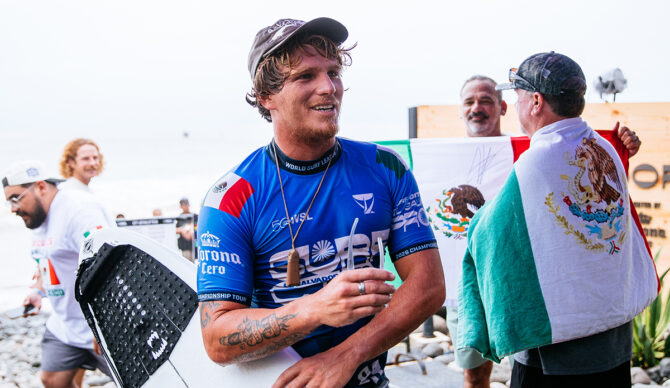
Al Cleland broke out of a slump in El Salvador, making his first quarterfinal of the season. Photo: Aaron Hughes//WSL

In the age of well-funded surfer kids with personal coaches, $2,000 ebikes, and video breakdowns on tablets, Al Cleland is a Gen Z throwback. He was molded by a childhood as a half-Mexican, half-American kid playing in the sand of one of the world’s most powerful beachbreaks — Pascuales.
The dream of becoming a pro surfer in a small village without any Championship Tour (CT) surfers to emulate forced him to carve his own path. Through an expertise in big barrels and heavy carves, he’s climbed to the pinnacle of competitive surfing and the Olympic Games. In a recent Spanish-language interview with DUKE, he opened up about his upbringing and the challenges that shaped the human, and surfer, he is today.
Here are four surprising stories that Cleland revealed in the conversation.
The depression when he missed out on the CT
In the 2024 Challenger Series, Cleland looked like a lock to finish top-10 and qualify for the CT. But in the last two events, he performed poorly: a 33rd in Portugal and a 25th in Brazil. During the deciding heat in Brazil that he had to pass, he said the nerves got to him. He couldn’t explain why. Ultimately, he finished 11th in the ranking, one spot short of qualification.
“I was depressed and didn’t even know what to do,” Cleland told DUKE. “I didn’t want to compete. I wanted to take a year off without competition, just to enjoy (surfing).”
He said he was able to get past the depression by staying at the final Challenger event in Brazil to support his good friends — Jackson Bunch, Marco Mignot, and Macy Callaghan — in their quests for qualification.
“That changed my whole mentality,” he said.
Months later he stayed in the Marshall Islands for 20 days for the Natural Selection event, turning his phone off. When he turned it back on, he had thousands of messages. Just a few days before the 2025 season kicked off, after John John Florence announced he was stepping away from the tour, the WSL called and said the vacant spot was for him. He said he personally thanked Florence when he saw him in Hawaii, which sparked laughter from both of them.
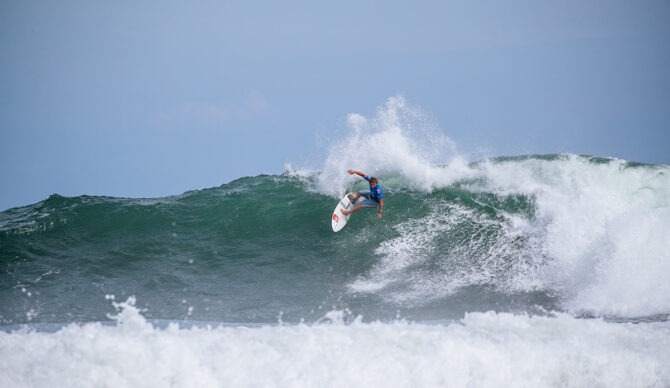
Few can match the power that Cleland injects into his surfing. Photo: Aaron Hughes//WSL
Growing up a “gringo” in Mexico
If you have never heard Cleland speak Spanish, you might not guess that he’s Mexican. But born with a Mexican mother and American father, growing up in Mexico, he insists his blood and heart are more Mexican than anything else.
Even so, looking different from his peers has drawn some criticism.
“People have always said things to me because I am ‘güero,’” said Cleland, using the Mexican Spanish word to describe someone who has lighter features. “They’ve called me ‘gringo’ and said, ‘You aren’t from here.’”
Cleland said he was able to take the criticism in stride, knowing that, even though his appearance may not look like a typical Mexican, he’s 100 percent Mexican on the inside.
“Not taking it personally helped me a lot,” Cleland said. “I’m going to do my thing whether they hate me or love me. I’m not going to change for anyone.”
Since his father is American, Cleland could have chosen to represent the U.S., but he said there was never a question of which country he’d surf for.
“You were born in a country, you grew up there, you’ve lived there your whole life, how are you going to represent another (country)?”
Crying for fear of Pascuales
Pascuales is not the typical wave one learns to surf at, but living at the notorious beachbreak, there was nothing to surf but heavy sandbars for miles in each direction. Cleland said his father forced him into the bigger surf, even on days he didn’t want to paddle out.
“I was crying in the water,” Cleland said. “Pascuales would have 12-foot faces, and I’d say, ‘Get me out of here!’ I’d catch a wave and run straight home so he couldn’t make me go back out.”
Even if he got scared, the training regimen served him well for the heavy barrels on tour, like Pipeline and Teahupo’o. That experience hasn’t translated to a breakout performance yet. But now, with a year of CT experience, those hours of tube time logged in Mainland Mexico are bound to lead to a big result.
An envious childhood
“I had a childhood that many people would pay for,” Cleland said.
He recounted growing up with a group of wild kids, “the little devils” of the village.
It was a simple life: surfing, skateboarding, fishing, running around the orchards, and riding horses. He didn’t have electronics, and didn’t get his first phone until he was 15.
“Nowadays you see four-year-olds who are on phones all day,” Cleland said. “Pascuales made us grow up differently. (It was) the best thing that could have happened in my life.”

