
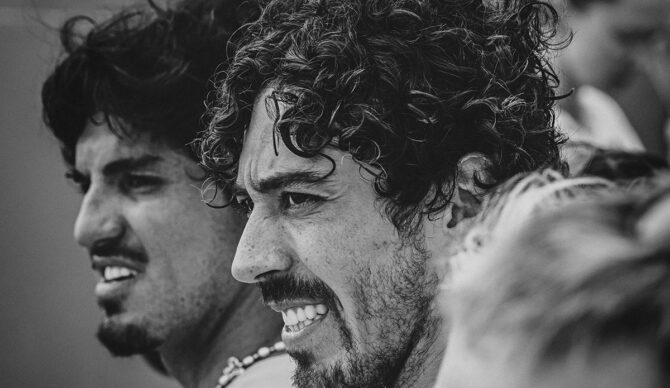
Could there be a drought of Brazilian world champs once Gabriel Medina and Yago Dora hang it up? Photo: Pablo Franco//ISA

Brazilians have dominated the past decade of professional surfing. Since 2014, when Gabriel Medina became the country’s first world champion, Brazilian surfers have won eight of the past 11 world titles.
That run of dominance, however, may be nearing its end. According to business leaders within the Brazilian surf industry, the Brazilian Storm — as this era has come to be known — is not set up for future success. Once the current generation (Medina, Toledo, Ferreira, Dora) retires, they warn Brazil could face more than a decade without another world champion.
The topic was discussed on a recent episode of the Brazilian surf podcast Fala Papah hosted by Ader Oliveira. The episode featured Daniel Cortez, manager of Yago Dora, and Luiz Campos, a sports marketing consultant who works with Filipe Toledo and João Chianca. Both believe there is reason to be concerned for the next generation of Brazilian surfing.
“In my view, it’s going to be at least a 10-year gap (of Brazilian world champions), maybe longer,” Campos said.
The current Challenger Series rankings highlight the point. Among the top 20 male surfers, only two are Brazilian: Samuel Pupo and Mateus Herdy, both 25 years old, but not exactly title favorites. In the top 50, there are eight additional Brazilians, most of whom are nearing or over 30 years old, and most are far from Championship Tour qualification. By comparison, Australia has 13 surfers ranked inside the top 50, seven of whom are currently in the top 15, with 11 athletes under the age of 30, illustrating a far stronger pipeline of talent.
Campos and Cortez agree that the downturn among Brazil’s younger generation is not the result of a single failure, but rather a combination of factors that have left the next wave of surfers less prepared than their predecessors. Cortez points to brand investment as one of the most important elements, recalling a time when Volcom sponsored a 10-surfer team that included Dora.
“The Brazilian Storm wasn’t by accident,” Cortez said. “It was a lot of work by the brands, work by the people around the surfers.”
“Maybe it’s not even about blame, but about a chain of events that pushed things in this direction,” Cortez said. “People need to understand that an athlete really can change the life of a company. That’s a fact. And investing in the grassroots level is essential. We always did that.”
Both industry figures point to Australia as a current model for surfer development, noting similarities to the systems that helped build Brazil’s dominant generation.
“Australia, in my opinion, is going to dominate,” Cortez said. “They’re doing exactly what we did back then – and then stopped doing.”
Campos added an anecdote from his own experience working with Australian surf executives.
“I remember being in a meeting with the Billabong guys, and they kept asking me, ‘What did you do in Brazil?’” Campos said. “They’d ask, ‘What would you do in Australia?’ and I’d say, ‘I don’t know yet. First, I’d need to go there, spend time there, understand how people think, so we can build something adapted to your culture and personality.’”
While government funding for Brazilian surfing has increased in recent years, they argue that brand support has not kept pace. Cortez said the contrast raises important questions about the sport’s long-term direction in Brazil.
“Brazilian surfing is hot right now – why does the Ministry of Sport invest in our sport?” Cortez said. “But at the same time, you see companies pulling the brakes. So we need to understand what’s really going on.”

