
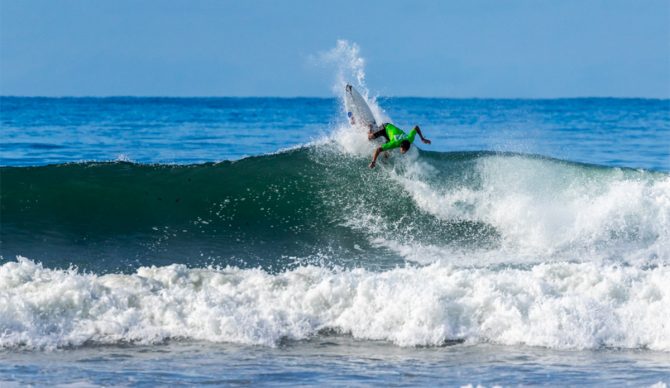
With a lack of CTers, the 2025 World Surfing Games spotlight is on lesser-known rippers, like Chile’s Noel De La Torre. Photo: ISA

The World Surfing Games got a boost in 2019 after WSL Championship Tour surfers were required to compete to stay Olympic-eligible. Since then, the ISA’s flagship event has drawn the sport’s biggest stars.
But in 2025, things look different. As the Games get underway in El Salvador, the CT surfers are all but absent (former CT surfers like Callum Robson and Morgan Cibilic are competing).
The explanation for the lack of elite talent is straightforward: 2025 marks the first time since 2018 that the Games have no direct Olympic connection. With no direct stakes, most of the world’s best chose to pass.
Paulo Moura, Vice President and Sport Director of the Brazilian Surf Federation, confirmed this thinking. He told The Inertia that Brazil’s CT surfers decided to rest this year, especially Yago Dora and Italo Ferreira, after competing in the WSL Finals in Fiji.
“Next year the Olympic qualification begins, so most of (the CT surfers) will confirm their participation,” said Moura.
The only current CT surfer in El Salvador is defending gold medalist Sally Fitzgibbons. A four-time World Surfing Games champion, she embraces her mentorship role on the team even without Olympic incentives.
“(It’s) about more than just qualification,” said Fitzgibbons. “Competing here is about connection, culture, and giving back to the sport that’s given me so much.”
Between 2019 and 2024, the Games either awarded Olympic slots directly or served as a mandatory eligibility requirement. The qualification system for LA 2028 hasn’t yet been released, but if it mirrors Paris, the World Surfing Games will directly qualify surfers again starting in 2026.
The ISA has emphasized that 2025 still holds significance. “Though this year’s WSG doesn’t feature any specific Olympic Games qualification scenarios, it does set up all-important seeding situations for the coming years, potentially directly impacting who will qualify for LA 2028,” the organization said in a release. Seeding is determined by the previous edition’s team ranking.
One star who did make the trip is Tahiti’s 2024 Olympic gold medalist Kauli Vaast. Though not a full-time CT surfer, Vaast told The Inertia that competing was part of a deal with the French Surfing Federation. Balancing sponsor obligations with Quiksilver made it tricky, but he said he welcomed the opportunity.
“The main (reason I’m participating) is because I wanted to,” said Vaast, who is competing alongside his sister, Aelan. “I love this kind of contest. I love to bring the vibes to a team.”
The absence of CT surfers opens the door for fresh faces. Mexico’s Alan Cleland Jr. turned heads by winning the event in 2023 to qualify for the Olympics. Within two years, he qualified for the CT and survived the mid-season cut.
“It’s a good opportunity for other talented Brazilian athletes,” said Moura, who was able to award a slot to the men’s national champion, Douglas Silva, in the absence of Brazil’s tour surfers.
While the World Surfing Games may still offer exciting matchups featuring former CT surfers and Olympians, the team rosters highlight a reality: the Olympic incentive has always been the primary motivation for most top athletes. They’ll be back in 2026.

