
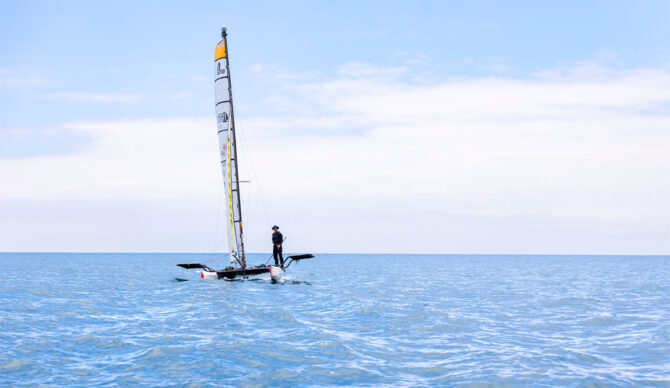
Chris Bertish has called off the TransCat 2026 expedition. Photo: Courtesy Chris Bertish

Chris Bertish, the big wave surfer, ocean explorer, and author, recently made a very tough decision: he’s calling off the Transcat 2026, a solo crossing of the Pacific on a catamaran that he’s spent three years training for.
Bertish is a driven man, so canceling a project he’s spent so much time preparing for was not something he took lightly. He’s got a wealth of experience doing similar expeditions, as well as a vast collection of accolades that prove his mettle. In 2010, he won the Maverick’s Big Wave Invitational. In 2013 and 2014, he set three separate stand-up paddle world records. In 2017, he paddled solo on a tricked out paddleboard across the Atlantic Ocean, covering 4,000 miles alone from Morocco to the Caribbean.
The latter feat won him the global Expedition of the Year Award at the 2017 US SUP Awards. In 2018, he was named one of the Top-100 Genius Icons by Global Genius 100, Leaders of Innovation and Creativity, by the Einstein Institute. An accomplished man, to say the least.
After speaking with safety experts and weather forecasters, however, he’s decided that the risks that come with his most recent project are just too much.
“When you have the experience I have gained over the last three decades dealing with high-stakes world-first expeditions, being a risk technician helps you make the right decision to keep you alive so you can move forward and create future impactful expeditions,” Bertish explained. “When more than 700NM of testing, training, data and experience over the last 12 months all point to the risk being too high and you proceed anyway, that is no longer calculated adventure – that is called reckless. I pride myself on being meticulous about reducing risk to an acceptable level before moving forward. If I cannot do that, then it is simply not acceptable to continue.”
The vessel he was planning on crossing the ocean with is a modified beach catamaran with no cabin, which means no protection from the elements. He wasn’t going to have the help of a support vessel, either. After his original departure date in mid-June was postponed until early July, he was forced to call the whole thing off. A big part of that call was the forecasted super El Niño, which would have likely thrown a whole lot of speed bumps in his way.
“Over the past several weeks, California experienced some of the largest early season south swells in almost a decade, while forecasts confirmed the strengthening influence of a heightened Super El Niño weather pattern,” a press release from Bertish’s team reads. “These conditions significantly increased the probability and danger aspect across the route, with a higher-than-normal probability for more extreme, challenging seas and severe weather anomalies.”
While disappointment runs deep, Bertish’s decision reflects the very principles that have allowed him to successfully complete some of the world’s most demanding ocean expeditions. It wasn’t a quick decision, either. Bertish carefully looked at various routes and did additional testing with his team before pulling the ‘chute.

Bertish decided against the TransCat 2026 expedition after safety teams and weather forecasters advised him of the potential dangers. Photo: Fred Pompermayer//TransCat 2026
“After assessing every option available to us, we have determined that the risks are simply too high to proceed safely,” he said. “This has been one of the most difficult decisions I have ever had to make after investing three years of my life into this project, but protecting the safety of everyone involved – including myself, our partners, sponsors and any rescue services that could potentially be called upon – must come first.”
Although the crossing itself is no longer on the table, the reason Bertish was doing it remains. Each one of his expeditions raises awareness and funds for different organizations. The TransCat Expedition 2026 would have served as a platform for Oceans Without Borders and the Chris Bertish Foundation.
Its main objective was to build “a circular economy school classroom in Northern Kenya, planting thousands of trees across Africa and supporting environmental restoration initiatives.” In the meantime, Bertish has personally donated US $8,000 toward the classroom project, which is almost 30 percent of the US $28,000 target.
“In many ways, the mission and intention have become even more important now, as this was never about world records,” Bertish said. “It has always been about impact, inspiration and creating positive change. That remains the driving force behind everything we do.”
The fundraising platform launches on June 30, 2026 and with any luck, construction of the planned classroom will begin in the fall and last through the rest of 2026.
“A school classroom will be built. The trees will be planted. The impact will happen,” Bertish concluded. “No matter what it takes, we will get it done.”

