
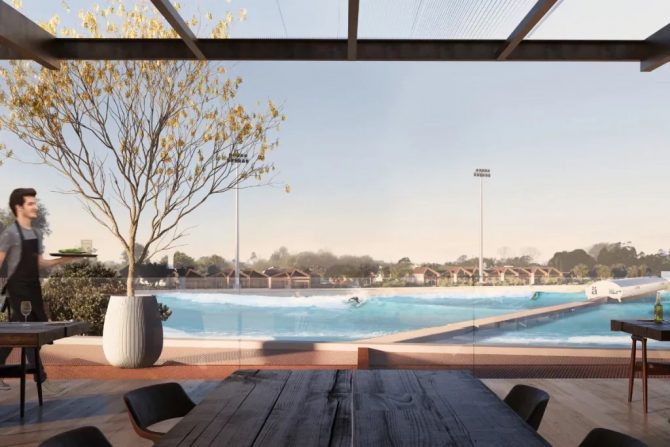
Heated via data center? A rendering of the Auckland, New Zealand pool.

Plans have been approved in Auckland to build a data center next to a new wave pool. What’s the connection, you ask? Well, like Tom Curren and Al Merrick, Jack McCoy and Occy and Strider and Kaipo, it might be surfing’s newest, symbiotic relationship.
You’ll not be surprised that the global data center demand is growing faster than Mason Ho’s hair. Driven by AI and Nathan Florence’s YouTube subscriber base, in 2023 the annual demand was 60 gigawatts (GW). By 2030, it will exceed 200GW. To meet the demand, twice the data center capacity built in the last 25 years will have to be built in the next five.
You’ll also know these data centers take a vast amount of energy to run. They are currently chewing through between two and three percent of the world’s electricity, almost all of it created by burning fossil fuels. This energy consumption is converted into heat. For every 1MW of IT power allocated to servers, the data center generates 1.3MW of heat. In an ironic twist, the heat isn’t good for the data centers, and as much half of the electricity is used for cooling systems. Like a hot tub with eight blokes, it’s a very warm, vicious cycle.
So, what’s this got to do with surfing? Sure, there were a few theories that if there was some way to harness the power of Conor O’Leary’s backside bottom turns at J-Bay, it could have fueled the webcast, or at least Turpel’s microphone batteries. Less theoretical is finding businesses and industries that can use all that wasted heat.
Enter stage right, the wave pool sector. So far, heating the water in the tubs has been largely impossible due to the amount and movement of the water involved. And as with all unheated pools, the water temperature usually mimics the ambient air temp. During winter in Bristol, Edinburgh, Shizunami, and Alaia Bay, the water temp can get as cold as 5°C (42°F). Melbourne and Waco can drop to 10-12°C (52°F-56°F).
The only heated large-scale tub is in Seoul, where steam is piped a mile from the Siheung Green Center, a waste-to-energy facility, better known as a garbage dump. This keeps the winter water temps at double the air temp, around 20°C (72°F) in winter.
However, and you probably can see where this is going, it is data centers that could provide an obvious solution. The surplus heat generated by data centers, often considered waste, can warm the water of surf lagoons and leisure facilities, reducing energy expenses, carbon footprints, and operational costs. It could be the best heat exchange since Andy and Kelly’s Pipe Masters Final in ‘03. And as Kelly said after the final, “Who said colocation facilities and getting barrelled can’t mix?”
“We’re seeking to capture the heat generated by an on-site data center to warm the water of our lagoon,” said Aventuur, the developers behind the Auckland wave pool. “To create a sustainable virtuous circle, a seven-hectare solar farm (also located on-site) will provide renewable energy for the data center.”
And who doesn’t love a virtuous circle? The company, which is also building the Perth tub, has enlisted Adrian “Ace” Buchan as its Director of Surf and Sustainability. In terms of the pro surfer/enviro Venn Diagram, no one has more cred than Ace. The park is still to get the final regulatory approval but is due to open in 2027.
Now, some might say the most sustainable way to create waves is to have wind blow them across the ocean. That’s kinda worked, renewably, ever since water vapor started to condense as the planet cooled about four billion years ago. And it didn’t require the building of 50 individual cabins, a 50-room lodge, cafe, kiosk, and farm-to-table restaurant.
But the wave pool genie, like AI, low alcohol beer, and mid-lengths, has popped out of the bottle long ago. With many of the new developments costing near $100-million, building in-demand data centers, and using the waste to heat the water, makes for that rarest of unicorns: common sense. Watch this space. Or, just go and catch a wave in the ocean.

