
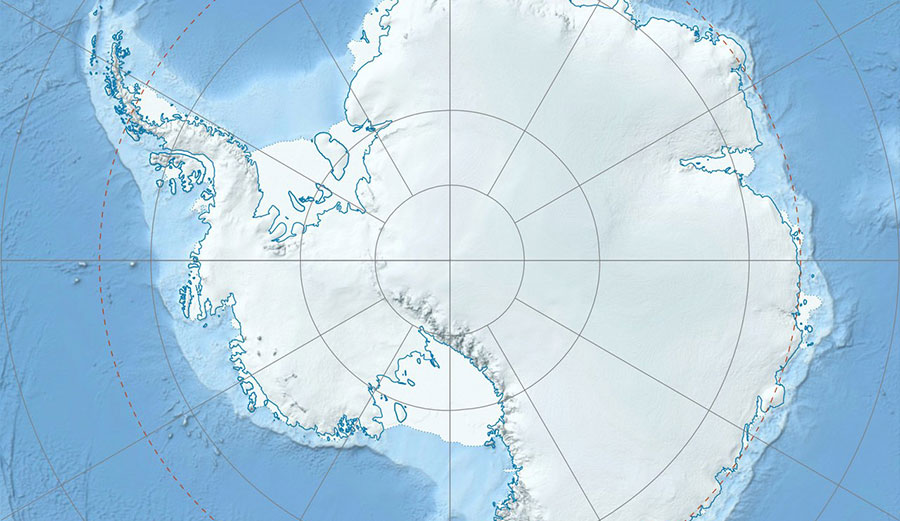
The Amery Ice Shelf, previously home to a very large lake that no longer exists. Photo: Alexrk2/Wikimedia Commons

A massive Antarctic lake disappeared recently, and researchers are baffled. The lake, which was as big as one of North America’s Great Lakes, was around 21–26 billion cubic feet.
According to the journal Geophysical Research Letters, the lake drained through the ice shelf it was situated on top of. The process is known as hydrofracturing. Now, it’s just an empty crater of ice.
“We believe the weight of water accumulated in this deep lake opened a fissure in the ice shelf beneath it, a process known as hydrofracture, causing the water to drain away to the ocean below,” said lead author Roland Warner, a glaciologist with the Australian Antarctic Program Partnership at the University of Tasmania, in a statement.
When it still existed, the lake sat on the Amery Ice Shelf. It’s the third-largest ice shelf in Antarctica, after the Ross Ice Shelf and the Filchner-Ronne, and it’s been a source of worry for a few years now. In September of 2019, an iceberg twice the size of New York City broke off. The enormous bergs are apparently hazardous to shipping lanes, so the ice shelf is continually monitored.
According to the journal, while it’s not extraordinarily uncommon for lakes to drain through hydrofracture, it is rare for it to happen to a lake sitting on so much ice. Some areas of the Amery Shelf are up to 5,900 feet thick. Scientists hope to be able to study the process with the goal of understanding how Antarctica’s ice shelves are degrading.
“Since surface meltwater on ice shelves can cause their collapse which ultimately leads to sea-level rise when grounded ice is no longer held back, it’s important to understand the processes that weaken ice shelves,”co-author Helen Amanda Fricker, a glaciologist at Scripps Institution of Oceanography, said.
Antarctica is in the middle of a heatwave of historic proportions, sending melt rates skyrocketing as fast as the thermometers. Still, though, researchers haven’t concluded that climate change is responsible, but that might be because it’s too early to say for sure.
“Surface melting over Antarctica’s floating ice shelves is predicted to increase significantly during coming decades, but the implications for their stability are unknown,” the authors of the study wrote. “The Antarctic Peninsula has already seen meltwater driven ice shelf collapses. We are still learning how meltwater forms, flows and alters the surface, and that rapid water-driven changes are not limited to summer.”

