
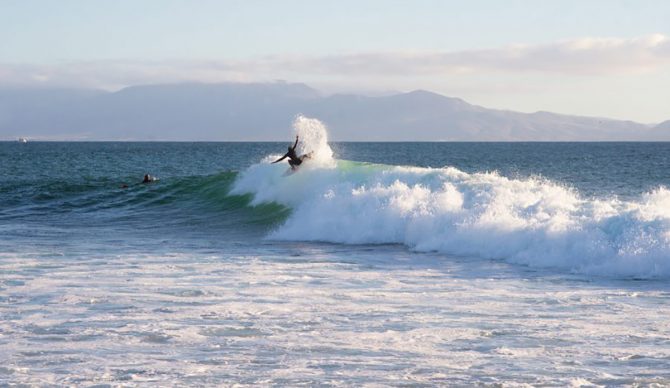
Tres Emes has its day and is a special spot for Ensenada locals. Impacts on the surf spot from the port expansion are still unknown. Photo: Nacho Felix//Save the Waves

A research center contracted by Mexico’s federal government to study the environmental impact of a proposed port expansion in Ensenada, says it will withhold relevant documentation for three years.
The research center, known by the acronym CICESE in Spanish, cited a federal law, arguing that releasing the information could harm state interests. It said the government should be responsible for informing the public about the project, adding that its role is limited to the technical side of the environmental research.
Due to the lack of transparency, it’s unclear if the environmental impact study has been started or how long it will take to complete.
The controversy centers on a USD $276 million federal proposal to expand Ensenada’s two ports. Environmental groups are especially concerned about plans for El Sauzal, a small fishing harbor north of the city that would be converted into a mile-long container port.
The current plans, revealed only through rough illustrations in government presentations, would destroy several waves, including the popular 3Ms reef, and likely hurt wave quality at the renowned point break of San Miguel.
Ensenada Digna, a coalition of 51 local organizations against the port expansion, released a statement criticizing the research center, a publicly funded organization, for withholding information.
They argued that with construction slated to begin next year, reserving environmental information for three years deprives the public of crucial knowledge about the project.
“By then there will be no more beaches to defend, coastal fishing and tourism will be in ruins, coupled with road congestion and air, sea, and soil pollution,” said Ensenada Digna. “What will remain, instead, will be the bitter memory of a science that chose silence when society demanded answers.”
Ensenada Digna launched a petition to stop the project, which has received more than 21,000 signatures. A protest is scheduled for September 4.
Beatriz Ibarra, a local environmental activist, told The Inertia that the public is left in the dark without access to the documents.
“The most ironic thing is that by law, before approving a project, the environmental impact statement must be made public, allowing time for its review,” said Ibarra. “During this review, the weaknesses or shortcomings of the report are discussed, and if appropriate, the statement must be revised or the project is canceled.”
“We won’t know anything about what they’re doing,” she added.
Last month, the federal government offered to compensate for the destruction of several waves by building a USD $1.06 million coastal walkway park at San Miguel. Locals also rejected this plan, calling it a “mockery” that doesn’t come close to replacing what would be lost. They also criticized the federal authorities for ignorantly saying the new harbor breakwater would “move the waves toward the north.”

