
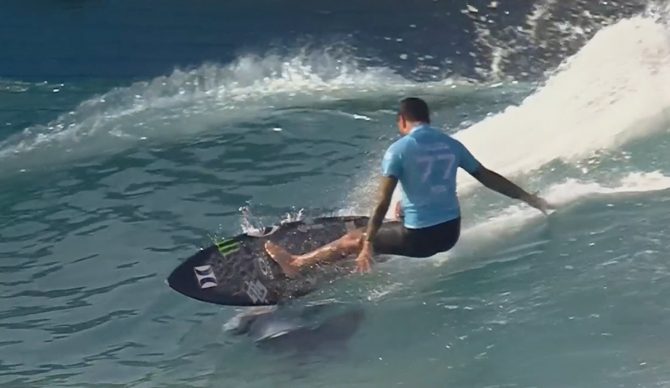
The photographer, Thiago Diz, can be seen just below the surface. Photo: Screenshot

When Filipe Toledo ran over WSL photographer Thiago Diz at the Surf Abu Dhabi Pro, no one felt Diz’s pain more than other water photographers. It’s a high-pressure job with little room for error – every key shot must be in frame and in focus while treading water for hours under the sun. But when mistakes happen (as they did in Abu Dhabi) the consequences can be monumental.
To understand the challenges of contest water photography, I spoke with two veteran industry lensmen, Pablo Jimenez and Sean Evans. Both have logged their fair share of time in the water, including at the Olympics.
“The first thing I consider is the type of wave I’m shooting,” said Jimenez. “Not all spots are the same if you are shooting from the water.”
According to Jimenez, shooting a reef break with a well-formed channel and a consistent takeoff zone would be the “easiest” type of spot. Long point breaks add an extra layer of difficulty because you have to pick the best section of the wave for a good shot and maintain that position as you deal with currents. Finally, Jimenez says beachbreaks are the most difficult due to currents, rips, and unpredictable peaks.
“I try to avoid (shooting from the water at beachbreaks) in competitions,” said Jimenez. “Sometimes it’s not worth it to swim out. I’m not saying you can’t do it, but sometimes the ratio of risk and reward isn’t that great. A lot of times you don’t get many good shots.”
For reefs and points, Jimenez says he strategically picks a lens in the Goldilocks zone – long enough to keep him out of the way of the competitors, but also close enough to get good shots. Both Jimenez and Evans reported that a 70-200mm is their go-to lens when shooting contests from the water.
“There are some reef breaks where you can get really close without being on the wave, like El Gringo in Arica, or Teahupo’o,” said Jimenez. “You could shoot those with a fixed 85mm lens, or 70mm. But for a wave like El Sunzal in El Salvador, I’ll use a 70-200mm. Or since it’s a longer wave I might go all the way up to 200mm to get close to the action while safe in the channel.”
The International Surfing Association rulebook (page 32) specifies that water photographers must use a lens of at least 135mm and wear a helmet. The WSL rulebook (page 73) has no such rules regarding lens length or helmet requirement – just that there’s a maximum of two water photographers allowed in the lineup at once and that the head judge has full discretion to remove them if necessary.
When Evans watched Toledo’s wave, he was surprised at how close Diz was to the action.
“When shooting freesurfs it’s best to get as close as possible while keeping the surfer in the frame, but during competition, you don’t want to impede at all,” said Evans. “Judges are always requesting that a 70-200mm is the only lens being used in the water.”
“It seemed like (Diz) was shooting extra wide or maybe a 50mm,” added Evans. “It’s possible (to use the smaller lens) in the Kelly Slater wave pool because there are markings and posts to help you judge your distance accordingly. But the biggest mistake that (Diz) made was trying to (shoot) that last turn. He had already gotten the main maneuver and he could have avoided that situation entirely. It was shot as if it was a freesurf.”
View this post on Instagram
Interestingly enough, when Toledo first exited the water, emotions running high, he complained that Diz had been shooting from a similarly precarious distance during the warm-up sessions, insinuating that it wasn’t a completely isolated incident.
Evans has shot at the Kelly Slater pool in Lemoore four times. Given the predictable nature of the artificial wave, he says it’s generally the easiest setting to shoot in when compared to the ocean. At the same time, Evans knows that mistakes can happen in the water. During the Tokyo 2020 Olympics, he also found himself in a risky position on one of Gabriel Medina’s waves.
“The wave was maybe one foot and Medina needed an eight at the last second,” explained Evans. “He took off and was coming right at me. The water was maybe two feet deep, so I just lay on the bottom and tried to stay out of the way. He landed the maneuver. Nothing happened but when the technical director later showed me the video, it was pretty close.”
Both Jimenez and Evans hope the incident in Abu Dhabi doesn’t deter Diz from continuing to shoot surf contests.
“I really enjoy his work,” said Jimenez. “His lifestyle behind-the-scenes stuff of the WSL events is really good. I feel for the guy. He must have felt so bad. Sh*t happens. We all have a bad day. I know he’ll bounce back and I look forward to seeing more of his work.”

