
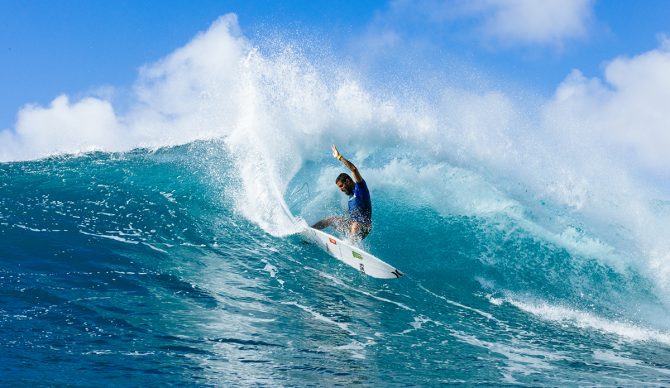
Filipe Toledo went pretty deep on a recent podcast. Photo: WSL

“Everyone was afraid of Kelly’s stare,” says Filipe Toledo of those who competed against the 11-time world champion.
According to Toledo, Slater’s notorious mental games didn’t work against him the first time they faced off in a heat. In fact, it backfired, Toledo explains in his native Portuguese on the podcast Fala Papah.
Throughout the hour-long interview, Toledo, who recently moved his family back to Brazil after 11 years in California, also discussed topics such as how he has dealt with criticism throughout his career, how Brazilian airs became polemic, and his not-so-distant retirement date.
Given that the interview is in Portuguese, we highlighted some of the telling moments.
Overcoming Kelly’s mind games
Host Ader Oliveira asks Toledo if he’d ever heard of the lore to avoid eye contact with Kelly Slater before a heat. Toledo responds with a story about his first heat against Slater, saying everyone on tour was afraid to look at Kelly when competing against him.
“The first time I faced him in the quarterfinals in France in 2014, I was in the water, and before going in the water, I was already avoiding friendly conversation,” Toledo said. “I was focused on my first time facing Kelly. I needed to be very focused.”
“We got in the water and on my first wave I got a nine-something,” he added. “Then I went back to the lineup and Kelly started talking: ‘What size is your board? Is your board good?’”
Toledo says he wasn’t paying much attention to Slater’s perceived mind games. Even though Slater kept chatting, Toledo says he stayed quiet and kept his glance on the horizon, not giving in to the distraction.
“I think he didn’t expect that from someone so young,” Toledo said.
Ironically, Toledo says that later that same day Slater caused a scene on the beach, complaining about the whistling from Filipe’s father.
Dealing with criticism
Filipe Toledo took a year off the pro tour in 2024 to focus on his mental health. The two-time champ had famously been criticized for years due to his lackluster performances in heavy waves, particularly Pipeline and Teahupo’o.
Toledo addressed the critiques with Oliveira, challenging those who send hate mail to come send themselves over a Teahupo’o lip.
“Before I didn’t deal with (the criticism) very well,” Toledo said. “I used to get really upset, but today I’d say, ‘Man go there and do it yourself if you’re so good.’”
“On the internet everyone says what they want,” he added. “There’s a guy with a belly this big, typing: ‘You don’t ride big waves.’ If (that person) could go there and just see one wave – he doesn’t even need to paddle, he just needs to see – then I want to see what he’s going to comment on the next post.”
Similarly, Toledo also explained why he doesn’t spend months of his offseason in Hawaii, as many pro surfers do, working on his heavy wave surfing.
According to Toledo, when he was young and got on tour, it was really tiring, especially when the results didn’t go his way. Recovering physically and mentally at home during the offseason was important.
“Pipe is crowded. It’s crazy to catch waves there,” Toledo said. “I don’t have time to fight with a bunch of people to be able to get a tube there. To catch a perfect, big tube I’d rather go to Tahiti without a crowd.”
How airs shaped Brazilian surfing
Oliveira asks Toledo whether the evolution of aerial surfing helped Brazilian surfers begin winning world titles — whether surfing history would have unfolded the same way if airs didn’t become so fundamental to the sport.
Toledo points to Jadson Andre’s 2010 landmark win over Kelly Slater at the Brazil stop on the ASP Tour, saying he wouldn’t have won without airs. But he also thinks that eventually judges got tired of Brazilian airs once they became so commonplace.
“I think there came a moment in surfing when aerials were being valued a lot less,” Toledo said. “I think judges were seeing them too often, and we Brazilians were enjoying the idea of flying and scoring points. It was exciting. I feel there was a bit of a pushback against progressive surfing.”
“My entire foundation came through the junior categories, from when I was a kid,” he added. “My older brother was already competing, just starting out. We had the grom divisions, and modern surfing was already a reference for us. So I had a really strong education from modern surfers. I learned a lot about aerials and different maneuvers, and I think that if aerials hadn’t existed, maybe we wouldn’t be here today.“
When Toledo wants to retire
Oliveira poses the question to Toledo: “If you don’t earn a 2028 Olympic slot, would you think about retirement?”
“It’s hard to discard that,” responds Toledo. “The best case would be to close out 2028 with a world title and Olympic medal.”
However, Toledo acknowledges that he already has two titles, and if that’s not how it plays out, he’ll be OK.
“If I stopped tomorrow, I’d be happy with my career,” he said.
Toledo ended the conversation joking with Olivera about his future retirement in the northeast of Brazil, living next to the ocean with a little boat, eating seafood.

