
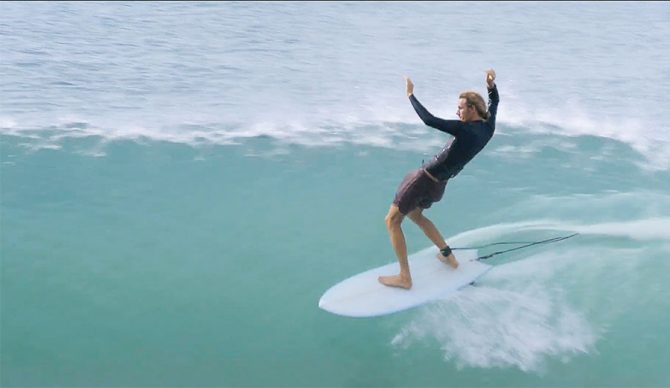
Torren Martyn, no turns needed. Photo: Screenshot

I recently was perusing a surf travel website that specialized in Indian Ocean yacht charters throughout the Maldivian atolls, where I came across what I found to be a curious description of the types of waves clients might be expected to experience. Profiling a particularly dreamy right reef-point, the surf guide explained that while from the initial take-off the wave featured a series of fast, hollow sections, clients were assured not to worry, as on the inside this wall of azure perfection would eventually slow down and flatten out enough to accommodate a few turns.
Now, it doesn’t take a whole lot of interpretive skills to understand that this helpful guide was tailoring his description of the Maldives surf experience on offer to his regular clientele who, unlike those surfers who in years past “lit out for the territory” to discover waves of this nature, apparently aren’t as interested in the faster, hollower outside portion of the wave, but rather on the slower, inside section where they’ll be able to do a couple of top turns and cutbacks. Putting aside the idea of paying thousands of dollars to travel to the far side of the world just to surf pretty much the same way you do at your home break, I’d say this promotional paragraph is clearly indicative of how “turn-oriented” so many surfers have become.
Which is by no means a bad thing — a repertoire of flashy moves on a wave can be as intensely satisfying as any other form of showing off. Problem is, just about any trip to the beach is an opportunity to watch surfers of all skill levels, and riding all sorts of equipment, focusing solely on turning their surfboard — and doing a bad job of it. I’m talking about too many flat-rail cutbacks performed too far out on the shoulder, powerless bottom turns, speed-scrubbing, mid-face chops and segmented top turns, generally attempted in sequence with no effective understanding of how to best utilize the wave’s anatomy. But there’s an easy first step toward fixing this collective deficiency. I call it the “No-Turn Challenge,” and trust me, if you can leave your ego back on shore where you hide your car keys and focus your energy on not just catching a few waves but becoming a better surfer, you’ll thank me for it.
The “No-Turn Challenge” is exactly what it sounds like: commit your next session to doing no turns of any sort, but instead riding every wave you catch absolutely as far as you can, right across the wave’s middle. That’s it. And, if you can stop howling in outrage for a second, I’ll tell you why.
It’s about science, really. For the purpose of this discussion, we’ll be talking about what are called mechanical waves, which are categorized by their type of motion. In the category of water waves there are two examples: longitudinal and transverse. Surfers are members of the transverse club, meaning we ride disturbances in a liquid medium that are perpendicular to the direction of propagation (storm size and swell direction.) Put simply, our waves have moving peaks (crests) and troughs (valleys) which are the highest and lowest points of the medium — a basic understanding of which would clear up the ridiculous custom of “Hawaiian Scale” wave height measurement. But that’s an issue we’ll take up at another time.
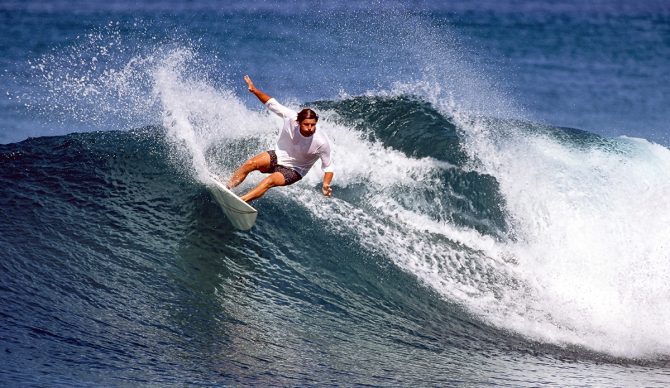
The author, taking advantage of a centered approach, off the bottom and off the top. Photo: John Seaton Callhan//surfEXPLORE
The crests and troughs of any particular wave are the furthest points from the wave’s center equilibrium, the term referring to a state of balance between opposing forces or influences (remember this — you’ll be asked about it later.) Another big word in wave speak is amplitude, which describes the distance from the wave’s center equilibrium up to the crest, or down to the trough. The greater the amplitude, the more energy the wave is carrying. Like we don’t already know this — bigger waves are more powerful. But here’s where it gets interesting: both equilibrium and amplitude find their start in the center of the wave, regardless of its size. Meaning that in the context of effective surfing, the optimum points of balance and energy are found there, too. Not in the lip, nor in the trough, but right down the center.
Does this mean I’m suggesting you start riding every wave you’ll ever catch right across the center of its face? No, only for a single session. The purpose being to familiarize yourself with this vital element of the wave’s anatomy, its beating heart, so to speak, which is much too often considered merely a transition zone between maneuvers; learning to ride the wave, as opposed to just riding the surfboard.
You’ll be surprised what you find there. Speed, for one thing. The single element that every good turn requires, whether off the bottom, the top, or out on the shoulder, for that matter. Then there’s trim, the hydrodynamic essential, applied to either speeding up or slowing down, subtly matching the speed of the wave rather than running away from the curl. Finally, and probably most importantly, a position from which to actually start reading the wave ahead of you, rather than merely lazer-focusing on the nose of your board, and where you can stick it. Dare I say, flowing with the waves, moving with them, not at right angles against them, for just one session. Guaranteed, your turns will love you upon resumption.
Make no mistake, this challenge isn’t just for beginners and intermediates — I know plenty of surfers with years of experience who regularly throw themselves through a series of extravagant turns, giving very little thought to where on the wave they are. Do they pull them off? Most of the time. Could they be doing them better? Sure. Would they look better doing them? Absolutely.
So, there it is, the “No-Turn Challenge.” If you’re interested in becoming a better surfer, you’ll give it a try. And if not…well, I’ll leave you with this: if you don’t think your surfing could benefit from a challenge like this, you’re probably the surfer who needs it the most.

