
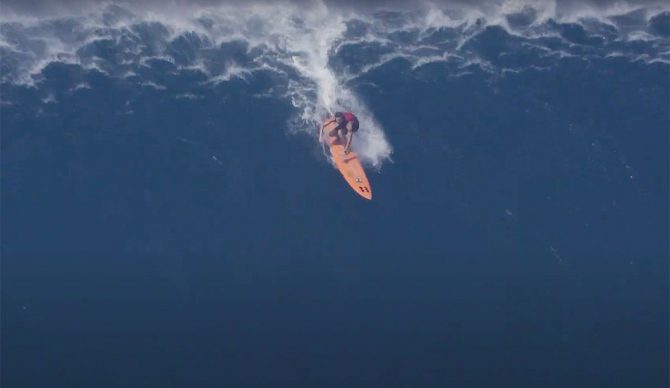
You can’t do this without the right training and equipment. Well, you can, but you might die. Photo: YouTube//Screenshot

Matt Bromley knows a lot about surfing big waves. He’s been doing it for a while now, and he’s basically shaped his whole life around it, so it pays for him to not only be up to par in a physical sense, but a mental one as well. And part of big wave surfing is controlling fear. In his new series, Edging Fear Out, Bromley is giving the viewer a lesson into how he goes about doing that.
The first lesson focused on acclimatization to fear. He uses a sort of stepping stone method to ease himself into scarier and scarier situations. Starting small and working his way up, as it were. Smaller waves to bigger and bigger and bigger until finally, he was relatively comfortable surfing waves that most people would not feel at all comfortable surfing. It’s a pretty intuitive approach, but if you’re aware of what you’re doing, you can do it with more intent.
The second installment is all about preparation. It’s about equipment and training. “A core part of edging out the fear for big waves is knowing and trusting your gear and physical training,” Bromley wrote.
In a different life, I was a utility arborist. I spent years in trees, dodging power lines and trying my very hardest not to knock the power out with an errant tree limb. A big saying in that line of work is this: “trust your knots.” When you’re confident that you’ve tied a clove hitch properly, you can do your job without worrying that you’re going to hit the ground when you put your weight on it. In big wave surfing, there’s a similar mentality.
“When you have confidence in your equipment,” Bromley explains, “it really puts peace of mind that you can go out there and charge the biggest waves.”
But surfing does not only require a surfboard. It requires a user who is able to ride it, and your physical training is just as important — if not more — than your equipment. You need to know that you are able to deal with the consequences of what you’re getting yourself into, and in big wave surfing, training hard is the only way to do that.
“The idea for me is to mimic the big wave environment as much as possible in your training regime,” Bromley says. “When you’re out there, you want to feel that you’re surging through the water. You want to have strength in your breath. You want to feel yourself with forward momentum. All of that gives you so much confidence.”
So how to get that big wave training without the big waves? Swimming. Bromley has a swim training program he’s made available to anyone who wants it, and even if you’re not going to surf a Hawaiian outer reef, it would be helpful.

