
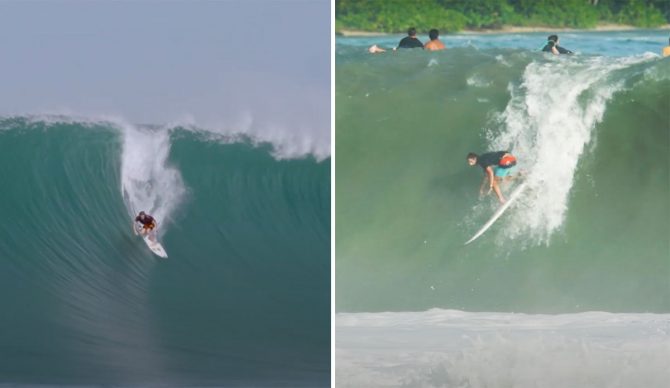
Matt Bromley has a few tips to help you do the most important thing: take off. Photos: YouTube//Screenshots

Matt Bromley has spent a lot of time surfing waves much larger than most people are comfortable surfing. There’s a lot that goes into it — years and years of experience, generally — and Bromley’s got a pile of knowledge about nearly every facet of surfing bigger waves. Here, he breaks down what’s arguably the most important part: the take off.
As waves get steeper and more critical, both the ability to position yourself in the right spot and to actually make the take off become more important.
“You’ve done your super strong paddle in, you have an idea of what the wave is going to be doing, and now it’s all about getting down the face of the wave against that pull; against that suck,” Bromley says. “The take off has to be full commitment and everything is about leaning forward.”
Much like dropping into a ramp on a skateboard, commitment is the only way it’ll work. If you’ve got a bit of weight on the back foot, you’re screwed from the get go.
“My eyes are focussed on the base of the wave,” Bromley explains. “That is my only goal during a take off. As I pop to my feet, I make sure that my hands are in front of me and I’m super crouched, leaning very, very forward.”
It’s one of those things that even the best can mess up, especially when things are getting a little bigger. Offshore winds and a gun can be a difficult thing to navigate, since that’s just more foam for the wind coming up the face to get under. But with time, practice, and a whole lot of wipeouts, everything gets easier. And easier means more waves. And more waves means more fun.

