
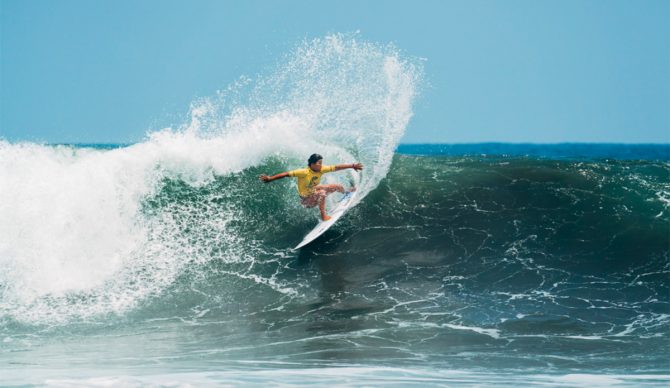
Mahina told us that she’s done, for a number of reasons. Photo: ISA

When I called Mahina Maeda’s decision to step away from surfing a “retirement,” I corrected myself and changed the wording to a “career shift.” But Maeda responded in a gentle, yet decisive manner over the phone, “It is retirement.”
The 2014 WSL junior champ, two-time ISA junior gold medalist, and Tokyo 2020 Olympian made her new life path official with a message on Instagram. “It’s been a whole year since I’ve stepped away from competitive surfing,” wrote Maeda. “I’ve had this burnout feeling since I competed in the Tokyo Olympics. This past year has been one of my best years but also one of the toughest years.”
I recently wrote a story hypothesizing that the Olympics have been partly to blame for the recent trend of burnout among elite surfers. I shared the story with Maeda before calling her. While she acknowledged that the Olympics were a factor, she was quick to point out that surfing burnouts are nuanced, and some of hers even predate the Olympics.
“I’ve had multiple burnouts,” said Maeda, an Oahu native. “Surfing is such a special sport in which you’re brought up at such a young age. I started surfing when I was four. At 12, I was pushed into the sport as a profession, entering junior events. I was traveling internationally full-time. It was just a constant, go, go, go. And I’m pretty sure a lot of people will say the same exact thing.”
“That translated to not understanding what it’s like to be a kid and a professional athlete at the same time,” added Maeda. “I had my first burnout when I was 18.”
Maeda earned her Tokyo 2020 qualification slot with a strong performance at the 2021 ISA World Surfing Games in El Salvador. She competed for the host nation of Japan in the Olympics less than two months later, where she received an equal 9th. But the Games pushed her over the edge.
“My last burnout was after the Olympics,” said Maeda. “There is a lot of pressure being an Olympian and going through that whole process, let alone that it was probably one of the hardest years because of COVID. But I think more so, the reason is that I just got really disappointed with myself that I was losing so much.”
The Olympic pressure coincided with big changes in the WSL format that didn’t sit well with Maeda. The WSL introduced the Challenger Series (CS) in 2021 to solve a few problems: First, Championship Tour (CT) surfers wouldn’t have to surf the tour and simultaneously balance qualification events in case they fell off the tour. Second, it would, in theory, create a more equal playing field financially for surfers, as they could qualify via events just in their region, not having to travel all around the globe before joining the CS.
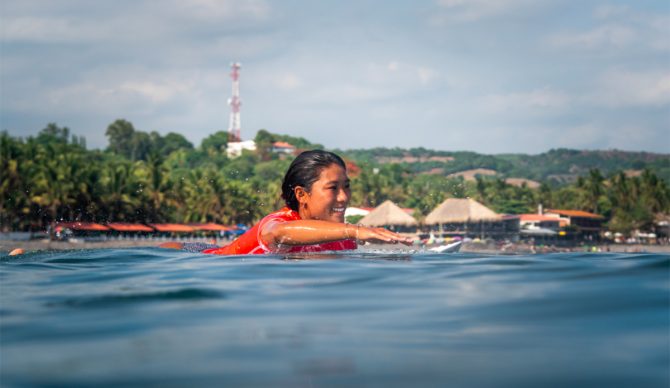
Photo: ISA
But for Maeda, the new format felt like a burden.
“The new WSL format really upset a lot of people,” said Maeda. “The regional events were limited in the beginning and the incentives from those smaller events didn’t cover the costs to compete on the Challengers. Before, you could pick and choose the events you enjoyed and suited your surfing, whether it was a 1500 or 3000, and earn points for qualification while funding your career. Even if it was a 1500, you’d still be making quite good money depending on the location you chose to compete in.”
Maeda observed that the Olympic era, combined with the new CS format, forced some surfers to make a difficult choice: to pursue the CT or focus on the Olympics.
“I noticed that a lot of people who were Olympians didn’t even attend the Challenger Series,” explained Maeda. “They were focusing on and traveling to Tahiti to train for the Olympics. You can’t really do two at once. It’s pretty tough. You’d have to be a superhuman to do that.”
Conceivably, Maeda would have a pretty good shot at qualifying for the Los Angeles 2028 Olympics. She could earn a regional qualification slot reserved for Asia, and the two-athletes-per-country rule that limits the number of Australians and Americans/Hawaiians bodes well for her chances. But she’s at peace with leaving competitive surfing behind, adamant that she isn’t going to return.
“A lot of people tell me that I should qualify (for the Olympics) or try to get on the tour because I have the ability to,” said Maeda. “I don’t think I want to put myself in that same mental strain again. If you don’t have that fire within you to want to compete and win again, then what’s the point?”
“Surfing is not a cheap sport, and having that financial backing is another stress that a lot of people face,” added Maeda. “How do you afford to get from point A to point B, let alone compete at the location with the right amount of backing? I’ve noticed the people who do qualify are the ones that have the whole setup – the coach and the family member traveling with them, the perfect setup to compete with peace of mind and focus on that single event. Not everybody has that luxury, and I didn’t. I did have amazing sponsors, but I feel like I was missing maybe one or two factors, and I honestly don’t want to put myself in that same mindset again.”
Maeda revealed that this perspective helped her support Tatiana Weston-Webb when she was also going through burnout that led her to take a CT sabbatical.
“I told Tati it’s fine,” said Maeda. “Ten years of being on tour, if you haven’t had one single day of break, give yourself a good pat on the back. It seems like we have this amazing lifestyle, but being a professional athlete, we really don’t have a day off.”
Maeda is now shifting gears towards a career in production. She’s worked on the set of NCIS: Hawaii and did surf stunts in Rescue: HI-Surf. Entering the workforce post-pro surfing has also had its challenges, but she’s discovered that her career as an athlete prepared her well for what is to come.
“When you stop competing and go into real life, you don’t have that same control to be in a specific spot within a company,” said Maeda. “You’ve got to go through the process of applying for jobs, digging deep, and working sh*tty jobs. But it’s fine, as long as you’re at peace with that and have patience, everything will fall into place.”
“Not many people realize that athletes are the best workers,” added Maeda. “We’re so driven, and we’re hard workers because we put in so much time and effort to make our company, which is ourselves. That easily translates back to regular work.”

