
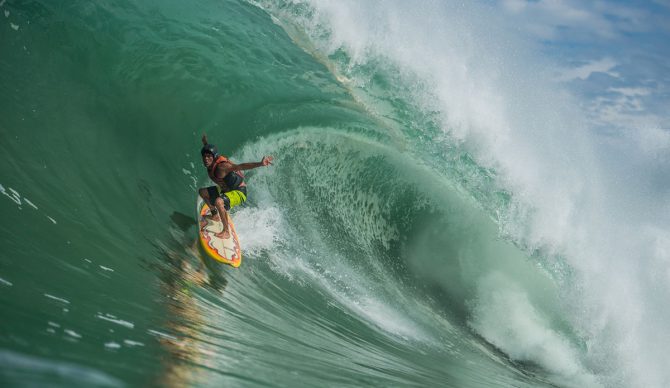
The spectacular wave at Playa Zicatela. Photo: Maria Fernanda

In a rare case of bringing waves back to life, significant progress has recently been made in restoring the world-class wave at Playa Zicatela – better known as Puerto Escondido.
“Studies have shown that ever since the jetty was built, the sand flow has stopped,” said Kalama Stratton. “It has caused the sand to accumulate, making the waves break closer to shore and meaning a lot more closeouts.”
Stratton, at the tender age of just 13, has already packed and escaped more of those closeouts at Zicatela than many surfers twice his age. Yet in his very short lifetime, Stratton has seen the quality of the iconic beachbreak deteriorate to the point where its world-class reputation was in danger. The Mexican Pipeline was slowly being clogged to death.
“For years, this wave — the heart of our town — was weakened by a breakwater built in the main bay, Bahía Principal,” said a spokesperson from Salvemos La Bahia, or Save The Bay. “Its rocks changed the currents, the sandbars, and the magic of the wave we all know and love.”
Surfers like Stratton and Coco Morales, who produced the 2024 documentary “Place of Thorns,” which showcased its legendary status and deteriorating condition, believe that a large portion of the drop in quality was due to the poorly planned jetty.
The jetty was built by the government at the northern end of the beach to protect fishing boats just after the turn of the millennium. And while a rapid expansion in the town’s infrastructure, driven by a rapid growth in tourism since COVID, may have also played a role, it is the jetty that has been the primary cause of the altered banks at Zicalata.
Organizations including Save The Waves, Wildcoast, and the Puerto Escondido World Surfing Reserve, have all agreed that the groyne had been trapping the sand and widening the beach. That has led to the increased incidence of straight-handers at Puerto’s previously (sort-of) defined peaks.
“Based on my decades of science, everything they are describing makes perfect sense,” said Dr. Chad Nelsen, CEO of Surfrider Foundation. “Coastal systems are so dynamic and complex that anytime we mess with them, it’s usually bad.”
>However, in a rare case of nature striking back, when Hurricane Erick hit Oaxaca in June 2025, the jetty was severely damaged. The locals, sensing an opportunity, organized a large “tequio,” the Oaxacan tradition of community service, and started removing the dislodged rocks by hand.
However, human power, no matter how committed and organized, wasn’t going to be able to remove the tonnes of boulders that had been put in place by machines. A fundraiser was quickly put in place to raise one-million pesos, or $50,000, so professional equipment, heavy machinery and resources could be used. So far, almost a fourth of the funds have been raised.
That money has been used over the last few weeks to remove at least half of the closeout-forming jetty. That was in line with recommendations from scientific studies organized by the coalition looking to save the wave. Following the removal, the plan now is to do continuous environmental monitoring to check on any changes in the movement of sand as well as assess the impact on local fishermen and businesses that the (hopeful) change in new coastal dynamics will bring about.
“If you have ever surfed the wave, you will know how perfect our home can be. For anyone who loves this wave, or wants to come in the future, it’s really important we look after it now,” finished Stratton, with almost alarming maturity. “This might be our only chance. We have to act now.”

