
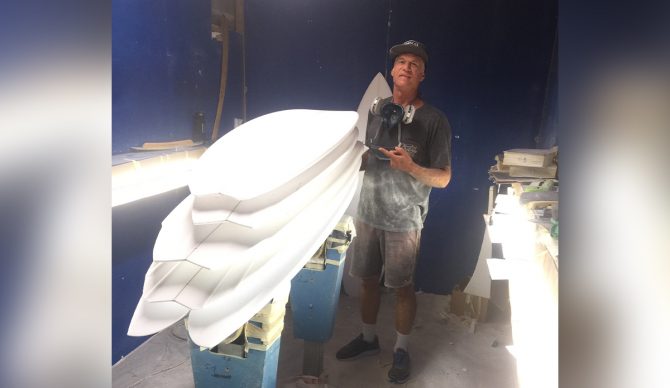
Photo: Robert Weiner
Robert Weiner and his boards have been an integral part of Ventura, California surfing for decades. Weiner’s brand, Roberts Surfboards, is known for producing innovative, beautiful, and eminently rippable craft. They’ve made their way under the feet of comp legends Dane Reynolds and Jordy Smith, and into the pages of SURFING magazine, which named Weiner 2011 shaper of the year. It was a long road that took him to shaping his first board, though. One that took Robert all along the coast of California.
Though Roberts and Ventura are synonymous at this point, Weiner didn’t start off there. He was born in Orange County and grew up in Los Angeles. His parents, both German immigrants, lived far from the ocean, but his mother quickly fell in love with the beach and took Robert and his brother there three or four days a week, where he would see the surfers that he would eventually emulate. “She’d have to pry us out of the water just to get us to eat a lunch,” he remembers. “I would see the surfers, and be like, ‘I want to be a surfer,’ you know? That was the beginning of this whole craziness.”
His love of the surfboards themselves was never far removed from the fascination with surfing. “The first time I ever saw really cool surfboards, we were at El Segundo,” he recalls. “My father had a job on the beach, and he took us with him to work. And we all went down and hung out at the beach in El Segundo and we saw these beautiful Plexiglas purple and red and blue and yellow fins that these guys had in their boards. I was just so taken aback by it. I was like, ‘Look at that. Those boards are so cool. Man, I want to be a surfer.’ And I think I bought my first issue of SURFER magazine with Jock Sutherland on the cover. I was like, eight years old or something.”
He stood up on his first wave at Bay Street in Santa Monica, where he would often see the colorful boards under the arms of Dogtown surfers. Soon after, he began to range much farther, though. “The cool part about living in that area back in those days was the fact that we were going to drive to the beach no matter what, whether we went to Salt Creek or Rincon or Jalama or Newport. We were going to go somewhere, and we might as well go to the best spot, so we were mobile. What you would think as a disadvantage became kind of a blessing, in a way, because I got to surf the entire California coast.”
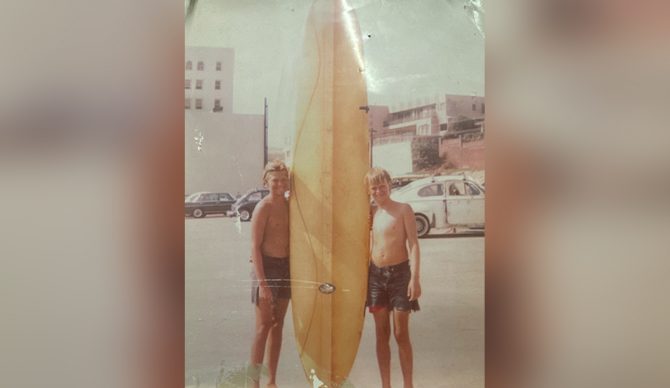
Robert (right) with his first shaping partner, his brother Erich. Photo: RW
Which brings us to his first board. His very first effort was just a glass job on a board a friend of his had shaped when they were kids. The first board he ever shaped in earnest was maybe another year later, with his brother, Erich. Robert was 12 years old.
“There was a paint store called Standard Brand Paints, and they actually sold all the materials to make surfboards,” he explains. “It would be like the equivalent of Lowe’s today, or Sinclair Paints or something. They were all over the place. And they sold all the materials. They sold the resin, the fiberglass, they even had a brochure on the step-by-step process of how to build a surfboard. So I had that, and I was like, ‘Okay, I’m going to need six yards of cloth, this fin rope, this much resin, this much sanding resin.’ That’s kind of how I got all my earliest memories of working on surfboards.”
To source a blank, they had to get more creative, though. They found an abandoned longboard and stripped it, forming the usable remnants into a recycled blank. “There was a lot of longboards going around back in those days,” he remembers. “Boards that had been damaged or the noses were smashed, and people were getting rid of stuff. My brother and I, we didn’t have tons of money. My father was a painting contractor. He never thought that surfing was going to amount to much, so he wasn’t investing a bunch of money into our surfing careers.”
Of course, the flat rocker and shortened length left them with only a few options in terms of shape. They ended up with the classic board of a beginner shaper: a fish. Roberts remembers it being around 5’ 10” with a deep swallow tail. Though it wouldn’t strike a modern surfer as unusual, that was incredibly short for the time, a byproduct of its recycled nature.
“The tendency, when you’re making boards for the first time, is you over-shape them,” explains Robert. “You keep looking at it, you step back, and you’re like, ‘Oh, take a little off here, take a little off there,’ and you end up with a thin board. I remember that board was maybe almost on the thin side, and it wasn’t as easy to surf as I was hoping it would be, because we were used to bigger boards.”
They glassed it in the garage, where their father’s experience as a painting contractor came in handy. He helped them lay down coats of resin. “That was the first one that I had ever done, and it came out all right,” Weiner tells me. “I don’t have too many memories of how I rode the board, but I just remember building it.”
The one he does remember was his second: a 6’0” shortboard, once again made from a stripped-down longboard. This time he got bolder with the design, which he shaped and glassed in the woodshop of his middle school. It had a yellow and red tint and a distinctive double-bump round tail.
“In the ’70s, there was a guy named Col Smith. And Shaun Tomson was also riding these boards,” he remembers. “They had these double-bump round tails, and he would ride them in, like, Pipeline and stuff. That’s what I was trying to emulate. They didn’t put a wing in it, they just kind of put an abrupt curve in the outline, and then another one, and then it’d go into a round tail.”
Of course, he still didn’t have the proper tools. The template was traced out on a piece of paper folded in half lengthwise, using the center of the crease as the stringer. Instead of a planer, he shaped the entire board with a Surform made of a block of wood and a piece of sandpaper. “It was very, very crude,” he says. ”I’m sure the boards had tons of scratches in them.”
Still, it worked even better than the first board – he was on to something. “I remember riding that board on some really good waves and it worked well,” he recalls. ”That was a really cool board, actually.”
He didn’t shape many more boards in the following years, instead buying used or from local shapers. But the inexorable pull of shaping would soon find him again when he started getting boards from Casey McCrystal, then got a job working for him out of his Oxnard factory at the age of 26.
In that time period, Roberts also dove headlong into the world of competitive surfing. “I had gone through kind of a wild period and I had gotten sober,” he explains. “I was 26 when I got sober and I instantly got back into surfing, heavy. All my friends were doing contests. Casey McCrystal was doing contests, and they kept telling me I should do them. So I did, and I got really immersed. One addiction took over another, and I got addicted to surfing contests. I ended up eventually winning like four national titles in the NSSA.”
He still has the trophies. They sat on a shelf in front of him as we spoke.
What made them even more impressive is that they were almost entirely won on shapes he himself had made. “The first title I won was on a McCrystal. That was right when I was getting into shaping,” he says. “The next year, I showed up on I believe the seventh board I’d ever shaped. I ended up winning another nationals, back-to-back masters titles. Then I was like, ‘Man, if I can win a nationals title on one of my shapes, I guess I can make a decent board.” That kind of gave me that confidence to continue shaping. Then the next two I won were also on my shapes.”
After seven years at McCrystal, he struck out on his own, and Roberts Surfboards was born.
Editor’s Note: The Inertia’s Cooper Gegan works with well-known shapers to tell the stories of the first surfboards they created. Read about Rusty Preisendorfer here, Craig Sugihara here, Stretch Riedel here , Darren Handley here, or Doc Lausch here.

