
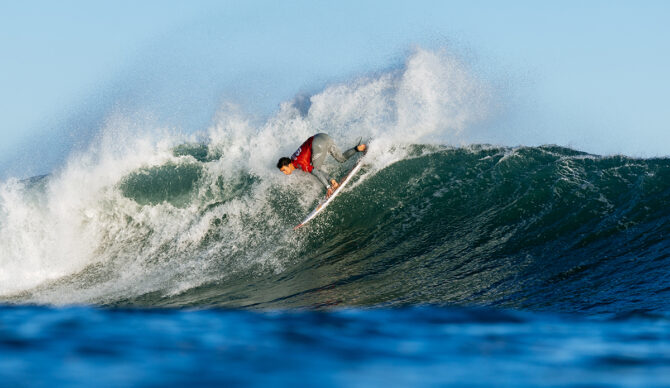
Griffin Colapinto is the America’s best hope for a men’s title at the moment. Photo: Ed Sloane//WSL

American men’s competitive surfing has been top-heavy for years, buoyed by a few freak talents instead of a steady supply of title contenders. (And, to be clear, we’re using the Olympic sense of the word “American” to bundle the Hawaiians into this conversation.)
After the Kelly Slater era, John John Florence grabbed the torch and won three titles. But aside from those two, no one other than Griffin Colapinto has seriously contended. If you remove Florence from the equation, since 2015, there have only been six American top-five finishes — two fifths for Kolohe Andino, a fourth for Conner Coffin, and two thirds and a second for Griffin.
But now, with John John Florence on an indefinite, two-year-and-counting hiatus, the odds of another American men’s title look slim. The removal of a non-elimination round has reverberated throughout the tour, and, it may be purely coincidental, but the American men have struggled through the first third of the season.
As the rankings stand, six of the seven Americans are in the bottom half of the rankings. That list includes Crosby Colapinto, Jake Marshall, Cole Houshmand, Barron Mamiya, Seth Moniz, and Eli Hanneman. In Moniz’s case, he has yet to pass a heat.
The lone exception is Griffin, ranked eighth. But as the reigning runner-up, he has higher expectations for himself. Houshmand and Mamiya, coming off seasons where they both captured event wins, must also be scratching their heads as to why things haven’t gone their way.
If there’s ever to be another American champion not named John John, these are the guys who will need to figure it out because no one is coming to save them. Of the 10 new Challenger Series qualifiers added to the tour, the only American was Hanneman. There is no Kelly Slater, Tom Curren, or Dane Reynolds knocking on the door (at the moment).
It’s hard to say why the U.S. has struggled to produce elite male surfers while the women have been surging with fresh talent. Is it a broader commentary on the environments that these surfers come from? The waves they surf? We do know that USA Surfing had to divert resources to defend its Olympic status. That uncertainty surely didn’t help the talent pipeline.
There are still two-thirds of a season ahead — plenty of time to jumble up the rankings. But, for whatever reason, Australia and New Zealand did not treat the Americans (and Hawaiians) well. We’ll see if the Latin American leg of the tour can change their fortunes.

