
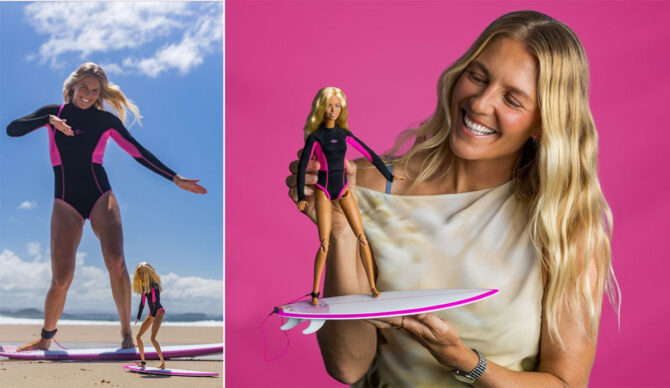
Stephanie Gilmore says this Barbie is “as rewarding as any of my trophies.” Photos: Instagram

Stephanie Gilmore has eight world titles. She’s widely considered to be the best female surfer ever. She’s got more awards than she can count, but there’s one thing she didn’t have: a Barbie modeled after her. Until now. “It truly feels as rewarding as any of my trophies,” she said.
The whole thing is part of Barbie’s celebration of International Women’s Day, where the toy manufacturer created dolls of inspirational women, like Serena Williams, research astronaut and payload specialist Kellie Gerardi, race car driver Regina Sirvent Alvarado, soccer superstar Chloe Kelly, climber Zoja Skubis, and cricketer Smriti Mandhana.
“Barbie has always championed the belief that girls can be anything. From astronauts to CEOs, Barbie has broken barriers and redefined what’s possible – igniting imagination and inspiring generations of girls to dream without limits,” said Nathan Baynard, vice president and head of Barbie, Mattel. “This International Women’s Day, we’re proud to build on that legacy with the launch of our Barbie Dream Team, celebrating an extraordinary group of global trailblazers who are paving the way for the next generation. By honoring their achievements, we hope to inspire girls everywhere to pursue their passions boldly and realize their limitless potential.”
View this post on Instagram
Gilmore has always been an inspirational figure, so for her, playing a role in that through a Barbie doll is pretty incredible.
“So cool to be immortalized as my very own Barbie as part of the Barbie Dream Team this International Women’s Day,” she wrote on Instagram, “celebrating women around the world who are helping pave the way for the next generation to chase their dreams.”
Barbie has been around since 1959, and although the toy has been accused of contributing to body image issues over the years, the brand has spotlighted over 100 women “across industries and communities who have driven meaningful change” in hopes of “increasing representation and broaden what’s possible for the next generation.”

