
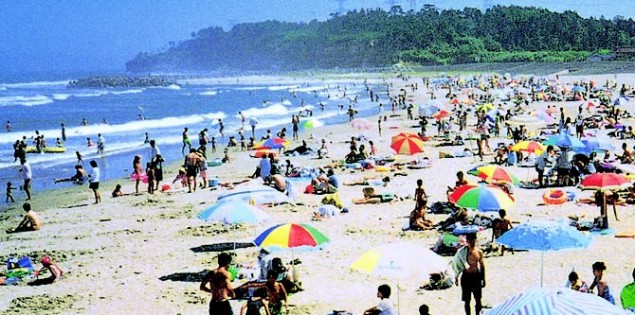
How Kitaizumi used to look in mid-summer.

The beach at Kitaizumi is 26kms North of the reactor so on the drive down there before we had to start the deliveries, even on a hot, sunny Sunday morning, I wasn’t expecting to see anyone in the water. As expected, the Haramachi Seaside Park area had been completely swept away and the power station on my left was the only thing still recognizable from eight years ago, but there were quite a few cars parked up.
Clambering up the verge I couldn’t believe it, once again it was small and glassy, but there were 25 guys out! The only way I knew I was in the right spot was to look out at the waves, the half-smashed up terraced embankment leading down to the sand, the cliffs to the right and the power station to the left. Nothing was recognizable when I turned around and looked inland. All the concrete tetrapods that used to sit 50 yards out to sea just to the South were now thrown up against the foot of the cliff like a set of jacks. There were no families enjoying the hot summer weather, no dog-walkers, no beach-goers… just the surfers.
I caught up with a guy who’d just got out of the water, he asked where I was from and if I was scared of the radiation, the exact question I was thinking about how to ask him. From his point of view, he was a Minamisoma local; he was born here, lived here and like the other locals they’d got used to it. The plant may still be unstable, no-one knows for sure, but if you’re a local and have grown up surfing these breaks, and you know from taking your own measurements that the radiation levels at the beach are the same as the levels in Tokyo (averaging 0.12uSv/hr where I measured) and in town they are only slightly elevated (at around 0.2-0.3uSv/hr) then for them they are just taking a calculated risk, like other surfers might take with sunburn, shallow reefs, or sharks.
You could argue there’s nothing calculated about surfing so close to the reactor when no-one knows for sure what’s going on, but just as an example, is it really any more calculated to paddle out in South Africa, South Australia or any other place where surfers have been taken by sharks? The locals here probably think those guys are the ones off their head.
This also has nothing to do with taking a stance on nuclear power, it’s a decision that’s been forced on these surfers as they’ve watched their empty local breaks firing like they have done for years. Radiation at the beach is lower than the readings they see in town, the same as in Tokyo, so over time, they’ve talked themselves into it. If I lived here, I’d have done the same.
Thanks to TEPCO, these guys now have to add one more factor to their “is-it-worth-a-dip” equation. Wave-height, number of people out, wind-direction, stage-of-the-tide, how-much-water-over-the-reef… and now radiation. Maybe these days they also avoid rivermouths especially after heavy rains to factor in any extra radiation that might be washed down from the hotspots in the mountains, but they’re out there.
I was brought up surfing the relatively safe waters of S. Wales. When I first got to Australia in 1988 it took a while for me to get my head around surfing spots where I was sure sharks were lurking. Talking to the locals about it, you’d usually get two different responses depending on the stance you took. If you said you were scared of sharks, they’d laugh at you for being some sort of pommie poofter and tell you there was nothing to worry about. If you said their shark stories were exaggerated, they’d fix you with a steely glare and tell you any number of old shark stories, like the time a pack of 600 hammerheads cruised down the coast past Narrabeen with a shark-patrol helicopter flying ahead warning everyone to get out of the water.
The usual attitude though was “no worries.” One guy summed it up best when he told me (incorrectly) not to worry about sharks since I’d only ever get bothered by a Great White, and if I did, it would all happen so fast that I wouldn’t know anything about it anyway… so just get out there!
Then there was Phil Horley one of the Cactus locals in South Australia known as Sharkbait, or Sharky after being attacked surfing Outside Castles in 1977. He went on to be “bumped” another twice at the same spot before being killed years later in a car crash. Imagine surviving three close encounters with a Great White and then dying in a bloody car crash! You can take all the precautions you like, but if you’re not doing the thing you love, are you really living?
In any surf community there will always be a group of guys who are out there charging when it’s big, guys who’ll sit that bit further inside and take off on anything, guys who will paddle out when no-one else will. That could have been what happened in Minamisoma. The local crew could only watch the empty waves go by unridden for so long before one day, maybe when it just got too perfect to watch from the beach anymore, one or two guys just suited up, got out there and the rest followed.
Away from crowded city beaches, surfing has always been one of the best ways I know to relax. Away from life’s problems, away from the job, relationship hassles, away from anything dragging you down and give you a little time to yourself, a little time to refocus. I read in an old SURFER mag that surfers were lucky that in times of stress we could jump off the edge of any continent we like and spend a few hours laughing back at the world and all its problems. Good on these boys for deciding to get back in the water, with all the issues they face on land, it’s doing a damn site more to keep them sane than watching the news or trawling the internet.
I wish I’d had more time to talk to these guys that Sunday morning but I had to get back into town for the temporary housing deliveries…I’ll be back though for sure.

