
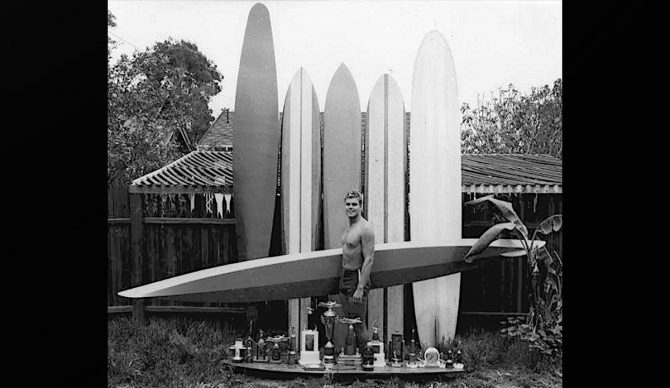
Tommy Zahn, one of the greatest ocean athletes you probably haven’t heard of. Until now. Photo: California Gold Surf Auction

Whatever Los Angeles U.S. District Court Judge Laughlin Waters was expecting to see in his case load that morning in 1984, this wasn’t it. The file delivered from the California Public Employees Retirement System’s regional office in Glendale was innocuous enough. Standard issue, from the looks of it. But upon opening the file and giving its contents even the most precursory examination, the good judge realized this was anything but.
First off, most cases forwarded to his desk from the CPERS administrative office in Glendale Plaza characteristically involved disputes stemming from early retirement claims. But here was a case regarding a complaint filed with the Federal Equal Employment Opportunity Commission citing age discrimination, and requesting a hearing to change a classification of a “public safety employee,” who would ordinarily face mandatory retirement at age 60, to “general employee,” affording the complainant an additional 10 years on the job. Apparently, the man didn’t want to retire, and saw no reason why he should. Well, this was something new. But who was this guy?
He was 60-year-old Thomas C. Zahn, of Santa Monica, California. More accurately, Lifeguard Lieutenant Zahn, of the L.A. County Fire Department Lifeguard Division, currently skipper of the rescue vessel “Baywatch”, operating out of Marina del Rey.
“Well, I’ll be damned,” thought Judge Waters. “A 60-year-old lifeguard? Isn’t that a job for kids?”
A look at the man’s employment record belied that misconception. In fact, Zahn had been a lifeguard his entire working life, beginning in 1942, when at age 18 he joined the Santa Monica Lifeguard Service. And with the exception of time served in the U.S. Fleet Marines during the last years of WWII (deployed during the battle for Okinawa in 1945) he’d been working on the beach in both California and Hawaii ever since. But it was the details of Zahn’s most recent decade of service that really caught the judge’s eye, and held it. They want this guy to retire?
When eventually awarded the L.A. County Medal of Valor in 1984, Zahn had officially been credited during the previous 10 years with rescuing 1,634 swimmers, responding to 1,216 boat distress calls (including almost destroying the rescue boat while successfully towing a stricken sloop to safety in 15-foot winter surf) and performing 22 successful resuscitations. In fact, department records showed that in just the single year leading up to his potential forced retirement, Lt. Zahn had gone on 392 patrols, responded to 101 boat distress calls, assisted in rescuing 244 people, and had recovered two dead bodies.
If that sort of service record wasn’t enough, there were the man’s fitness stats. Standing ramrod straight at 5’11”, and a well-muscled 180 pounds, Zahn, although born in 1924, was currently ranked as one of the top rescue boat skippers in L.A. County’s annual 500-meter re-qualifying swim test, and, even more incredibly, in the top 50 percent of all lifeguards tested, of any age.
Then there was the passion. In his complaint Zahn stated that, considering his obvious qualifications, forced retirement would be, “an affront, an economic hardship, and an ignominious end to a decades-long career.” Adding, “I still have a lot to contribute. I will know when it’s time to go. I’m not going to jeopardize the public’s safety.”
And to think, this was just the man’s day job. During those same decades, earlier, in fact, from the day on the Santa Monica beach in 1932, when the eight-year-old towhead rode his first wave to shore on a redwood surfboard, Tommy Zahn would go about establishing himself as one of the sport’s most influential, albeit relatively unsung historical figures, and, by just about any standard, its most accomplished waterman. Consider, in dossier format, a few highlights of Zahn’s barefoot adventures that didn’t make the file on Judge Water’s desk.
1940-46: Zahn is one of the first L.A. surfers to explore the coast to the west and north, surfing summer waves at Malibu, and bigger, colder swells at winter spots like Ventura Overhead and Rincon.
1947: Already a Malibu regular, Zahn encounters the already legendary Tom Blake checking the surf there one day and almost immediately establishes a sensei-student relationship that will last decades.
1947: Zahn commissions a board from best friend Joe Quigg, specifically designed for Zahn’s girlfriend Darrilyn Zanuck, daughter of 20th Century Fox studio founder Darryl F. Zanuck. Zahn’s only requirements are that it’s short, narrow and light enough for her to carry, and will fit into her Town and Country convertible. Quigg, scouring lumberyards for the lightest balsawood possible, produces a slight, light 10’2” that, upon first test rides at Malibu, is declared the most maneuverable surfboard on the coast. By the next summer Zahn is riding it more than Darrilyn, forcing her on one dark night to steal it back from Zahn’s garage. Regardless of who’s riding it, the modern surfboard, and, in turn, modern surfing, has been born.
1947-48: Zahn makes the first of what would be many extended visits to Hawaii, eventually becoming one of the prime movers behind the hugely influential island/mainland cross-cultural exchange. Convincing Malibu buddies Joe Quigg, Dave Rochlen and Matt Kivlin to make the trans-Pacific voyage, the trio witness Island standouts like George Downing and Rabbit Kekai in their prime, both riding narrow-tailed Hot Curls at various Waikiki breaks and Makaha. Designer/shapers Quigg and Kivlin, upon returning home, break from the “Malibu Chip” mold, adding balsa, fins and fiberglass to the Hot Curl template, essentially introducing the Modern Surfboard 2.0. Wrote eminent surf scribe and provocateur Craig Stecyk of Zahn’s salient influence in The Surfer’s Journal, “Zahn was the individual who got Rochlen, Quigg and Kivlin over to Oahu. In a feverish couple of years of innovation and cross-pollination, these were the guys who established the future that we all live in.”
1948-1950: Zahn becomes one of the first mainland surfers to ride the bigger waves of Makaha and Oahu’s North Shore.
1948-1952: Employing sophisticated Quigg paddleboard designs, Zahn wins four successive Pacific Coast Paddling Championships.
1951: Against an all-Islander field, Zahn wins his first paddle race in Hawaii, Waikiki’s one-mile Kamehameha Day Cup. He credits his win to the coaching of Tom Blake, with whom he was living with in a 30-foot sloop berthed in the Ala Moana Yacht Basin. Summer bonus was surfing big south swell “bluebirds” at Waikiki’s “Zero Break.”
1953: Zahn enters the Moloka’i-to-Oahu Ocean Paddle Race. Paddling a 16-foot, hollow balsa, plywood-decked Quigg, complete with a foot-operated tiller, Zahn wins the race, lopping two hours, 47 minutes off the previous record set by the infamous Gene “Tarzan” Smith.
1954: Following a year of focused training, and again paddling a revolutionary Joe Quigg design, Zahn wins the prestigious Diamond Head Paddleboard Race, the first of four first-place finishes in the annual event.
1955: In the inaugural Catalina-to-Manhattan Beach Paddleboard race, held in heavy fog conditions. Zahn leads the field and is first ashore, but finds himself making landfall far from the official Manhattan Beach Pier finish line. He’s subsequently disqualified, but returns in 1956 to decisively win the race’s stock class division with a time of six hours, 24 minutes.
1956: Zahn wins the Pacific Coast Dory Championships, establishing himself as one of the country’s top oarsman. The following year, just for good measure, he wins the event a second time,
1956: Along with fellow SoCal lifeguards Greg Noll, Mike Bright, Bobby Moore and Bob Burnside, Zahn travels to Australia, hosted by the Australian Surf Lifesaving Club at their national championships, held in Torquay, Victoria. Zahn, Noll, Bright and Moore pay extra to bring their lightweight balsa surfboards, and put on an impromptu surfing exhibition that blows the Aussie’s minds, all of whom were at the time still striking manly poses on awkward, 16-foot, hollow paddleboards. Suitably inspired by Zahn and Crew, the Aussies quickly adopt the Californian’s more sophisticated equipment, eventually establishing Australia as the first major center of significant international surfing development.
1958: Zahn wins the Catalina-to-Manhattan Beach Paddleboard Race, open division.
1960: Zahn wins the open division of the Catalina-to-Manhattan Beach race again, his finish at the pier cheered by an estimated 75,000 enthusiastic onlookers.
1962: On Christmas Day, Zahn wins Waikiki’s six-mile Diamond Head Senior Open Paddleboard Race.
1963-1984 Permanently settled in California, Zahn begins lifeguarding in Newport Beach and later for the L.A. County Fire Department Lifeguard Division.
1984: Zahn, 59, places a close third overall in the Second Annual Waterman Memorial Paddleboard Race.
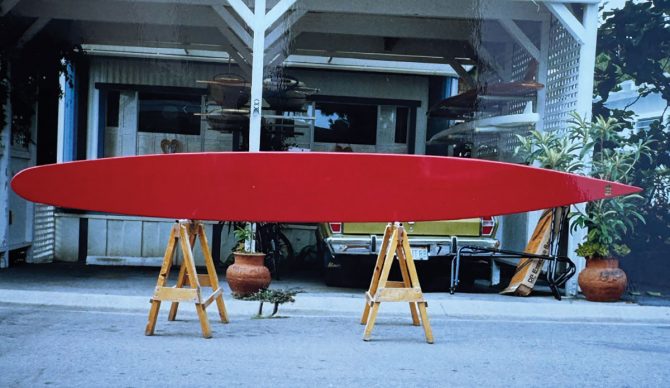
Zahn’s personal, lovingly restored Hawaiian paddleboard, built by legendary shipwright Teru Funai in the late 1940s, could be yours. For California Gold Auction info see below.
So, this is the man that the California State Retirement Act of 1937 insists must retire at age 60, regardless. District Judge Laughlin Waters, musing over Zahn’s complaint file, finds this idea preposterous, and immediately issues a preliminary injunction blocking L.A. County from imposing the mandatory retirement age law, pending the results of a later trial.
“We needed him,” states Waters. “Tell him to go back to work and get that boat [Baywatch] going.”
At the subsequent trial, Zahn, impressive as ever, easily wins his case and returned to the helm of Baywatch-Santa Monica. He continues to make the sea a much safer place until a hip injury leads to his voluntary retirement in 1987.
In 1991, and much to the shock of close friends and colleagues, Tom Zahn, a towering athletic figure and paragon of healthy living throughout his entire life, dies of cancer.
“Figures like Tom [Blake] and Duke [Kahanamoku] are really historic figures,” he wrote two years before his death. “Had they never existed, the sport wouldn’t be quite the same. They were the real contributors and innovators. I did none of these things. I surfed, paddled and swam for the pure joy of it. I was successful in some of these ventures, all more or less forgettable. I tried, not always succeeding, in living an exemplary life. It was my pleasure to be personally acquainted with figures like Tom, Duke, Pete Peterson, Rabbit Kekai, George Downing, Joe Quigg, Wally Froiseth and Gene “Tarzan” Smith, but I have no desire to become a professional ‘grand old man’ of surfing.”
Tom Zahn needn’t have worried about ever being considered a “grand old man.” His long reign and remarkable legacy as “the lifeguard’s lifeguard,” as well as the sport’s greatest waterman*, would certainly see to that.
*With honorable mention and the utmost respect extended to fellow water-persons Pete Peterson, Mike Doyle, Rell Sunn, Laird Hamilton, Brian Keaulana and Kai Lenny.
**With thanks to Malcolm-Gault Williams and Craig Lockwood, for their extensive biographical research on the life and times of Tom Zahn.
Editor’s Note: Tom Zahn’s Sand Island Boat Works Teru Funai traditional paddleboard is up for sale during The California Gold Surf Auction October 4-18. Make your bids for his board or other timeless surfboards here.

