
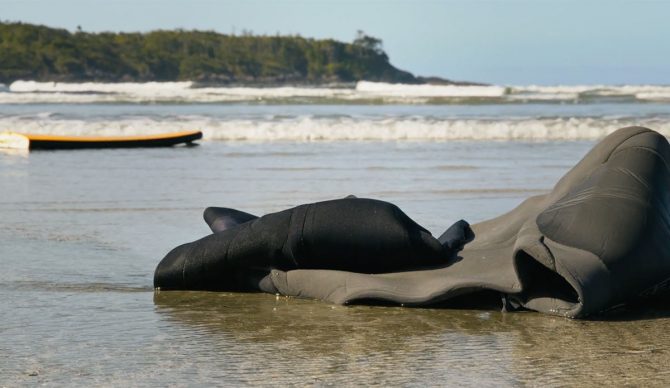
Surfboards and old wetsuits generally end up in the landfill, but ReSurf aims to fix that. Photo: Surfrider Foundation Canada

Surfing is a funny thing. It attracts quite a few environmentally minded people, and yet it’s terrible for the environment. We spew emissions all over the place as we hunt waves around the world. We ride surfboards made of foam while wrapping our bodies in toxic materials, all while espousing the importance of saving Mother Nature. It’s tough, though, because despite our best intentions, there simply aren’t a whole lot of things we can do to dramatically shrink our footprints. But Surfrider Foundation Canada just launched a program that will definitely help: The ReSurf Program.
In short, ReSurf aims to take old EPS surfboards and neoprene wetsuits and upcycle them in a variety of ways. Surf gear — especially EPS foam surfboards and neoprene wetsuits — is, for the most part, just thrown in the trash when it reaches the end of its life. According to Surfrider, at the West Coast Landfill, a dump near Tofino, British Columbia, up to 14,000 pounds of wetsuits and around 11,000 pounds of surfboards end up there every year. Until now, they’ve just stayed there.
“We’re looking forward to working with local surf shops, surf schools, and the broader community across the Pacific Rim to manage surf gear at the end of its life,” said Adam Gilmer, operations manager for the ReSurf Program. “By partnering with residents, visitors, and the surf industry, we can build a more sustainable future for our coastline and the sport we love.”
Surfrider Canada says that the number of surfers around the world has jumped 35 percent in the last 10 years, “amplifying the urgency to create sustainable pathways for keeping surf gear materials in a circular economy.”
Recycling, of course, is a good way to grease the wheels of a circular economy, and the ReSurf Program is tackling it head on at its facility in Ucluelet, a little town about 30 minutes down the road from Tofino.
“For wetsuits we’ll work with industry partners and landfills to process (old suits) into a ground neoprene powder, and give that powder back to industries to make new products like yoga mats, playground flooring, industrial uses and sometimes even new wetsuits, creating a circular economic practice,” Surfrider Canada’s Daniel Raab explained to the CBC, regarding what goes on in the new ReSurf factory. “On the surfboard side we’re doing something similar. It’s a little trickier, we’re staring with EPS soft-tops, taking apart the materials, pulling various parts from the boards to recycle them. Things like the top layer and the core. We can can make upcycled pellets that can be used for other products. Again, a circular economic program.”
ReSurf will also feature a research wing, working to develop new techniques for reuse of surfing-related gear.
“Recycling is a critical step forward, though ReSurf aims to move materials up the pollution prevention hierarchy,” reads a Surfrider press release. “Research and development to improve these solutions will be conducted in-house at the ReSurf first-of-its-kind ‘Blue Barrel’ facility, with insights from local shapers and major surf brands.”

